
[论文解读] Precisely determining photon-number in real-time
本文提出了一种基于定制FPGA硬件处理器的实时光子数分辨系统,可对超导过渡边缘传感器(TES)脉冲进行实时分析,实现低光子数下的十亿分之一精度分辨,并能分辨高达16个光子。该系统可在无需事后处理的情况下立即完成光子数分配,显著推动了量子光学与天文学领域的应用发展。
Superconducting transition-edge sensors (TES) are extremely sensitive microcalorimeters used as photon detectors with unparalleled energy resolution. They have found application from measuring astronomical spectra through to determining the quantum property of photon-number, $\hat{n} {=} \hat{a}^† \hat{a}$, for energies from 0.6-2.33eV. However, achieving optimal energy resolution requires considerable data acquisition -- on the order of 1GB/min -- followed by post-processing, which does not allow access to energy information in real time. Here we use a custom hardware processor to process TES pulses while new detections are still being registered, allowing photon-number to be measured in real time as well as reducing data requirements by orders-of-magnitude. We resolve photon number up to n=16 -- achieving up to parts-per-billion discrimination for low photon numbers on the fly -- providing transformational capacity for applications of TES detectors from astronomy through to quantum technology.
研究动机与目标
- 解决基于TES的光子数分辨中后处理带来的延迟问题,从而延迟获取能量信息。
- 克服TES探测器为实现最优能量分辨率所需的数据密集型采集(最高达1 GB/min)的瓶颈。
- 通过在数据采集过程中处理TES脉冲,实现实时光子数分配,摆脱对离线分析的依赖。
- 在光子数n = 16以内实现高精度光子数分辨,且在低光子数下分配误差极小。
- 开发一种灵活可重构的硬件平台,用于实时脉冲分析,必要时支持校准与完整脉冲记录。
提出的方法
- 使用现场可编程门阵列(FPGA)实时数字化TES模拟电压信号。
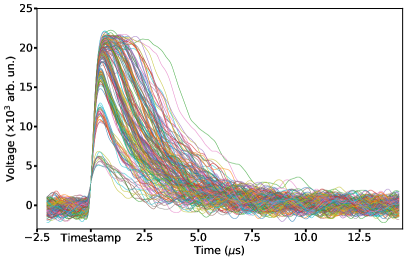
- 应用基于阈值的检测:仅当脉冲幅度和斜率均超过用户定义的阈值时,才记录该脉冲。
- 提取每个检测事件的关键脉冲特征(如幅度、衰减时间)以分配光子数。
- 利用可重构处理器仅存储具有物理意义的脉冲参数,除非用于校准,否则丢弃原始数据。
- 使用具有已知光子数分布的相干态进行校准,将脉冲特征映射为光子数概率。
- 采用600 ns的符合时间窗进行层析分析,剔除脉冲后100–700 ns以外的事件,以降低背景噪声。
实验结果
研究问题
- RQ1能否在无需后处理的情况下实现实时光子数分辨?
- RQ2使用实时脉冲分析技术,基于TES的系统最多能可靠分辨多高的光子数(n)?
- RQ3在使用实时硬件处理时,对于低光子数(n ≤ 16)的光子数分配精度如何?
- RQ4检测阈值和脉冲特征对光子数分配准确率有何影响?
- RQ5与传统后处理相比,实时处理在数据吞吐量和测量延迟方面表现如何?
主要发现
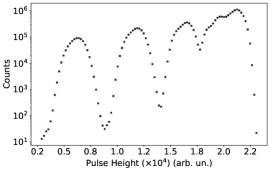
- 系统可分辨高达n = 16的光子数,当n = 16时,正确分配概率pⁿₘ₌ₙ > 0.90,n = 16时为0.90,n = 15时为0.936。
- 当n = 1时,正确分配概率为0.99999598734,标准差为2×10⁻⁴,表明精度达到十亿分之一量级。
- 对于n ≤ 10,将n−1或n+1个光子错误分配的概率可忽略不计,pⁿₘ₌ₙ₋₁ < 5×10⁻³且pⁿₘ₌ₙ₊₁ < 5×10⁻³。
- 使用相干态(α = 1.32和α = 2.16)进行校准,得到的α估计值在1个标准差范围内一致,证实了校准的可靠性。
- 在约1.8×10⁷个检测事件中,仅有525个(0.003%)落在600 ns符合时间窗之外,表明背景抑制效果良好。
- 系统通过在采集过程中分析脉冲实现实时处理,避免了1 GB/min的数据记录与后处理需求。
更好的研究,从现在开始
从阅读论文到最终审阅,大幅缩短您的研究时间。
无需绑定信用卡
本解读由 AI 生成,并经人工编辑审核。