
[论文解读] Probing multi-mobility edges in quasiperiodic mosaic lattices
本文在实验上证明了准周期马赛克晶格中存在多重迁移边界,利用集成光子学构建的系统,显示能量相关的局域态与扩展态共存并打破自对偶性。
The mobility edge (ME) is a crucial concept in understanding localization physics, marking the critical transition between extended and localized states in the energy spectrum. Anderson localization scaling theory predicts the absence of ME in lower dimensional systems. Hence, the search for exact MEs, particularly for single particles in lower dimensions, has recently garnered significant interest in both theoretical and experimental studies, resulting in notable progress. However, several open questions remain, including the possibility of a single system exhibiting multiple MEs and the continual existence of extended states, even within the strong disorder domain. Here, we provide experimental evidence to address these questions by utilizing a quasiperiodic mosaic lattice with meticulously designed nanophotonic circuits. Our observations demonstrate the coexistence of both extended and localized states in lattices with broken duality symmetry and varying modulation periods. By single site injection and scanning the disorder level, we could approximately probe the ME of the modulated lattice. These results corroborate recent theoretical predictions, introduce a new avenue for investigating ME physics, and offer inspiration for further exploration of ME physics in the quantum regime using hybrid integrated photonic devices.
研究动机与目标
- 在超越 Aubry–André 模型的1D准周期系统中研究迁移边界(MEs)。
- 实现具有破缺对偶对称性的马赛克晶格,以承载多重迁移边界。
- 通过单点激发和无序强度调控,在集成光子学中探测与能量相关的局部化。
- 在强准周期调制下显示局域态与扩展态并存。
- 展示光子平台在迁移边界物理学方面的可扩展性与可控性。
提出的方法
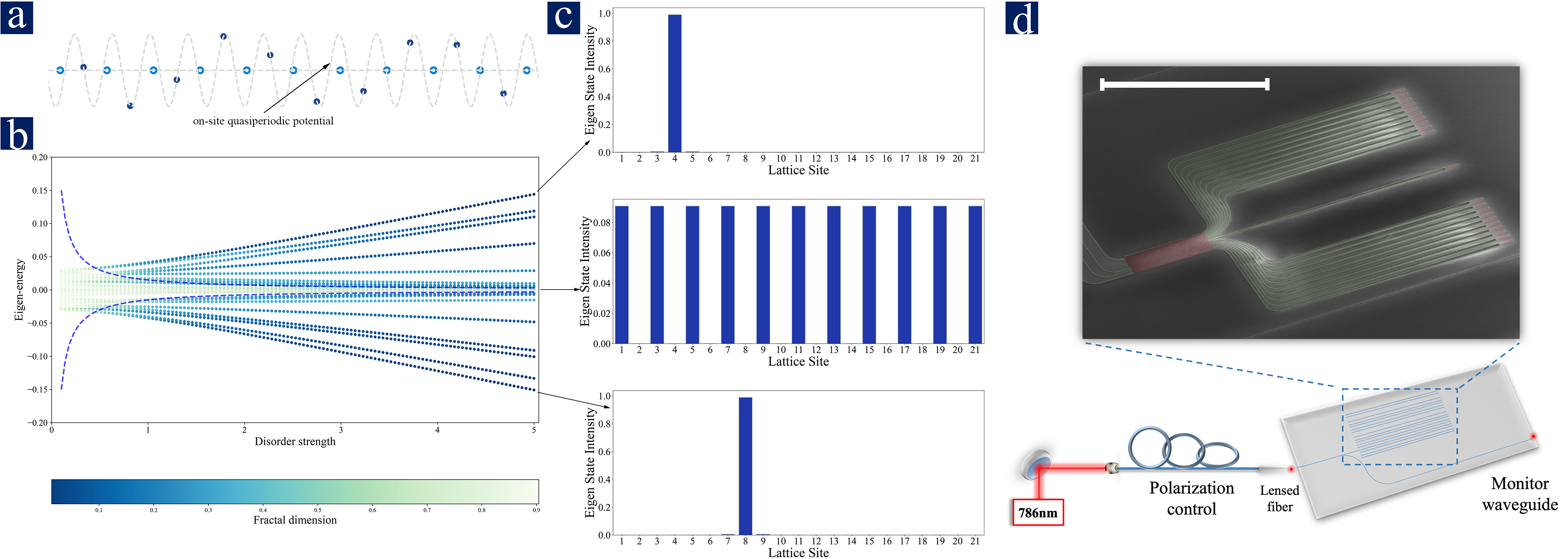
- 使用集成的 Si3N4 光子电路实现具有统一跳跃率 J 的准周期马赛克晶格。
- 在被调制的位点 (j = κ m) 上按照 lambda_j = lambda cos[2π(ω j + θ)] 设计准周期性局域势调制 lambda_j,其它位置则为零。
- 研究具有调制周期 κ 的马赛克晶格以破坏自对偶性并产生 2(κ−1) 个迁移边界,这一结果由 Avila 的全局理论预测。
- 通过基于 IPR 推导的分形维数 D2 来表征态,D2 = −lim L→∞ log⟨IPR⟩/log L,用以区分局域态(D2→0)与扩展态(D2→1)。
- 通过单点注入和扫描无序强度 λ 来探测迁移边界,跟踪与能量及态相关的局部化。
- 将实验观察结果与理论迁移边界公式 E_c 及 Lyapunov 指数关系进行相关分析。
实验结果
研究问题
- RQ11D 的准周期马赛克晶格是否支持多重迁移边界?它们如何依赖于马赛克周期 κ?
- RQ2破坏自对偶性的马赛克晶格是否能在任意无序强度下维持扩展态,以及当 λ 变化时局域态与扩展态如何共存?
- RQ3单点激发是否能够揭示能量相关的局部化跃迁并在实验中识别迁移边界?
- RQ4实验性光子实现与 Avila 的全局理论对马赛克模型的预测如何一致?
主要发现
- 在 κ=2 的马赛克晶格中证明扩展态与局域态并存,存在两个迁移边界 E_c = ±J/λ。
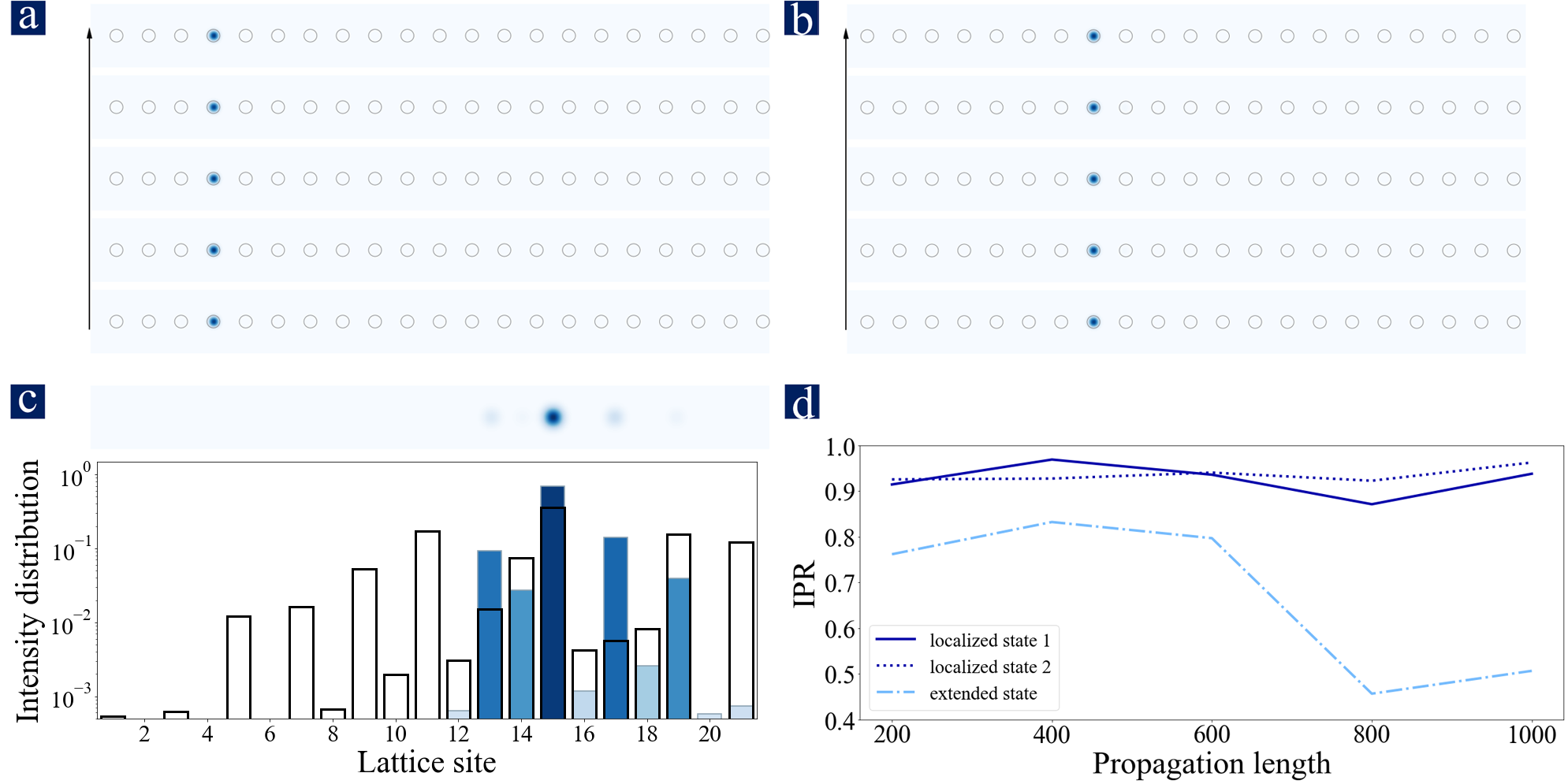
- 通过在光子马赛克中进行单点注入并改变 λ,观测并绘制能量相关的局部化跃迁。
- 在 κ=3 晶格中显示四个迁移边界产生多重局域化区域,在强调制下扩展态仍然存在。
- 提供实验证据,支持迁移边界来自马赛克晶格结构的理论预测,与自对偶性无关。
- 说明集成光子平台能够对迁移边界物理进行可扩展的探测,并开展潜在的量子阶段探测。
更好的研究,从现在开始
从论文设计到论文写作,大幅缩短您的研究时间。
无需绑定信用卡
本解读由 AI 生成,并经人工编辑审核。