
[论文解读] Probing Permanent Dipoles in CdSe Nanoplatelets with Transient Electric Birefringence
本研究利用瞬态电致双折射(TEB)检测到五单层厚闪锌矿结构CdSe纳米片(NPLs)在基态存在一个大于245 D的偶极矩,该偶极矩沿其长度方向排列。在油酸诱导的面对面堆叠过程中,面内偶极分量相互抵消,而法向分量相加,形成一个平行于法向的净80 D偶极矩,解释了其强烈的堆叠倾向以及尽管体相CdSe具有非极性τ3m对称性,仍表现出较差的胶体稳定性。
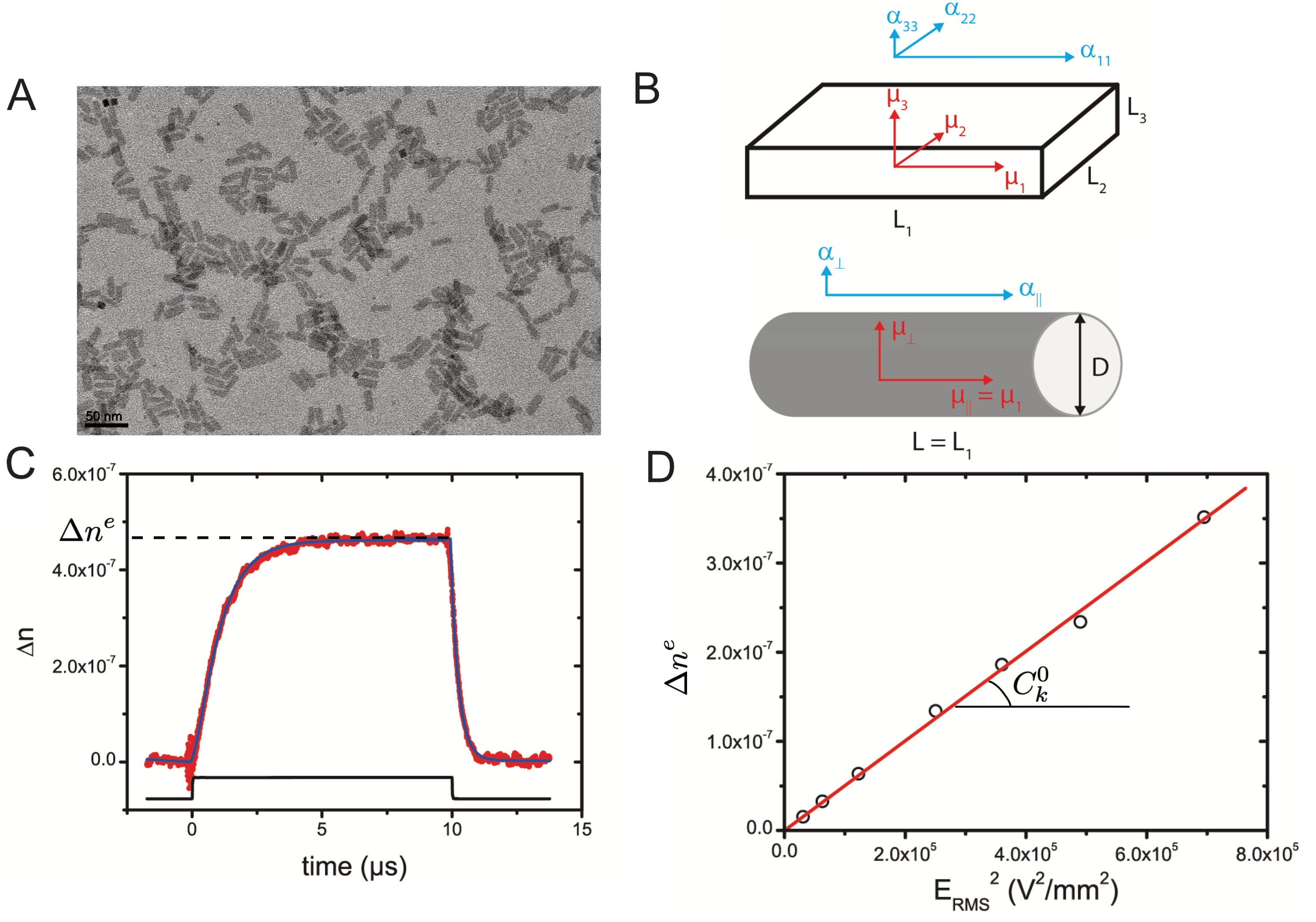
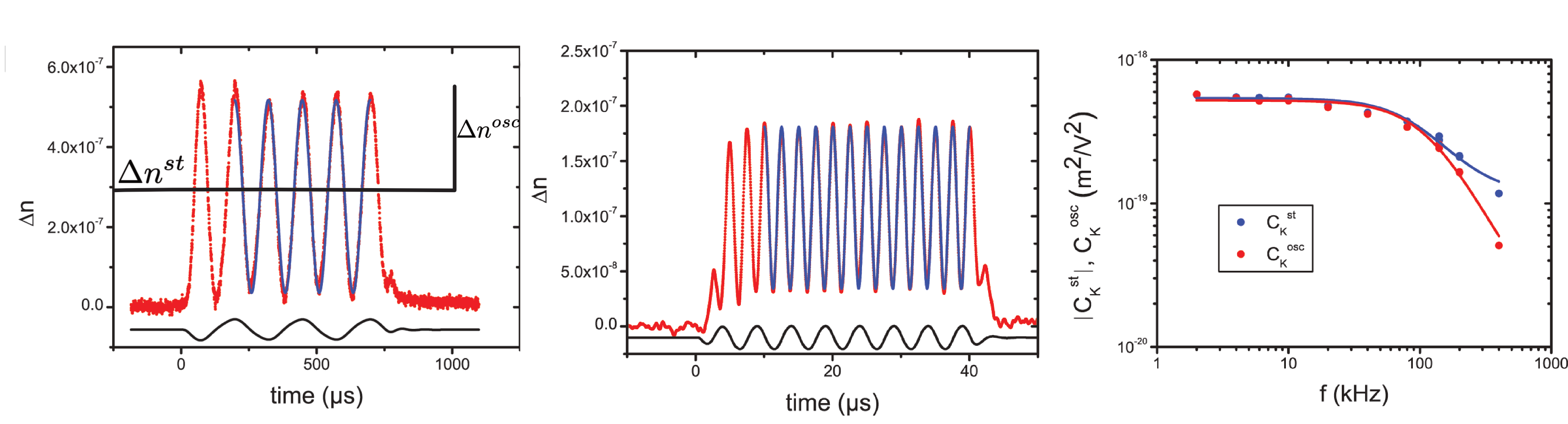
Zinc-blende CdSe semiconducting nanoplatelets (NPL) show outstanding quantum confinement properties thanks to their small, atomically-controlled, thickness. For example, they display extremely sharp absorption peaks that make them very interesting objects for optoelectronic applications. However, the presence of a ground-state electric dipole for these nanoparticles has not yet been investigated. We therefore used transient electric birefringence (TEB) to probe the electric dipole of 5-monolayer thick zinc-blende CdSe NPL with a parallelepipedic shape. We studied a dilute dispersion of isolated NPL coated with branched ligands and we measured, as a function of time, the birefringence induced by DC and AC field pulses. The electro-optic behavior proves the presence of a large dipolar moment (> 245 D) oriented along the length of the platelets. We then induced the slow face-to-face stacking of the NPL by adding oleic acid. In these stacks, the in-plane dipole components of consecutive NPL cancel whereas their normal components add. Moreover, interestingly, the excess polarizability tensor of the NPL stacks gives rise to an electro-optic contribution opposite to that of the electric dipole. By monitoring the TEB signal of the slowly-growing stacks over up to a year, we extracted the evolution of their average length with time and we showed that their electro-optic response can be explained by the presence of a 80 D dipolar component parallel to their normal. In spite of the $\\bar{4}$3m space group of bulk ZB CdSe, these NPL thus bear an important ground-state dipole whose magnitude per unit volume is twice that found for wurtzite CdSe nanorods. We discuss the possible origin of this electric dipole, its consequences for the optical properties of these nanoparticles, and how it could explain their strong stacking propensity that severely hampers their colloidal stability.
研究动机与目标
- 研究闪锌矿结构CdSe纳米片(NPLs)中是否存在基态电偶极矩,尽管其立方对称性本应使其为非极性。
- 理解这些NPLs中偶极矩的来源及其大小,特别是考虑到其优异的光学性质和强烈的堆叠倾向。
- 探测NPLs在缓慢面对面堆叠过程中偶极矩排列的演变,及其对电光响应的影响。
- 将时间分辨TEB信号与NPLs堆叠在长达一年时间内的生长动力学相关联。
- 从其本征偶极矩和堆叠行为角度,解释CdSe NPLs所观察到的胶体不稳定性。
提出的方法
- 采用瞬态电致双折射(TEB)测量由施加的直流和交流电场脉冲诱导的时间分辨光学各向异性。
- 使用自建的高灵敏度TEB装置,配备数字示波器和光电倍增管(PMT),通过Senarmont补偿器优化弱信号测量,通过Berek补偿器优化强信号测量。
- 应用电场反转的“双场”技巧,将诱导双折射从背景信号中分离,从而实现对高达2 kV/mm内部电场的测量。
- 使用带电极的毛细管密封样品,实现长达15个月的长期、原位TEB监测,期间无样品降解或溶剂蒸发。
- 通过负载电阻(R_L ≤ 1 kΩ)和去卷积技术控制旋转扩散和响应时间,实现对孤立NPLs的亚50 ns时间分辨率。
- 通过在添加油酸后0至415天的间隔测量TEB,监测堆叠动力学,路径长度固定为1 mm以最小化光散射和吸收。
实验结果
研究问题
- RQ1尽管具有τ3m对称性,闪锌矿结构CdSe纳米片是否具有永久基态电偶极矩?
- RQ2孤立的五单层CdSe NPLs中偶极矩的大小和方向为何?
- RQ3在NPLs缓慢面对面堆叠过程中,偶极矩如何演变?由此形成的堆叠物的净电光响应是什么?
- RQ4为何CdSe NPLs表现出强烈的堆叠倾向,尽管其体相结构为非极性?
- RQ5时间分辨TEB信号是否可用于提取长达时序尺度下NPLs堆叠的平均长度演化?
主要发现
- 在孤立的五单层CdSe纳米片中检测到一个大于245 D的永久电偶极矩,方向沿其长度方向,表明电荷分布存在显著不对称性。
- 尽管体相闪锌矿CdSe无极性晶体结构,这些NPLs单位体积内的偶极矩是纤锌矿CdSe纳米棒的两倍。
- 在油酸诱导的面对面堆叠过程中,面内偶极分量相互抵消,而法向分量相加,形成一个平行于法向方向的净80 D偶极矩。
- 堆叠物的电光响应主要由80 D偶极矩分量主导,另有来自过剩极化率张量的贡献,其方向与偶极矩效应相反。
- 15个月内TEB信号的演变使我们能够提取堆叠平均长度随时间的变化,证实了缓慢而持续的生长过程。
- 所观察到的偶极矩和堆叠行为解释了CdSe NPLs严重的胶体不稳定性,这限制了其实际应用。
更好的研究,从现在开始
从阅读论文到最终审阅,大幅缩短您的研究时间。
无需绑定信用卡
本解读由 AI 生成,并经人工编辑审核。