
[论文解读] Problematic Advertising and its Disparate Exposure on Facebook
本研究通过分析为期三个月的132名用户的纵向样本,调查了Facebook上的问题广告。研究识别出四类关键问题广告——欺骗性广告、Facebook禁止的广告、诱导点击广告以及敏感话题广告,并发现老年用户和少数族裔用户面临不成比例的曝光。研究发现,平台级个性化算法导致22%的问题广告曝光,表明广告分发中存在算法偏见。
Targeted advertising remains an important part of the free web browsing experience, where advertisers' targeting and personalization algorithms together find the most relevant audience for millions of ads every day. However, given the wide use of advertising, this also enables using ads as a vehicle for problematic content, such as scams or clickbait. Recent work that explores people's sentiments toward online ads, and the impacts of these ads on people's online experiences, has found evidence that online ads can indeed be problematic. Further, there is the potential for personalization to aid the delivery of such ads, even when the advertiser targets with low specificity. In this paper, we study Facebook -- one of the internet's largest ad platforms -- and investigate key gaps in our understanding of problematic online advertising: (a) What categories of ads do people find problematic? (b) Are there disparities in the distribution of problematic ads to viewers? and if so, (c) Who is responsible -- advertisers or advertising platforms? To answer these questions, we empirically measure a diverse sample of user experiences with Facebook ads via a 3-month longitudinal panel. We categorize over 32,000 ads collected from this panel ($n=132$); and survey participants' sentiments toward their own ads to identify four categories of problematic ads. Statistically modeling the distribution of problematic ads across demographics, we find that older people and minority groups are especially likely to be shown such ads. Further, given that 22% of problematic ads had no specific targeting from advertisers, we infer that ad delivery algorithms (advertising platforms themselves) played a significant role in the biased distribution of these ads.
研究动机与目标
- 识别用户认为有问题的Facebook广告的具体类别。
- 检验在Facebook上问题广告的曝光是否存在人口统计学差异。
- 确定广告商或广告平台(通过个性化算法)在广告曝光偏差中承担主要责任。
提出的方法
- 招募了132名付费参与者的多样化样本,对他们在三个月内Facebook广告体验进行纵向追踪。
- 通过浏览器插件记录所有Facebook广告,并提取Facebook提供的详细定位信息。
- 基于计算研究、社会科学文献和平台政策,开发了涵盖8类广告(包括诱导点击广告、敏感话题广告等)的广告类别编码手册。
- 由人工评分员使用编码手册将收集到的超过32,000则广告分类至指定类别。
- 定期开展调查,评估参与者对所接收广告的情感态度,识别出被其视为问题的广告类别。
- 应用统计建模分析问题广告曝光的人口统计学差异,并区分广告商定位与平台个性化算法的作用。
实验结果
研究问题
- RQ1用户在Facebook上认为哪些类别的广告是问题广告?
- RQ2问题广告在不同用户群体中的分发是否存在人口统计学差异?
- RQ3广告商与广告平台个性化算法在问题广告曝光偏差中各自承担多大程度的责任?
主要发现
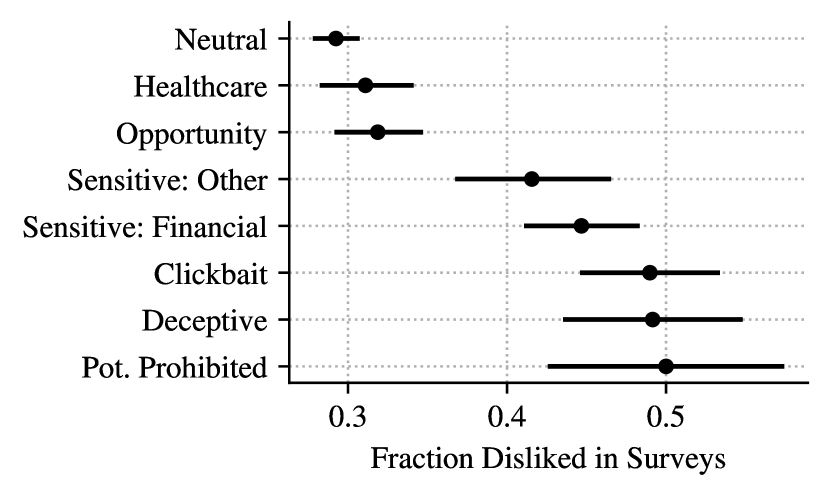
- 参与者最常认为欺骗性广告、Facebook禁止的内容、诱导点击广告以及敏感话题广告(如金融、赌博、减重类)是问题广告。
- 与年轻用户相比,老年用户更可能接触到欺骗性广告和诱导点击广告。
- 黑人参与者被不成比例地展示诱导点击广告,表明其在曝光上存在种族差异。
- 男性更可能接触到金融类广告——尽管该类广告因监管和政策限制而被归类为敏感话题,其潜在危害与益处并存。
- 22%的问题广告未显示广告商的特定定位,表明平台级个性化算法在偏差分发中起到了主导作用。
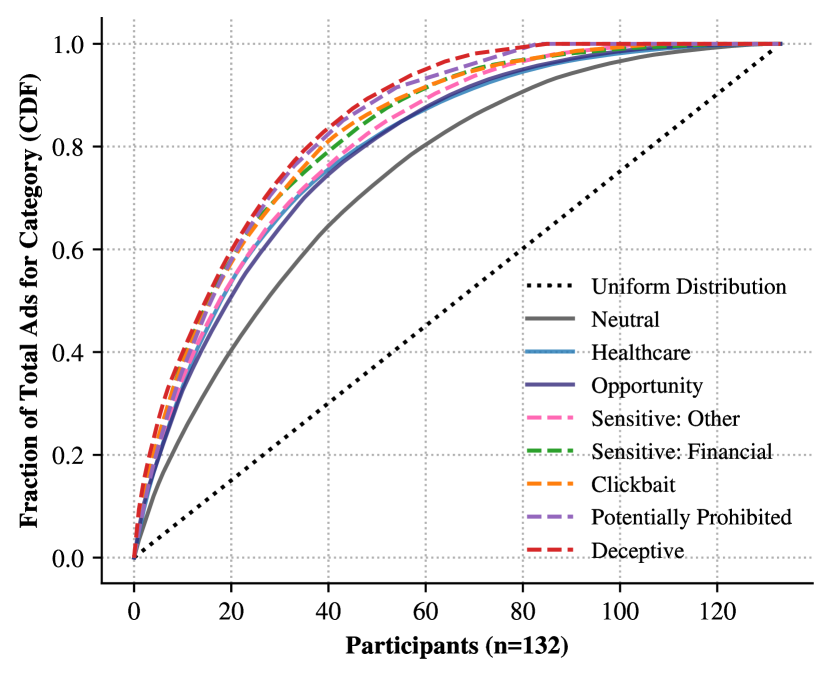
- 问题广告的分发呈现显著偏斜,部分用户接收到的问题广告数量超过中位数的三倍。
更好的研究,从现在开始
从阅读论文到最终审阅,大幅缩短您的研究时间。
无需绑定信用卡
本解读由 AI 生成,并经人工编辑审核。