
[论文解读] Production of Alternate Realizations of DESI Fiber Assignment for Unbiased Clustering Measurement in Data and Simulations
这篇论文提出 Alternate Merged Target Ledgers(AMTL)方法,用于生成多个真实 DESI 目标 realizations(实现/ realization),使 Pairwise Inverse Probability (PIP) 加权成为可能,以纠正 DESI 数据和 mocks 中的小尺度聚类不完整性。它在 DESI SV3 和 Year 1 数据及 mocks 上通过 AMTL 在真实观测条件下进行验证。
A critical requirement of spectroscopic large scale structure analyses is correcting for selection of which galaxies to observe from an isotropic target list. This selection is often limited by the hardware used to perform the survey which will impose angular constraints of simultaneously observable targets, requiring multiple passes to observe all of them. In SDSS this manifested solely as the collision of physical fibers and plugs placed in plates. In DESI, there is the additional constraint of the robotic positioner which controls each fiber being limited to a finite patrol radius. A number of approximate methods have previously been proposed to correct the galaxy clustering statistics for these effects, but these generally fail on small scales. To accurately correct the clustering we need to upweight pairs of galaxies based on the inverse probability that those pairs would be observed (Bianchi & Percival 2017). This paper details an implementation of that method to correct the Dark Energy Spectroscopic Instrument (DESI) survey for incompleteness. To calculate the required probabilities, we need a set of alternate realizations of DESI where we vary the relative priority of otherwise identical targets. These realizations take the form of alternate Merged Target Ledgers (AMTL), the files that link DESI observations and targets. We present the method used to generate these alternate realizations and how they are tracked forward in time using the real observational record and hardware status, propagating the survey as though the alternate orderings had been adopted. We detail the first applications of this method to the DESI One-Percent Survey (SV3) and the DESI year 1 data. We include evaluations of the pipeline outputs, estimation of survey completeness from this and other methods, and validation of the method using mock galaxy catalogs.
研究动机与目标
- 推动对 DESI 聚类分析中纤维分配不完整性的准确校正,特别是在小尺度上。
- 开发一种实用的 Monte Carlo 方法(AMTL),用于估计目标对的观测概率。
- 将 AMTL 与现有的 PIP 和角度加权结合,以产生无偏的两点统计量。
- 使用 DESI SV3/Y1 数据和 AbacusSummit mocks 验证该方法,评估完整性和零概率问题。
提出的方法
- 引入 Alternate Merged Target Ledgers(AMTL),通过几乎最大化的 Monte Carlo 实现来估计成对观测概率。
- 在 MTL 中随机化子优先级,并应用 BGS/ELG 提升,产生替代优先级实现。
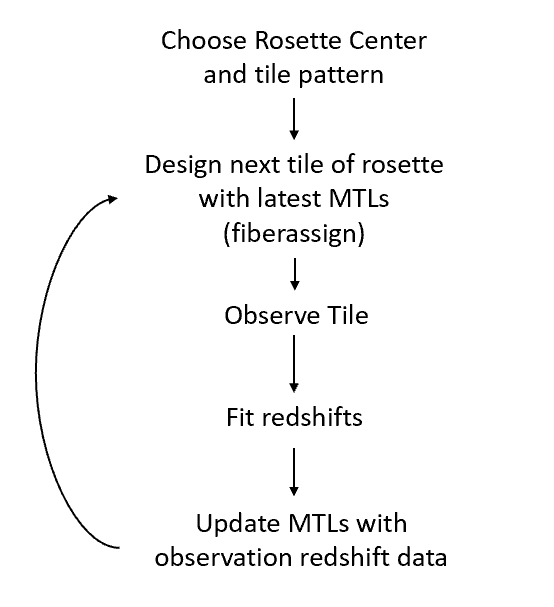
- 运行一个观测循环,模仿真实 DESI 流程,将替代观测映射到实际纤维分配并结合真实硬件状态。
- 使用 AMTL 实现来计算 PIP 权重(结合角向加权 PB17),以在 mocks 和数据中将聚类复原到小于等于 0.1 Mpc/h。
- 输出包括 AMTL 的 N 个实现(SV3 为 128,mocks 为 128–256)以及编码每个 TARGETID 观测频率的 bitweight 文件。
- 通过 AbacusSummit 构建的 mocks 进行验证,并比较聚类测量以证明对小尺度的无偏校正。
实验结果
研究问题
- RQ1基于 AMTL 的 PIP 权重是否能在 DESI 数据和 mocks 中恢复无偏的小尺度聚类?
- RQ2使用替代目标实现对完整性估计和零概率对的影响是什么?
- RQ3AMTL 产生的权重与 DESI 分析中先前的不完整性校正方法相比如何?
- RQ4AMTL 方法能否与现有的角向加权结合以减轻零概率问题?
- RQ5对 SV3 和 Year 1 数据的实际计算需求和验证结果是什么?
主要发现
- AMTL 通过对观测概率在各实现中的蒙特卡洛估计,实现近似无偏的成对权重。
- 在 SV3 中,对 QSO 和 BGS_BRIGHT 的零概率对可以忽略不计,对 LRGs 和 ELGs 的比例较小;在 Y1 中,零概率比例仍然非零但可控。
- AMTL 与 BP17 的 PIP 加权和 PB17 的角向加权结合,以纠正跨尺度到 0.1 Mpc/h 的不完整性,在 mocks 和数据中均成立。
- 观测循环在实际硬件状态和磁砖排序下现实地传播替代观测,提升完整性建模的保真度。
- AMTL 输出包括 128 个实现和映射观测频率的 bitweight 文件,使其能够无缝集成到大尺度结构(LSS)分析管道中。
更好的研究,从现在开始
从论文设计到论文写作,大幅缩短您的研究时间。
无需绑定信用卡
本解读由 AI 生成,并经人工编辑审核。