
[论文解读] Prompt a Robot to Walk with Large Language Models
本文提出了一种新颖的框架,利用少量示例的文本提示与GPT-4直接生成机器人行走的低层控制指令,无需针对任务进行微调。该方法使大型语言模型(LLMs)能够在高维机器人系统中充当反馈控制器,在模拟环境中成功实现多种机器人和地形上的动态行走,其归一化行走时间为0.721,复杂地形上的成功率为0.6%。
Large language models (LLMs) pre-trained on vast internet-scale data have showcased remarkable capabilities across diverse domains. Recently, there has been escalating interest in deploying LLMs for robotics, aiming to harness the power of foundation models in real-world settings. However, this approach faces significant challenges, particularly in grounding these models in the physical world and in generating dynamic robot motions. To address these issues, we introduce a novel paradigm in which we use few-shot prompts collected from the physical environment, enabling the LLM to autoregressively generate low-level control commands for robots without task-specific fine-tuning. Experiments across various robots and environments validate that our method can effectively prompt a robot to walk. We thus illustrate how LLMs can proficiently function as low-level feedback controllers for dynamic motion control even in high-dimensional robotic systems. The project website and source code can be found at: https://prompt2walk.github.io/ .
研究动机与目标
- 探究大型语言模型(LLMs)是否可在无需任务特定微调的情况下,作为动态机器人行走的低层反馈控制器。
- 通过从真实机器人轨迹中收集的少量示例提示,解决将LLMs与物理机器人控制相融合的挑战。
- 探究LLMs是否可通过上下文学习而非模仿或强化学习,生成稳定且动态的行走行为。
- 在多种机器人、地形和模拟环境中验证该框架的性能。
提出的方法
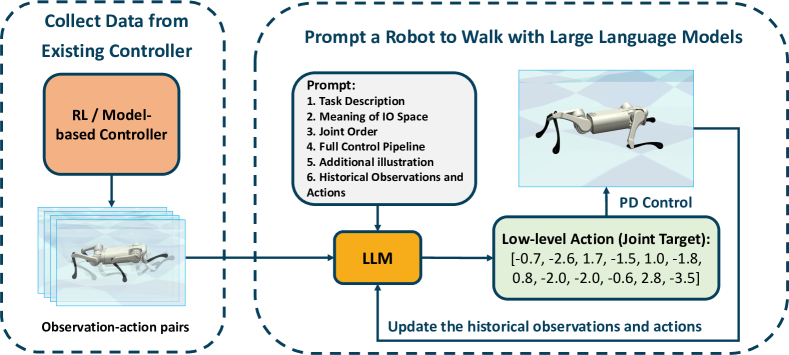
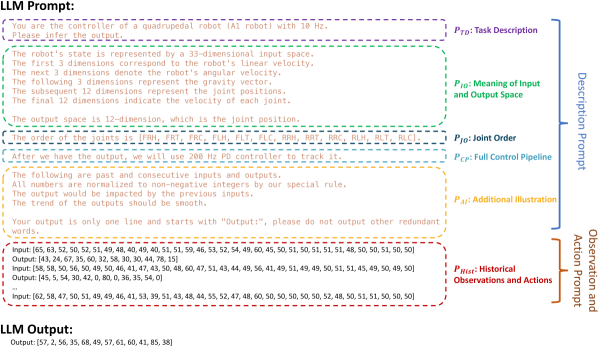
- 该方法采用少量示例提示范式,结合GPT-4,提示内容包括描述性提示和观测-动作历史序列。
- 控制指令以归一化的目标关节位置生成,由200 Hz的PD控制器跟踪,而LLM以10 Hz的频率进行推理。
- 在每次推理循环后,通过添加新的观测和动作动态更新提示,以维持上下文。
- 该框架通过预训练的强化学习策略数据初始化,以在提示中提供真实的示范。
- 精心设计文本提示,包含任务描述、环境观测和动作序列,以引导LLM的上下文学习。
- 该方法避免微调,转而依赖LLM的上下文学习能力,以泛化至新的行走任务。
实验结果
研究问题
- RQ1LLMs是否可在无需任何任务特定微调的情况下,作为动态机器人行走的低层反馈控制器?
- RQ2使用少量示例提示的上下文学习在多大程度上能有效帮助LLMs生成稳定且动态的行走行为?
- RQ3提示设计(包括描述和观测-动作序列)在多大程度上影响机器人行走的成功率?
- RQ4所提出的提示框架是否可在不同机器人平台和地形上实现泛化?
主要发现
- 该方法在不平坦地形上实现了0.721的归一化行走时间(NWT),表明其具备有效的长期行走性能。
- 在最具挑战性的地形(E5)上,成功率为0.6%,尽管数值较低,但仍证明其在复杂环境中的可行性。
- LLM策略生成的关节轨迹呈现出规律且符合生物力学的模式,与强化学习基线方法显著不同。
- 描述性提示对成功至关重要,因为当仅提供数值观测和动作时,LLMs无法实现行走。
- 该框架在多个机器人(A1和ANYmal)、模拟器(MuJoCo和Isaac Gym)以及地形间均实现了泛化,验证了其跨环境鲁棒性。
- 提示设计较为脆弱——微小改动会显著影响性能——凸显了在基于LLM的控制中,更优提示工程的必要性。
更好的研究,从现在开始
从阅读论文到最终审阅,大幅缩短您的研究时间。
无需绑定信用卡
本解读由 AI 生成,并经人工编辑审核。