
[论文解读] Prospective and retrospective coding in cortical neurons
本文提出,通过内在膜电位动力学,特别是钠通道失活和适应性机制,单个皮层神经元可表现出前瞻性编码——即其输出放电相对于输入提前。利用霍奇金-赫克斯利模型和基于仿真的推断,研究识别出控制这种时间提前的最小参数集,共三个关键参数,证明单个神经元的动力学可实现实时对未来的输入进行预测,从而调和了快速神经处理与生物物理延迟之间的矛盾。
Brains can process sensory information from different modalities at astonishing speed; this is surprising as the integration of inputs through the membrane of each individual neuron already causes a delayed response. Neuronal recordings {\em in vitro} reveal a possible explanation for this fast processing, in terms of individual neurons advancing their output firing rates with respect to the input, a concept which we refer to as prospective coding. The underlying mechanisms of prospective coding, however, are not completely understood. We propose a mechanistic explanation for individual neurons advancing their output on the level of single action potentials and instantaneous firing rates. We show that the spike generation mechanism can be the source for prospective (advanced) or retrospective (delayed) responses. A simplified Hodgkin-Huxley model identifies sodium inactivation as a source for prospective firing, controlling the timing of the neuron's output as a function of the voltage and its temporal derivative. We further show that slow adaptation processes, such as spike-frequency adaptation or deactivating dendritic currents, represent mechanisms generating prospective firing for inputs that undergo slow temporal modulations. In general, we show that adaptation processes at different time scales can cause advanced neuronal responses to time-varying inputs that are modulated on the corresponding time scales.
研究动机与目标
- 探究单个皮层神经元是否能对时变输入产生前瞻性(提前)响应,挑战既有的假设——即此类时间提前需依赖群体水平机制。
- 识别单个神经元内实现前瞻性编码的生物物理机制,尤其关注离子通道动力学与适应性过程。
- 确定霍奇金-赫克斯利模型中控制神经元输出相对于输入调制时间延迟或提前的关键参数。
- 开发一种简化的速率模型,以极低的计算成本捕捉前瞻性编码特性。
- 验证前瞻性响应并非统计伪影,而是源于单次试验中神经元的内在动力学。
提出的方法
- 作者使用实验拟合的锥体和海马神经元霍奇金-赫克斯利模型,模拟其对10 Hz正弦调制噪声输入的响应。
- 应用基于仿真的推断(SBI)解决逆问题,识别决定神经元输出是前瞻性还是回溯性响应的最小参数集。
- SBI框架基于观测到的相位偏移(如+4.2 ms提前)对后验分布进行条件化,实现参数空间分析,并通过后验预测检验进行验证。
- 推导出一种简化的速率模型,以更低的计算成本重现前瞻性响应,并通过适应性过程将模型扩展至更长的时间尺度。
- 信号分析包括对输出放电率拟合正弦函数以估计相位偏移,并使用离散互相关量化脉冲序列间的时移。
- 研究重点分析门控变量动力学(m, h, n)及其时间常数,关注激活与失活动力学变化如何影响响应时间。
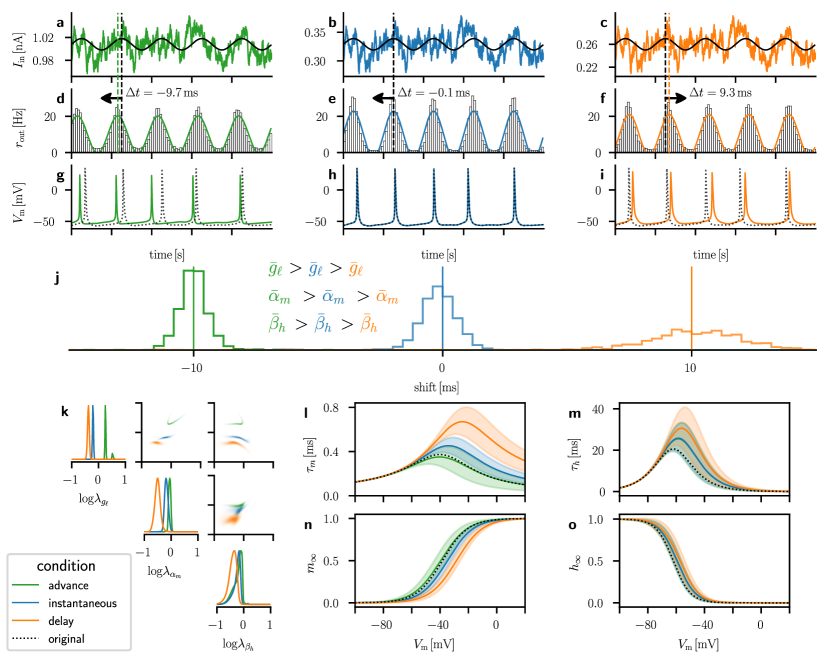
![Figure 1 : Hodgkin-Huxley model parameters define whether neuronal firing is prospective or retrospective. (a, b) The output firing rate $r_{\mathrm{out}}$ of a neocortical neuron model [ 10 ] is phase-advanced by $4.2\,$ ms with respect to the $10\text{\,}\mathrm{H}\mathrm{z}$ amplitude modulation](https://ar5iv.labs.arxiv.org/html/2405.14810/assets/x1.png)
实验结果
研究问题
- RQ1单个皮层神经元是否能在单次试验中产生相对于输入提前的输出放电?
- RQ2在霍奇金-赫克斯利框架内,哪些生物物理机制使单个神经元实现前瞻性编码与回溯性编码?
- RQ3霍奇金-赫克斯利模型中的哪些具体参数控制神经元输出相对于输入调制的时间特性?
- RQ4在不同时间尺度上的适应性过程(如放电频率适应、慢失活)是否能对缓慢调制的输入产生前瞻性响应?
- RQ5所观测到的相位提前是统计伪影,还是源于神经元内在动力学?
主要发现
- 霍奇金-赫克斯利模型成功再现了相对于10 Hz振幅调制输入的4.2 ms相位提前,与体外实验观测结果一致。
- SBI识别出控制神经元响应为前瞻性或回溯性的最小参数空间,共三个关键参数:λgℓ、λαm 和 λβh。
- 钠通道失活(由h门控动力学调控)被确定为实现前瞻性放电的主要机制,其输出时间由膜电位及其导数共同决定。
- 研究表明,不同时间尺度的适应性过程,包括放电频率适应与慢失活,均可对相应时间尺度调制的输入产生前瞻性响应。
- 简化的速率模型以极低的计算成本成功复现了全霍奇金-赫克斯利模拟中的前瞻性编码,使长时序动力学的高效探索成为可能。
- 后验预测检验确认模型能准确再现条件化相位偏移,验证了推断框架的可靠性及所识别机制的生物学合理性。
更好的研究,从现在开始
从阅读论文到最终审阅,大幅缩短您的研究时间。
无需绑定信用卡
本解读由 AI 生成,并经人工编辑审核。