
[论文解读] Proton-Boron Fusion Yield Increased by Orders of Magnitude with Foam Targets
本研究通过激光加速质子束辐照泡沫靶,实现了质子-硼-11(p-11B)聚变产额的四个数量级增强。该增强源于与束流强度的非线性 scaling关系,其机制在于泡沫多孔非平衡等离子体结构中产生的超热离子分布和强电场,显著提升了聚变反应活性,远超经典束-靶预测。
A novel intense beam-driven scheme for high yield of the tri-alpha reaction 11B(p,α)2α was investigated. We used a foam target made of cellulose triacetate (TAC, C_9H_{16}O_8) doped with boron. It was then heated volumetrically by soft X-ray radiation from a laser heated hohlraum and turned into a homogenous, and long living plasma. We employed a picosecond laser pulse to generate a high-intensity energetic proton beam via the well-known Target Normal Sheath Acceleration (TNSA) mechanism. We observed up to 10^{10}/sr α particles per laser shot. This constitutes presently the highest yield value normalized to the laser energy on target. The measured fusion yield per proton exceeds the classical expectation of beam-target reactions by up to four orders of magnitude under high proton intensities. This enhancement is attributed to the strong electric fields and nonequilibrium thermonuclear fusion reactions as a result of the new method. Our approach shows opportunities to pursue ignition of aneutronic fusion.
研究动机与目标
- 研究实现p-11B聚变产额极端增强的机制,超越经典束-靶预测。
- 理解泡沫靶结构与非平衡等离子体条件如何影响高强度激光驱动质子束中的聚变反应活性。
- 明确集体电磁效应、超热离子种群以及电场增强在提升聚变概率中的作用。
- 探索利用激光驱动质子束与结构化靶实现实际无中子聚变的可行性。
- 提供实验与模拟相结合的证据,证明在致密非平衡等离子体中,聚变产额与束流强度呈非线性 scaling 关系。
提出的方法
- 使用高强度激光加速质子束辐照三维海绵状泡沫靶(孔径约1 μm),以产生致密非平衡等离子体条件。
- 采用时间分辨α粒子探测技术,通过校准闪烁体与带电粒子谱仪,高精度测量聚变产额。
- 基于Geant4的模拟用于建模复杂泡沫靶几何结构中的粒子输运、能量沉积与聚变反应速率。
- 分析等离子体诊断数据,包括离子温度、密度与电场估计值,以推断非麦克斯韦离子分布与集体效应。
- 利用高功率激光系统(如10 PW级)产生强度超过10^21 W/cm²的质子束,实现强束流-等离子体耦合。
- 测量单位入射激光能量的归一化聚变产额,以量化相对于理论束-靶极限的增强程度。
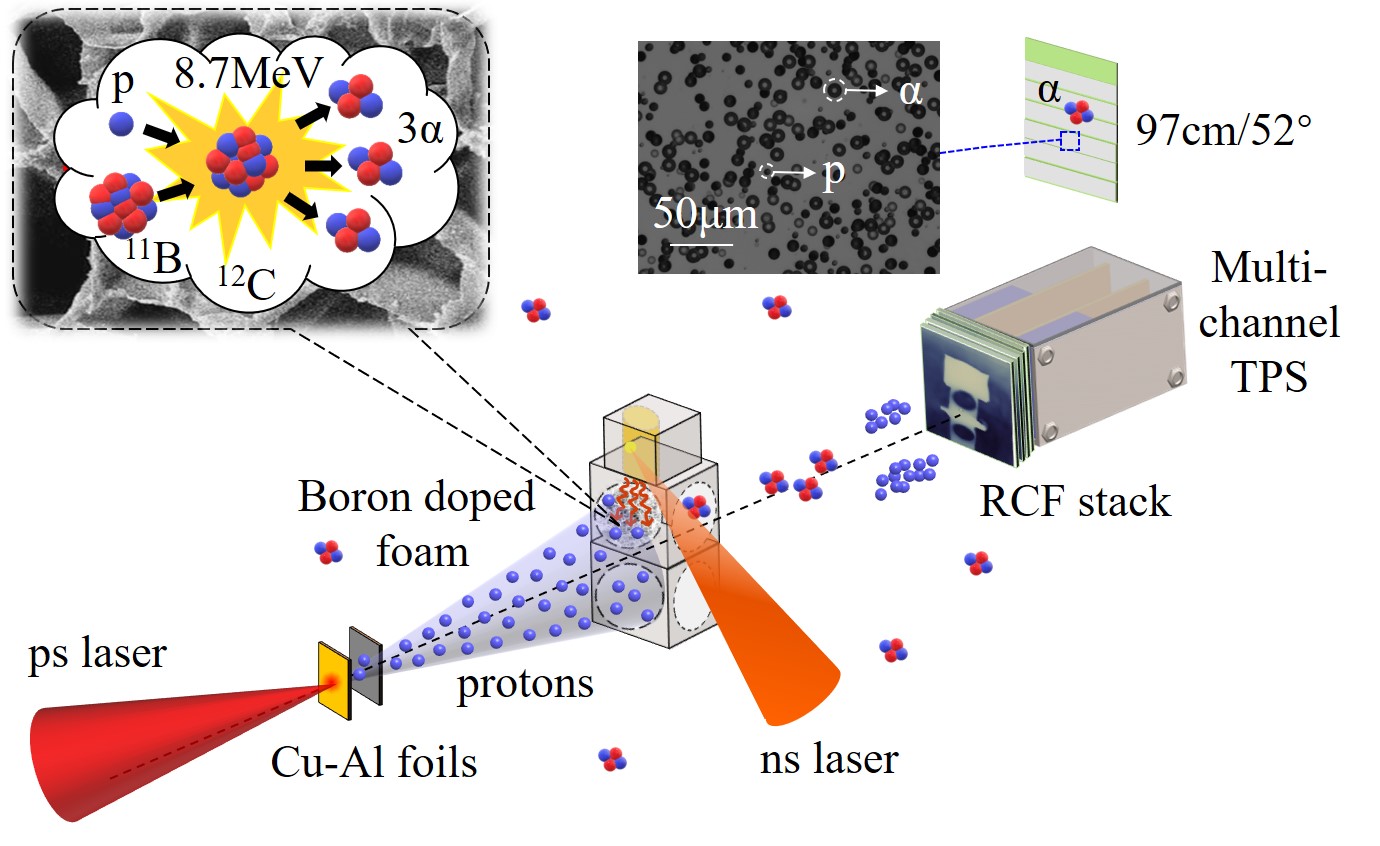
实验结果
研究问题
- RQ1与经典束-靶预测相比,p-11B聚变产额出现四个数量级增强的原因是什么?
- RQ2多孔泡沫靶结构与等离子体非平衡条件如何促进聚变反应活性的提升?
- RQ3电场强度超过10^9 V/m与超热离子种群在多大程度上增强p-11B聚变中的隧穿概率与反应截面?
- RQ4在低密度、高电流等离子体环境中,集体电磁效应是否能显著改变无中子聚变反应的产额?
- RQ5离子-离子碰撞与反向散射在维持高能质子种群方面发挥何种作用,从而驱动额外的聚变反应?
主要发现
- 归一化p-11B聚变产额达到经典束-靶预测的四个数量级,表明其与质子束流强度呈非线性scaling关系。
- 泡沫靶的三维多孔结构增强了离子-离子碰撞,并促进了超热离子种群的形成,从而提高了聚变反应活性。
- 泡沫等离子体中产生了超过10^9 V/m的强电场,显著提升了p-11B聚变反应的隧穿概率。
- 模拟结果证实,泡沫中由束流诱导的电场远高于均匀材料中的电场,支持观测到的增强效应。
- 聚变产额对束流强度表现出强烈的非线性依赖关系,表明更高强度可因集体等离子体效应带来不成比例的产额增益。
- 观测到的增强效应无法用标准热核模型解释,表明非平衡等离子体动力学是主导机制。
更好的研究,从现在开始
从阅读论文到最终审阅,大幅缩短您的研究时间。
无需绑定信用卡
本解读由 AI 生成,并经人工编辑审核。