
[论文解读] Pytorch-Wildlife: A Collaborative Deep Learning Framework for Conservation
Pytorch-Wildlife 是一个基于 PyTorch 的开源平台,面向易获取、可扩展的野生动物检测与分类,特点包括模型库、用户界面,以及在亚马逊和加拉帕戈斯的真实世界应用。
The alarming decline in global biodiversity, driven by various factors, underscores the urgent need for large-scale wildlife monitoring. In response, scientists have turned to automated deep learning methods for data processing in wildlife monitoring. However, applying these advanced methods in real-world scenarios is challenging due to their complexity and the need for specialized knowledge, primarily because of technical challenges and interdisciplinary barriers. To address these challenges, we introduce Pytorch-Wildlife, an open-source deep learning platform built on PyTorch. It is designed for creating, modifying, and sharing powerful AI models. This platform emphasizes usability and accessibility, making it accessible to individuals with limited or no technical background. It also offers a modular codebase to simplify feature expansion and further development. Pytorch-Wildlife offers an intuitive, user-friendly interface, accessible through local installation or Hugging Face, for animal detection and classification in images and videos. As two real-world applications, Pytorch-Wildlife has been utilized to train animal classification models for species recognition in the Amazon Rainforest and for invasive opossum recognition in the Galapagos Islands. The Opossum model achieves 98% accuracy, and the Amazon model has 92% recognition accuracy for 36 animals in 90% of the data. As Pytorch-Wildlife evolves, we aim to integrate more conservation tasks, addressing various environmental challenges. Pytorch-Wildlife is available at https://github.com/microsoft/CameraTraps.
研究动机与目标
- 解决野生动物监测对可访问、可扩展且透明的深度学习工具的需求。
- 提供一个开源、模块化的框架,用于创建、修改和共享保护模型。
- 实现从数据摄取到检测、分类和可视化的端到端工作流。
- 在生物多样性丰富的地区演示真实世界应用,以验证可用性和性能。
提出的方法
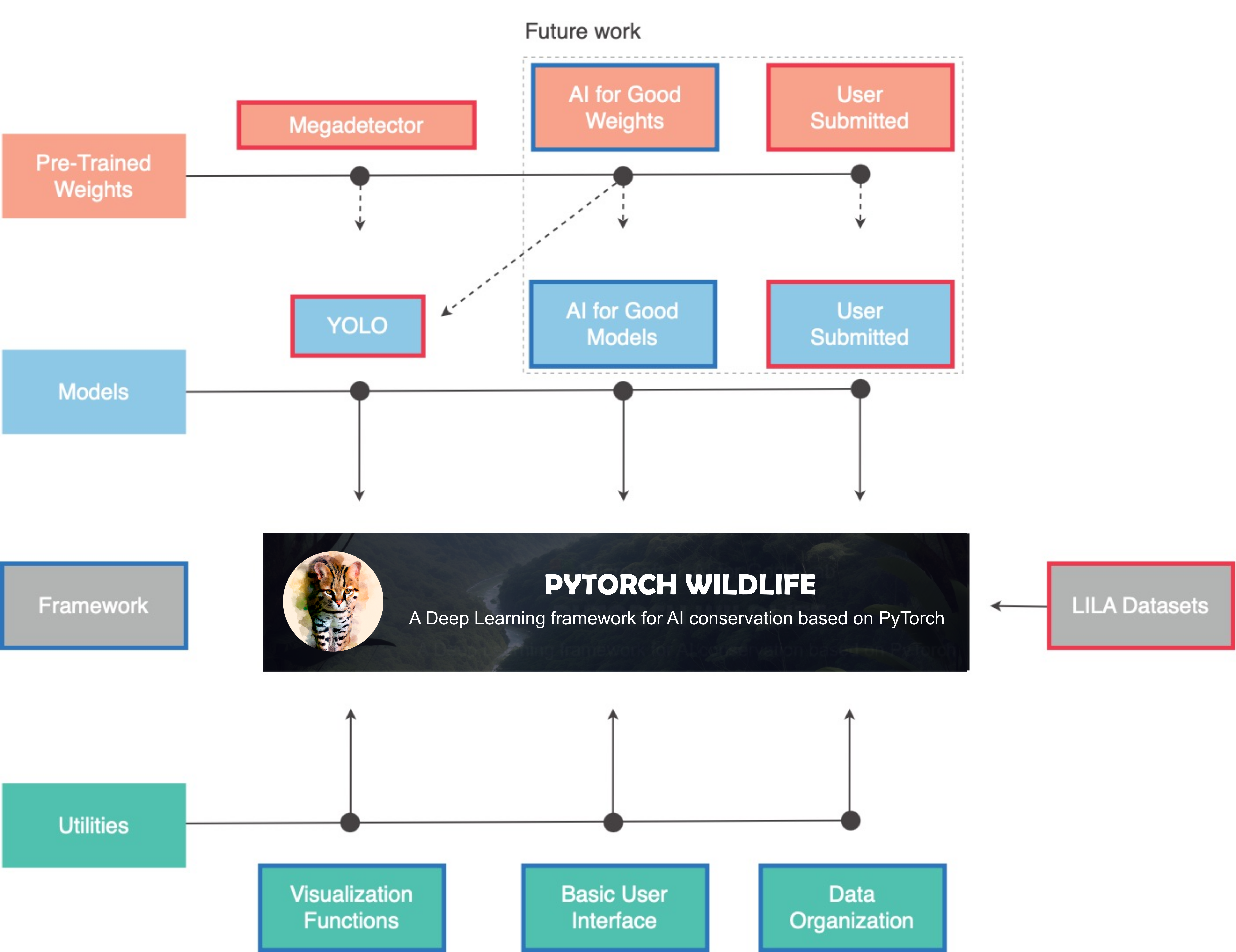
- 介绍 Pytorch-Wildlife 作为一个以 PyTorch 构建、具模块化架构的开源框架。
- 提供一个模型库,其中包含 MegaDetectorV5 以及在 Amazon、Galápagos 和 Serengeti 训练的三个动物识别模型。
- 提供一个用于单图/批量图像及单视频检测的用户界面,阈值可调。
- 将数据集连接到 LILA-BC 进行训练/验证,并包含一个分类微调模块。
- 提供数据预处理/后处理工具和可视化工具。
- 默认包含与 COCO 输出的兼容层,并提供与 Timelapse 和 EcoAssist 集成的选项。
实验结果
研究问题
- RQ1开源、模块化框架如何提升野生动物保护领域对深度学习的可访问性和采用率?
- RQ2在标准数据集上,紧凑型探测器( MegaDetectorV6-compact )相对于 MegaDetectorV5 的性能与效率权衡是什么?
- RQ3框架是否能够在带有人类在环验证的情况下,支持从检测到属/种分类的真实世界工作流?
- RQ4模型库如何通过标准化评估和社区反馈促进透明度和可比性?
主要发现
| 模型 | 参数量 | 精确度 | 召回率 | mAP |
|---|---|---|---|---|
| MDv5 | 121M | 0.96 | 0.73 | 0.85 |
| MDv6-c | 22M | 0.92 | 0.85 | 0.84 |
- MDv6-compact 的召回率高于 MDv5(0.85 对 0.73),且参数量只有六分之一(22M vs 121M)。
- MDv6-compact 模型在 MegaDetectorV5 训练数据上使用 YOLOv9-compact 达到 0.92 精度和 0.85 召回,0.84 mAP。
- 使用 MegaDetectorV5 进行检测,Amazon 数据集在高置信子集上识别准确率为 92%,占图像的 90%。
- Galápagos 视频通过跨帧多数投票实现对负鼠与非负鼠分类的 98% 准确率。
- 一个人类在环阈值 0.98 能提供高置信度的结果,同时将人工验证减少到大约 10% 的检测。
- 该框架与 LILA-BC 数据集连接,并提供一个由社区主导的模型库,带有排行榜和反馈。

更好的研究,从现在开始
从论文设计到论文写作,大幅缩短您的研究时间。
无需绑定信用卡
本解读由 AI 生成,并经人工编辑审核。