
[论文解读] Quantum Computing-Enhanced Algorithm Unveils Novel Inhibitors for KRAS
一个在量子硬件/设计上训练的混合量子-经典生成模型(QCBM-LSTM)用于 KRAS 抑制剂;有两种化合物显示实验活性,包括一个全KRAS抑制剂。
The discovery of small molecules with therapeutic potential is a long-standing challenge in chemistry and biology. Researchers have increasingly leveraged novel computational techniques to streamline the drug development process to increase hit rates and reduce the costs associated with bringing a drug to market. To this end, we introduce a quantum-classical generative model that seamlessly integrates the computational power of quantum algorithms trained on a 16-qubit IBM quantum computer with the established reliability of classical methods for designing small molecules. Our hybrid generative model was applied to designing new KRAS inhibitors, a crucial target in cancer therapy. We synthesized 15 promising molecules during our investigation and subjected them to experimental testing to assess their ability to engage with the target. Notably, among these candidates, two molecules, ISM061-018-2 and ISM061-22, each featuring unique scaffolds, stood out by demonstrating effective engagement with KRAS. ISM061-018-2 was identified as a broad-spectrum KRAS inhibitor, exhibiting a binding affinity to KRAS-G12D at $1.4 μM$. Concurrently, ISM061-22 exhibited specific mutant selectivity, displaying heightened activity against KRAS G12R and Q61H mutants. To our knowledge, this work shows for the first time the use of a quantum-generative model to yield experimentally confirmed biological hits, showcasing the practical potential of quantum-assisted drug discovery to produce viable therapeutics. Moreover, our findings reveal that the efficacy of distribution learning correlates with the number of qubits utilized, underlining the scalability potential of quantum computing resources. Overall, we anticipate our results to be a stepping stone towards developing more advanced quantum generative models in drug discovery.
研究动机与目标
- 动机并展示使用量子增强的生成建模以加速小分子设计。
- 开发一个混合量子-经典框架,将QCBM先验与LSTM生成器整合用于配体设计。
- 整理大规模多样化的KRAS抑制剂数据集,并训练一个模型以生成可合成、药物样的分子。
- 实验合成并评估顶尖候选物,以验证预测与KRAS靶点的一致性。
提出的方法
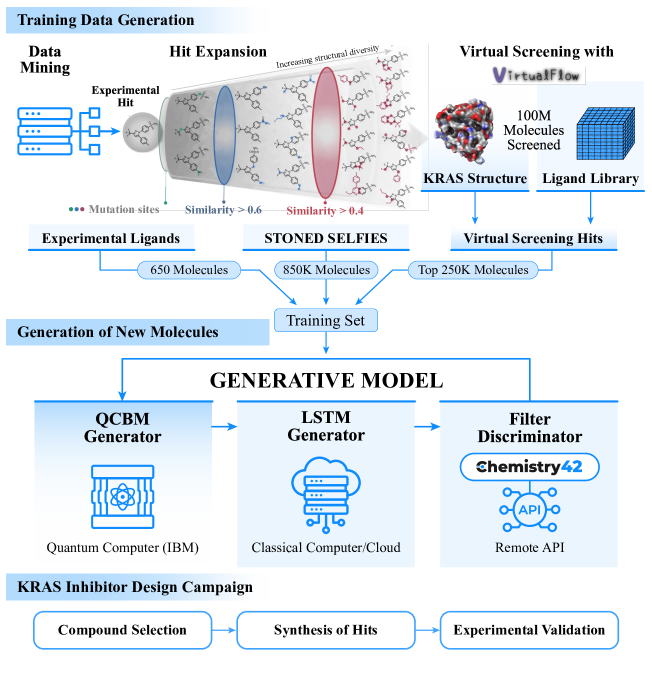
- 从约650个已知KRAS抑制剂构建训练数据集,并通过STONED-SELFIES和虚拟筛选(REAL library)扩增至约100万个分子。
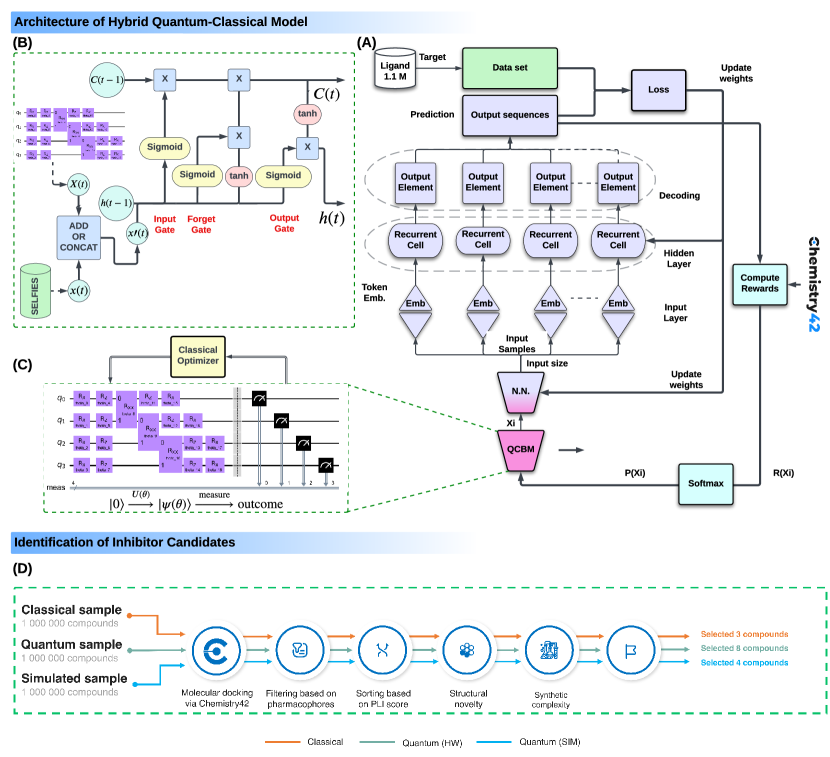
- 实现一个混合生成器,使用16量子比特的QCBM作为先验以及基于LSTM的经典模型,并以Chemistry42作为奖励信号。
- 用来自硬件的量子先验进行迭代采样训练模型,然后将量子信息与分子信息合并以作为LSTM输入。
- 使用Tartarus局部过滤器和Chemistry42评分评价生成的分子;合成15个有前景的候选物进行实验测试。
- 通过SPR和MaMTH-DS测定结合与功能活性进行实验验证;分析KRAS突变体的结构-活性关系。
实验结果
研究问题
- RQ1将量子先验整合是否相较于经典基线提高了所生成KRAS抑制剂的质量与多样性?
- RQ2量子先验中的量子比特数量如何影响分布学习和分子质量?
- RQ3量子增强的生成模型是否能够产出经实验验证的KRAS抑制剂?
- RQ4量子生成的候选物在对接得分、可合成性和靶点结合方面与经典方法相比如何?
主要发现
- 两种合成化合物,ISM061-018-2和ISM061-22,对KRAS显示实验绑定。
- ISM061-018-2 以1.4 μM亲和力结合KRAS-G12D,并作為全KRAS抑制剂。
- ISM061-22 显示对突变体的选择性活性,特别是对 KRAS G12R 和 Q61H 突变体,对 G12D 结合有限。
- 量子先验在Tartarus基准测试中改善了分布学习和分子质量。
- 成功率与量子先验所用的量子比特数量大致呈线性相关。
- 本工作报道了药物发现中首次被量子算法实证确认的命中案例。
更好的研究,从现在开始
从阅读论文到最终审阅,大幅缩短您的研究时间。
无需绑定信用卡
本解读由 AI 生成,并经人工编辑审核。