
[论文解读] Quantum-Noise-Driven Generative Diffusion Models
本文提出了三种由量子噪声驱动的生成扩散模型(CQGDM、QCGDM、QQGDM),将量子噪声、相干性和纠缠作为计算优势而非错误来源。通过用量子随机动力学替代经典扩散或去噪过程,这些模型实现了对复杂概率分布更高效的采样。数值模拟表明,利用参数化量子线路,可在一维数据集上成功训练出混合经典-量子模型。
Generative models realized with machine learning techniques are powerful tools to infer complex and unknown data distributions from a finite number of training samples in order to produce new synthetic data. Diffusion models are an emerging framework that have recently overcome the performance of the generative adversarial networks in creating synthetic text and high-quality images. Here, we propose and discuss the quantum generalization of diffusion models, i.e., three quantum-noise-driven generative diffusion models that could be experimentally tested on real quantum systems. The idea is to harness unique quantum features, in particular the non-trivial interplay among coherence, entanglement and noise that the currently available noisy quantum processors do unavoidably suffer from, in order to overcome the main computational burdens of classical diffusion models during inference. Hence, we suggest to exploit quantum noise not as an issue to be detected and solved but instead as a very remarkably beneficial key ingredient to generate much more complex probability distributions that would be difficult or even impossible to express classically, and from which a quantum processor might sample more efficiently than a classical one. An example of numerical simulations for an hybrid classical-quantum generative diffusion model is also included. Therefore, our results are expected to pave the way for new quantum-inspired or quantum-based generative diffusion algorithms addressing more powerfully classical tasks as data generation/prediction with widespread real-world applications ranging from climate forecasting to neuroscience, from traffic flow analysis to financial forecasting.
研究动机与目标
- 探索在生成建模中将量子噪声视为计算资源而非障碍的方法。
- 开发利用量子特性(如纠缠和相干性)的古典扩散模型的量子推广。
- 通过用量子随机过程替代经典动力学,实现对复杂概率分布更高效的采样。
- 通过数值模拟展示混合经典-量子扩散模型的可行性。
- 为气候预测、神经科学和金融建模等应用开辟量子增强生成建模的新路径。
提出的方法
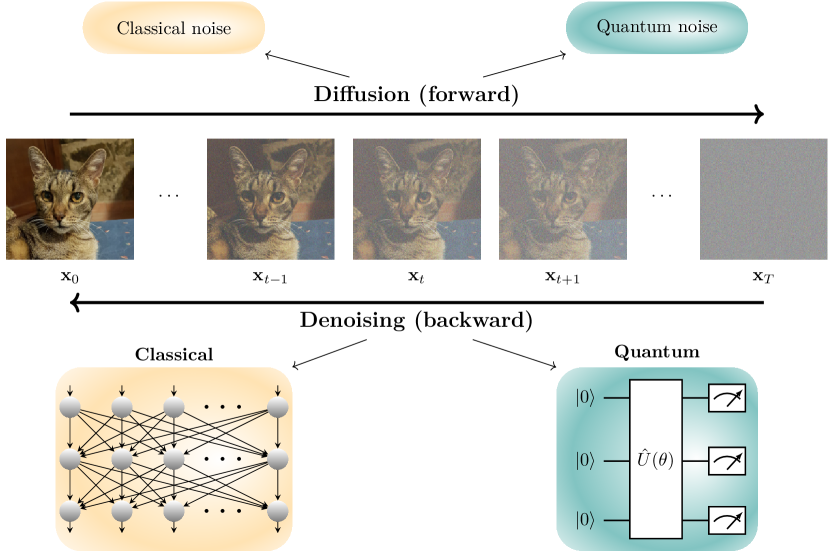
- 提出三种变体:经典扩散结合量子去噪(CQGDM)、量子扩散结合经典去噪(QCGDM)以及完全量子的扩散与去噪(QQGDM)。
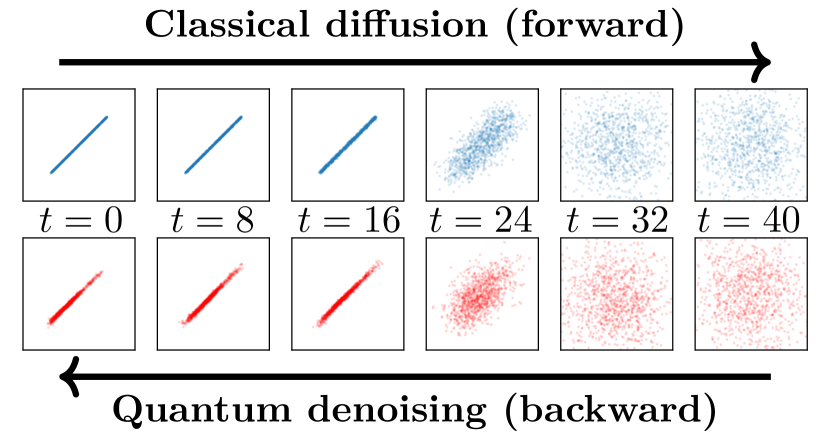
- 使用带有高斯转移核的经典马尔可夫链实现前向扩散过程,将数据映射到时间 T=40 时的各向同性高斯分布。
- 采用参数化量子线路(PQC),结合角度编码和纠缠CNOT门,建模去噪过程,估计均值和对角协方差。
- 设计双部分量子线路:'头部'用于特征编码,'尾部'用于时间依赖的参数化,分别共享参数和特定参数。
- 使用随机梯度下降配合Adam优化器,基于Kullback-Leibler散度损失,在40,000个周期内对每批1,000个点进行PQC训练。
- 使用Pennylane和PyTorch进行模拟,通过测量σz的期望值提取均值和方差的预测结果。
实验结果
研究问题
- RQ1能否将量子噪声作为有益资源用于生成建模,而非误差来源?
- RQ2与经典扩散模型相比,量子随机动力学如何提升对复杂概率分布采样的效率?
- RQ3混合经典-量子扩散模型在生成合成数据方面的性能特征是什么?
- RQ4参数化量子线路能否有效近似扩散框架中的反向去噪过程?
- RQ5纠缠和相干性等量子特性在增强生成模型表达能力方面发挥什么作用?
主要发现
- 混合经典-量子生成扩散模型(CQGDM)成功学习将一维线段分布的数据去噪为目标高斯分布。
- 模型在40,000个周期内使用Adam优化器(学习率为10−4)进行训练,最小化预测分布与目标分布之间的Kullback-Leibler散度。
- PQC架构采用四量子比特线路和256层参数旋转与CNOT门,有效估计了均值和方差参数。
- 线路的头部在时间步之间共享参数,而尾部使用时间特定参数,提升了去噪序列中的泛化能力。
- 模型输出的均值预测乘以3,方差预测加1,以确保正值并扩展生成样本的范围。
- 数值结果表明,使用量子处理器实现去噪步骤在处理复杂分布时比经典模型更高效。
更好的研究,从现在开始
从阅读论文到最终审阅,大幅缩短您的研究时间。
无需绑定信用卡
本解读由 AI 生成,并经人工编辑审核。