
[论文解读] QUEST-DMC superfluid $^3$He detector for sub-GeV dark matter
该论文提出QUEST-DMC,一种利用超流 $^3$He 通过基于纳米机械谐振器的热释电计探测器检测准粒子,以搜寻亚GeV/$c^2$ 暗物质的新探测器。其投影的核反冲能量灵敏度低于1 eV,使该探测器在轻质暗物质的自旋无关和自旋相关相互作用方面具备竞争力,且可通过多线纳米机电系统(NEMS)和先进测温技术进一步提升性能。
The focus of dark matter searches to date has been on Weakly Interacting Massive Particles (WIMPs) in the GeV/$c^2$-TeV/$c^2$ mass range. The direct, indirect and collider searches in this mass range have been extensive but ultimately unsuccessful, providing a strong motivation for widening the search outside this range. Here we describe a new concept for a dark matter experiment, employing superfluid $^3$He as a detector for dark matter that is close to the mass of the proton, of order 1 GeV/$c^2$. The QUEST-DMC detector concept is based on quasiparticle detection in a bolometer cell by a nanomechanical resonator. In this paper we develop the energy measurement methodology and detector response model, simulate candidate dark matter signals and expected background interactions, and calculate the sensitivity of such a detector. We project that such a detector can reach sub-eV nuclear recoil energy threshold, opening up new windows on the parameter space of both spin-dependent and spin-independent interactions of light dark matter candidates.
研究动机与目标
- 开发一种针对亚GeV/$c^2$ 暗物质的新探测概念,特别关注自旋无关和自旋相关的相互作用。
- 解决传统以WIMP为中心的实验对轻质暗物质候选者探测灵敏度不足的问题。
- 利用超流 $^3$He 的独特性质——如低温稳定性与高准粒子灵敏度——实现超低能量阈值探测。
- 通过模拟和建模探测器响应、信号与背景相互作用,预测在亚eV能量区间的探测灵敏度。
- 为未来实验实现与超流相变基本现象的研究奠定基础。
提出的方法

- 探测器使用约1 cm$^3$ 的超流 $^3$He 热释电计腔体,通过稀释制冷机和铜磁冷却级将温度冷却至约100 $\mu$K。
- 由亚微米直径纳米线构成的纳米机械谐振器(NEMS)用于探测暗物质-$^3$He 碰撞事件中产生的准粒子激发所释放的热能。
- 首次在该温度范围内采用基于SQUID的读出技术,以实现对准粒子产生能量的高分辨率测量。
- 利用详细的探测器响应函数对核反冲的能量沉积进行建模,考虑准粒子的产生与热化过程。
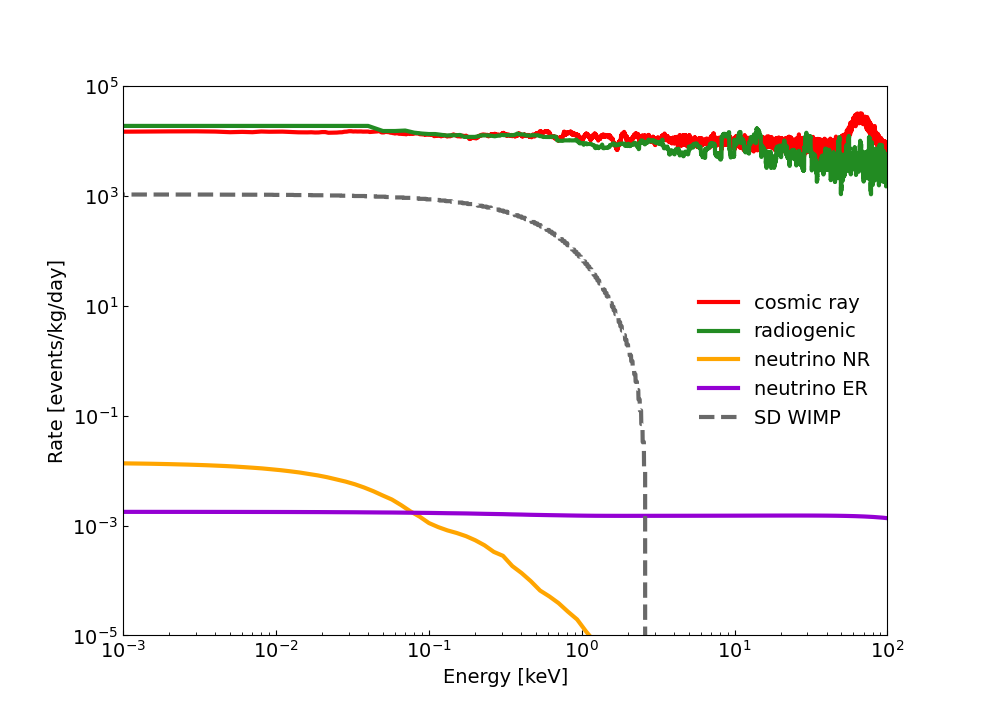
- 采用蒙特卡罗模拟对候选暗物质信号与背景相互作用(包括电子反冲与宇宙射线)进行建模。
- 通过包含能量阈值、信号效率与背景抑制的完整模拟框架,预测探测灵敏度。
实验结果
研究问题
- RQ1基于超流 $^3$He 的热释电计与纳米机械谐振器能否实现对核反冲的亚eV能量分辨率?
- RQ2此类探测器对亚GeV/$c^2$ 暗物质的自旋无关与自旋相关相互作用的灵敏度如何?
- RQ3准粒子散粒噪声与谐振器设计如何影响能量阈值与灵敏度?
- RQ4在亚eV能量区间的主导背景来源是什么,如何加以抑制?
- RQ5该探测器概念能否扩展以探测基本超流现象,如均匀的一阶相变?
主要发现
- QUEST-DMC 探测器概念预测其核反冲能量阈值低于1 eV,可进入轻质暗物质参数空间中此前未被探索的区域。
- 该探测器对 $^3$He 核与暗物质的自旋无关和自旋相关相互作用均具有灵敏度,为现有稀有气体基实验提供了互补探测路径。
- 灵敏度预测显示,在亚GeV/$c^2$ 质量范围内具备竞争力,尤其在自旋相关相互作用方面,当前实验尚未充分探索。
- 采用多个独立的纳米线振子可使能量分辨率提高 $\sqrt{N}$ 倍,显著增强灵敏度。
- 采用膜附着谐振器或非局域测温(如自旋波BEC弛豫)等替代策略,可进一步降低噪声并使灵敏度扩展至1 eV以下。
- 模拟框架表明,通过能量阈值与事件拓扑分析可实现背景抑制,为实现探测提供可行路径。
更好的研究,从现在开始
从阅读论文到最终审阅,大幅缩短您的研究时间。
无需绑定信用卡
本解读由 AI 生成,并经人工编辑审核。