
[论文解读] Quiescent or dusty? Unveiling the nature of extremely red galaxies at $z>3$
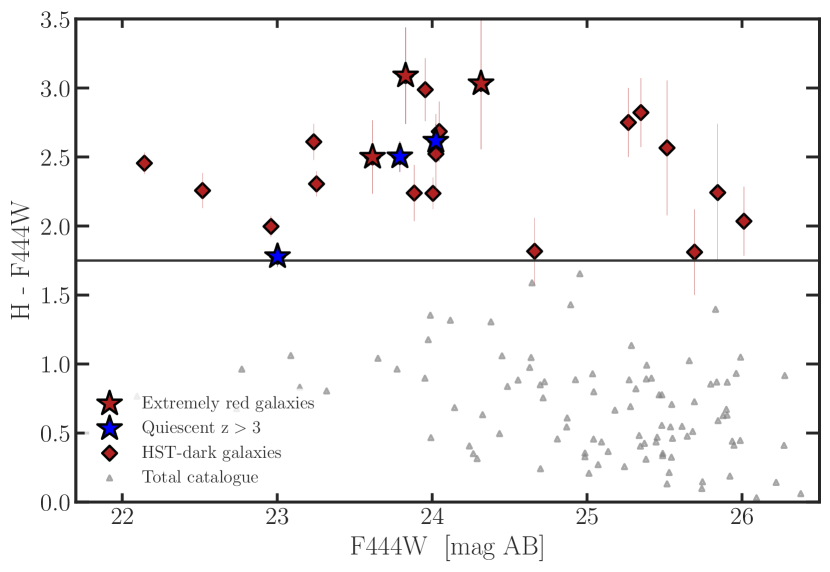
该论文展示了 JWST/NIRSpec PRISM 光谱观测的23个 HST-dark 星系(H-F444W>1.75),揭示大多数星系尘埃较重,且相当一部分处于静默状态,具有准确的红移和尘埃测量;其中一个静默源显示 AGN 活动。
The advent of the JWST has revolutionised our understanding of high-redshift galaxies. In particular, the NIRCam instrument on-board JWST has revealed a population of Hubble Space Telescope (HST)-dark galaxies that had previously evaded optical detection, potentially due to significant dust obscuration, quiescence, or simply extreme redshift. Here, we present the first NIRSpec spectra of 23 HST-dark galaxies ($\mathrm{H-F444W>1.75}$), unveiling their nature and physical properties. This sample includes both dusty and quiescent galaxies with spectroscopic data from NIRSpec/PRISM, providing accurate spectroscopic redshifts with $\mathrm{\overline{z}_{spec} = 4.1 \pm 0.7}$. The spectral features demonstrate that, while the majority of HST-dark galaxies are dusty, a substantial fraction, $\mathrm{13^{+9}_{-6} \%}$, are quiescent. For the dusty galaxies, we have quantified the dust attenuation using the Balmer decrement ($\mathrm{Hα/ Hβ}$), finding attenuations $\mathrm{A_{V} > 2\ mag}$. We find that HST-dark dusty galaxies are $\mathrm{Hα}$ emitters with equivalent widths spanning the range $\mathrm{ 68 A < EW_{Hα} < 550 A }$, indicative of a wide range of recent star-formation activity. Whether dusty or quiescent, we find that HST-dark galaxies are predominantly massive, with 85\% of the galaxies in the sample having masses $\mathrm{log(M_{*}/M_{\odot}) > 9.8}$. This pilot NIRSpec program reveals the diverse nature of HST-dark galaxies and highlights the effectiveness of NIRSpec/PRISM spectroscopic follow-up in distinguishing between dusty and quiescent galaxies and properly quantifying their physical properties. Upcoming research utilising higher-resolution NIRSpec data and combining JWST with ALMA observations will enhance our understanding of these enigmatic and challenging sources.
研究动机与目标
- 使用 NIRSpec PRISM 光谱(1–5 μm)通过 23 个从 NIRCam 成像中选出的 HST-dark 星系,确定其红移分布。
- 通过光谱特征区分尘埃型与静默型 HST-dark 星系。
- 量化样本的尘埃消光与基本物理性质(质量、SFR)。
- 评估 HST-dark 星系中是否存在 AGN 活动。
- 为未来 JWST+ALMA 对高红移红星系的研究提供基准。
提出的方法
- 获取分辨率较低的 (R~100) NIRSpec PRISM 光谱(1–5 μm)用于 23 个 HST-dark 星系,来自 NIRCam 成像的选择。
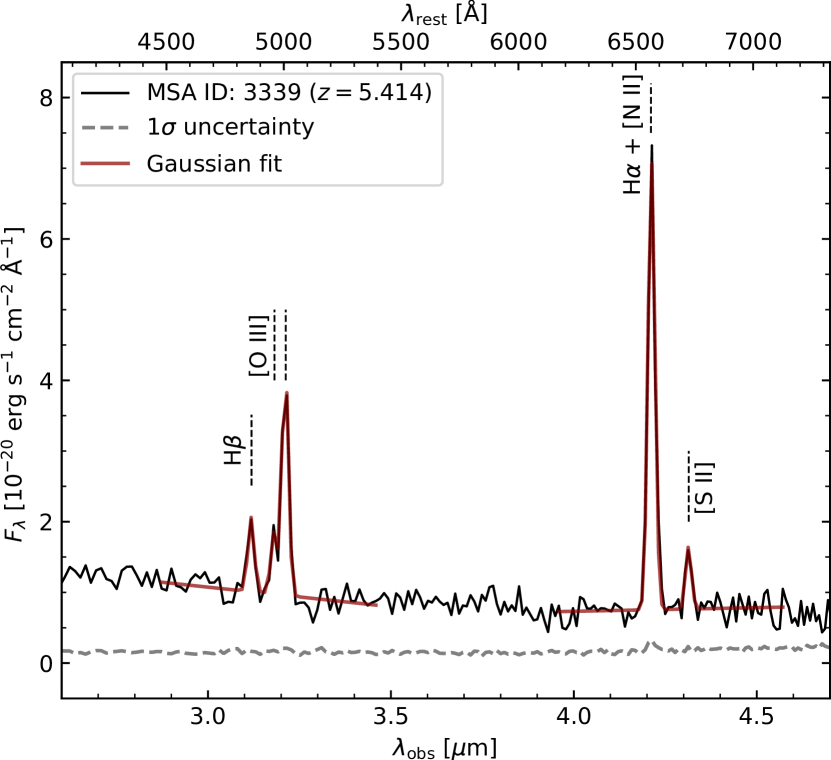
- 提取发射线与连续光谱,拟合 Hβ、[OIII]、Hα、[NII]、[SII] 以测量线通量与 Balmer 折返。
- 基于发射线与 Balmer breaks 特征将星系分类为尘埃型或静默型。
- 利用 BAGPIPES 在具有光谱红移与多波段光度数据的条件下进行 SED 拟合,以导出 M*、SFR 与 A_V。
- 利用 Balmer 折返 (Hα/Hβ) 借助 Calzetti 消光来推导 A_V,并在 Hα 光度测量中考虑 [NII] 的混合影响。
- 在 SED 分析中引入带有广义 τ 的延迟型 SFH 模型、金属丰度 0.2–2.5 Z⊙,以及 CLOUDY 星云发射。
实验结果
研究问题
- RQ1在 JWST/NIRSpec PRISM 观测下,HST-dark 星系的红移分布如何?
- RQ2基于光谱数据,z>3 的 HST-dark 星系中尘埃型与静默型各占多少比例?
- RQ3通过 Balmer 折返得到的星尘消光与 SED 拟合中的连续差异消光有何关系?
- RQ4是否有尘埃型 HST-dark 星系表现出 AGN 活性(通过发射线轮廓指示)?
- RQ5这些星系的恒星质量与 Hα 等效宽度(EW)是多少,它们与分类之间有何关系?
主要发现
| 编号 | RA | Dec | F_Hα (10^-20 erg/s/cm^2) | F_Hβ (10^-20 erg/s/cm^2) | A_V | EW_Hα (Å) | zspec |
|---|---|---|---|---|---|---|---|
| 1260 | 53.0748575 | -27.875898 | 290 ± 82 | <68 | >1.40 | 68 ± 26 | 4.44 |
| 1548 | 53.1347898 | -27.907492 | 463 ± 44 | <72 | >2.77 | 70 ± 9 | 4.43 |
| 1616 | 53.0766784 | -27.8734698 | 3553 ± 104 | <452 | >3.49 | 331 ± 17 | 3.46 |
| 3012 | 53.0767591 | -27.8641199 | 414 ± 50 | <115 | >0.80 | 149 ± 44 | 3.47 |
| 3339 | 53.1147448 | -27.8904202 | 1495 ± 50 | 230 ± 31 | 2.83 | 304 ± 59 | 5.41 |
| 3640 | 53.0821208 | -27.8598697 | 720 ± 94 | <78 | >4.03 | 146 ± 31 | 3.65 |
| 4307 | 53.1406347 | -27.8813756 | 1137 ± 55 | 83 ± 26 | 5.40 | 375 ± 231 | 5.52 |
| 4490 | 53.0410546 | -27.8544706 | 1829 ± 72 | 290 ± 42 | 2.74 | 484 ± 81 | 3.70 |
| 4820 | 53.034904 | -27.8521791 | 1966 ± 46 | 225 ± 36 | 3.85 | 545 ± 103 | 3.79 |
| 5446 | 53.0279874 | -27.8470862 | 1261 ± 51 | <209 | <2.58 | 267 ± 24 | 2.71 |
| 5510 | 53.1783286 | -27.8702734 | 1369 ± 49 | <264 | >2.06 | 134 ± 6 | 3.47 |
| 5607 | 53.1233683 | -27.8705379 | 434 ± 28 | 72 ± 28 | 2.58 | 346 ± 38 | 3.59 |
| 6151 | 53.0420756 | -27.8426437 | 316 ± 36 | <51 | >2.65 | 2025 ± 176 | 4.38 |
| 12469 | 53.0446935 | -27.8136318 | 2177 ± 50 | 323 ± 63 | 2.96 | 280 ± 17 | 3.55 |
| 12577 | 53.0484576 | -27.8151421 | 1799 ± 66 | 146 ± 19 | 5.05 | 977 ± 67 | 5.23 |
| 7151 | 53.05672 | -27.836383 | 1427 ± 67 | <119 | <4.8 | 2647 ± 93 | 3.79 |
- 中位 z_spec = 4.1 ± 0.7;所有源都位于 z ≳ 3,峰值约在 z ≈ 4。
- 13^{+9}_{-6}% (3/23) 的 HST-dark 样本在 z>3 时为静默型。
- 尘埃型 HST-dark 星系的 Balmer 折返所推导的 A_V 值通常>2.6 mag,某些情形接近 A_V ≈ 5 mag。
- 通过 Balmer 折返得到的尘埃消光高于通过 SED 拟合得到的连续光学消光,体现出 Nebular 与 stellar 区域之间的差异性消光。
- 所有尘埃型 HST-dark 星系都是 Hα 发射体,静态框的 rest-frame EW 介于 ~68 Å 到 ~550 Å(除一个 AGN 主导的案例约 ~1000 Å 外)。
- 一个静默星系(ID=8777,z=4.7)显示出宽 Hα,表明有 AGN 活性;总体而言,样本中 AGN 徽迹较少。
更好的研究,从现在开始
从论文设计到论文写作,大幅缩短您的研究时间。
无需绑定信用卡
本解读由 AI 生成,并经人工编辑审核。