
[论文解读] Rail-only: A Low-Cost High-Performance Network for Training LLMs with Trillion Parameters
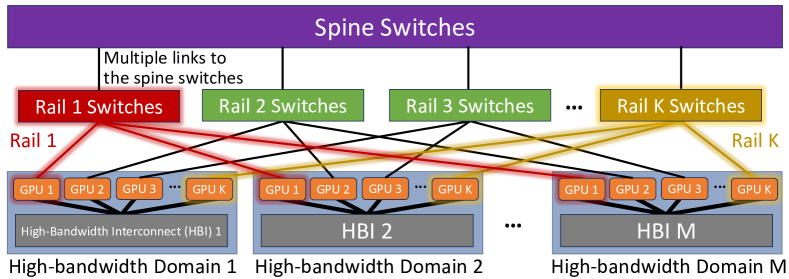
本文提出 Rail-Only,一种通过利用万亿参数大语言模型的独特通信模式,实现低成本、高性能的网络架构,用于训练万亿参数大语言模型。与全连接的任意对任意通信不同,它将 GPU 划分为高带宽(HB)域,并仅通过存在非零流量的跨域连接进行连接,从而在不损失性能的前提下将网络成本降低 37% 至 75%。
This paper presents a low-cost network architecture for training large language models (LLMs) at hyperscale. We study the optimal parallelization strategy of LLMs and propose a novel datacenter network design tailored to LLM's unique communication pattern. We show that LLM training generates sparse communication patterns in the network and, therefore, does not require any-to-any full-bisection network to complete efficiently. As a result, our design eliminates the spine layer in traditional GPU clusters. We name this design a Rail-only network and demonstrate that it achieves the same training performance while reducing the network cost by 38% to 77% and network power consumption by 37% to 75% compared to a conventional GPU datacenter. Our architecture also supports Mixture-of-Expert (MoE) models with all-to-all communication through forwarding, with only 8.2% to 11.2% completion time overhead for all-to-all traffic. We study the failure robustness of Rail-only networks and provide insights into the performance impact of different network and training parameters.
研究动机与目标
- 解决训练万亿参数大语言模型时大规模 GPU 集群日益增长的成本与复杂性问题。
- 挑战全连接任意对任意网络互连在大语言模型训练中为必需的假设。
- 设计一种与实际大语言模型通信模式相匹配的成本高效网络,以减少基础设施开销。
- 在最小化网络硬件的前提下保持训练性能,通过移除闲置互连实现。
- 提供一个分析框架,基于大语言模型超参数和基础设施条件,估算训练迭代时间。
提出的方法
- 分析大语言模型训练的通信流量模式,发现高带宽通信仅限于小型、局部的 GPU 组(HB 域)。
- 提出一种新型网络架构 Rail-Only,将集群划分为仅通过必要跨域链路连接的 HB 域。
- 使用分析模型估算训练迭代时间,综合考虑计算、通信和并行化策略。
- 通过消除传统 Clos 网络拓扑中未被利用的链路,实现网络成本降低。
- 为 Rail-Only 设计实现容错机制和故障恢复策略,提升系统容错能力。
- 将分析模型与先前研究的实测结果进行对比验证,浮点利用率估算误差低于 0.15%。
实验结果
研究问题
- RQ1大语言模型训练是否真的需要集群中所有 GPU 之间都实现任意对任意的网络连接?
- RQ2能否设计一种网络架构,使其与大语言模型训练的实际通信需求相匹配,从而降低成本?
- RQ3如何准确建模训练迭代时间,以指导大语言模型网络架构的设计?
- RQ4在大规模 GPU 集群中,移除非必要互连的性能与成本权衡如何?
- RQ5所提出的 Rail-Only 架构能否在显著降低网络硬件的同时保持性能?
主要发现
- 大语言模型训练表现出一种通信模式:仅小型、局部的 GPU 组需要高带宽的任意对任意通信,而组间通信量极少且趋于均匀。
- 与最先进 Clos 网络相比,Rail-Only 架构在不损失性能的前提下,将网络成本降低了 37% 至 75%。
- 用于训练迭代时间的分析模型,其硬件浮点利用率估算值与先前研究的实测结果相比误差低于 0.15%。
- 对于 32,768 个 GPU 的集群,Rail-Only 将交换机数量从 SOTA Clos 网络的 2,560 台减少至 1,536 台,实现 37% 的成本降低。
- 对于 128,000 个 GPU 的集群,通过将顶层配置的交换机数量从 1,280 台减少至 256 台,成本降低达到 75%。
- 通过支持集群的逻辑分区为独立域,该设计仍可兼容多任务训练和推理工作负载。
更好的研究,从现在开始
从阅读论文到最终审阅,大幅缩短您的研究时间。
无需绑定信用卡
本解读由 AI 生成,并经人工编辑审核。