
[论文解读] Rapid Chemical Enrichment by Intermittent Star Formation in GN-z11
该论文提出,间歇性恒星形成——特别是两次强烈的恒星爆发之间存在100 Myr的休眠期——可解释詹姆斯·韦伯空间望远镜(JWST)观测到的GN-z11(z=10.6)中超过太阳水平的氮氧比。来自第二次爆发的沃尔夫-拉叶星(最高达120 M☉)在短期内增强氮、氟、钠、铝以及13C和18O等同位素,成功再现了观测到的CNO元素比值,而无需引入极高质量恒星或预先富集。
We interpret the peculiar super-solar nitrogen abundance recently reported by the James Webb Space Telescope observations for GN-z11 ($z=10.6$) using our state-of-the-art chemical evolution models. The observed CNO ratios can be successfully reproduced -- independently of the adopted initial mass function, nucleosynthesis yields, and presence of supermassive ($>$1000$M_\odot$) stars -- if the galaxy has undergone an intermittent star formation history with a quiescent phase lasting $\sim$100 Myr, separating two strong starbursts. Immediately after the second burst, Wolf--Rayet stars (up to $120M_\odot$) become the dominant enrichment source, also temporarily ($<$1 Myr) enhancing particular elements (N, F, Na, and Al) and isotopes ($^{13}$C and $^{18}$O). Alternative explanations involving (i) single burst models, also including very massive stars and/or pair-instability supernovae, or (ii) pre-enrichment scenarios fail to match the data. Feedback-regulated, intermittent star formation might be common in early systems. Elemental abundances can be used to test this hypothesis and to get new insights on nuclear and stellar astrophysics.
研究动机与目标
- 解释詹姆斯·韦伯空间望远镜观测到的GN-z11(z=10.6)中异常高的N/O比值,其值超过太阳水平四倍以上。
- 检验是否存在间歇性恒星形成(含休眠期)可再现观测到的CNO元素丰度比值,而无需引入极高质量恒星(VMS)或预先富集。
- 评估沃尔夫-拉叶星在驱动快速化学富集及增强早期星系中特定元素与同位素中的作用。
- 利用化学演化模型评估反馈调节、随机恒星形成在高红移星系中的可行性。
提出的方法
- 采用先进的化学演化模型,模拟不同恒星形成历史下的星系尺度元素丰度。
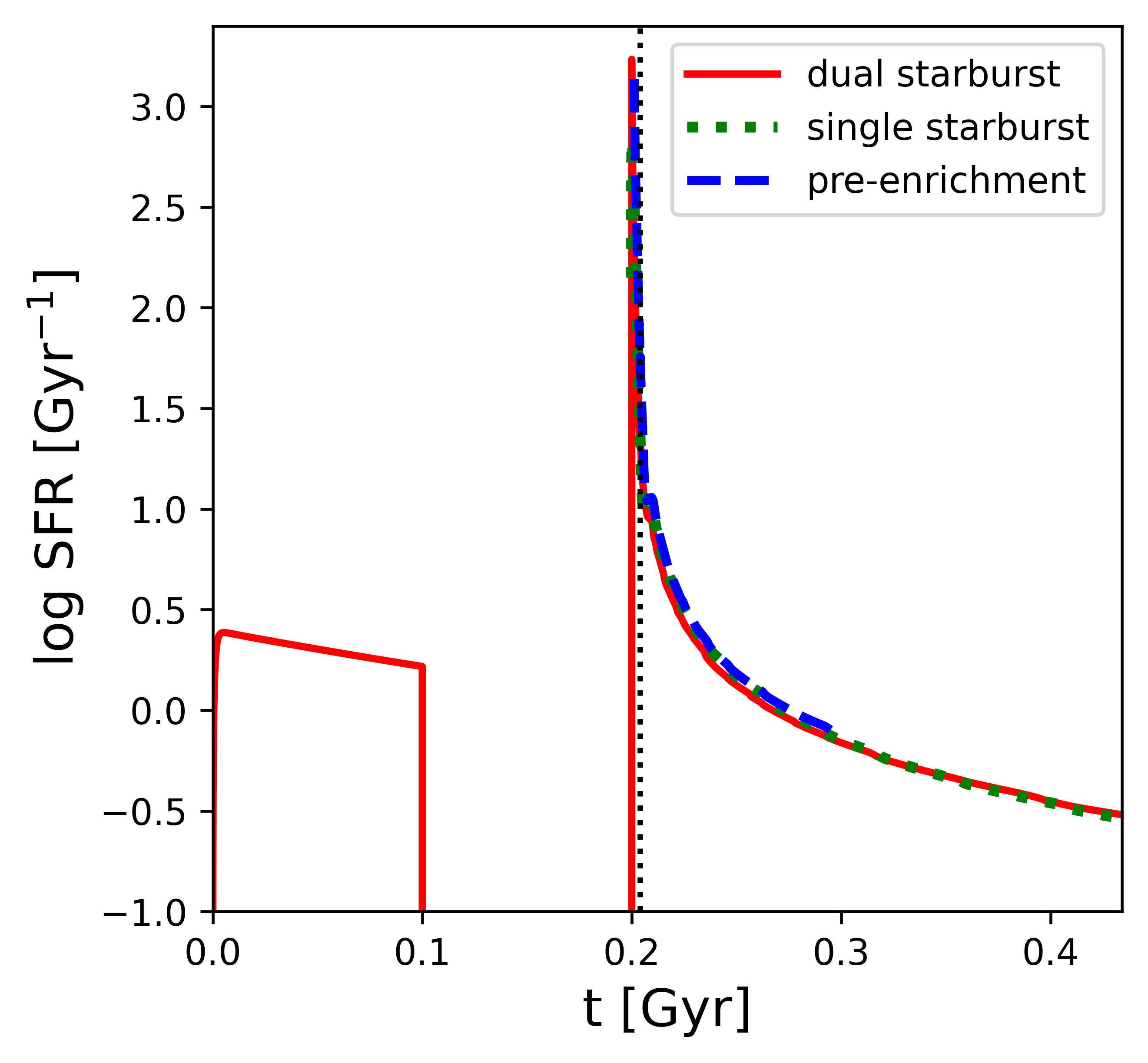
- 模拟两次分离的恒星爆发,中间间隔100 Myr的休眠期,以再现GN-z11中观测到的CNO比值。
- 纳入最高达120 M☉的沃尔夫-拉叶星的核合成产出,这些星体在爆发后阶段主导了富集过程。
- 测试多种配置:变化爆发持续时间、间隔时间及流入 timescales,以评估模型的鲁棒性。
- 将结果与含极高质量恒星和/或对不稳定超新星的单次爆发模型、以及预先富集情景进行对比。
- 预测同位素比值(如13C、18O)及其他元素丰度(F、Na、Al),以供未来观测验证。
实验结果
研究问题
- RQ1具有100 Myr休眠期的间歇性恒星形成能否再现GN-z11中观测到的超太阳N/O比值?
- RQ2第二次爆发产生的沃尔夫-拉叶星是否能解释GN-z11中观测到的氮、氟、钠和铝的增强?
- RQ3为何含极高质量恒星或对不稳定超新星的单次爆发模型无法匹配观测到的CNO比值?
- RQ4是否需要外部来源的预先富集来解释GN-z11中高金属度和高N/O比值?
- RQ5元素与同位素丰度模式能否作为反馈调节、随机恒星形成在早期星系中存在与否的诊断工具?
主要发现
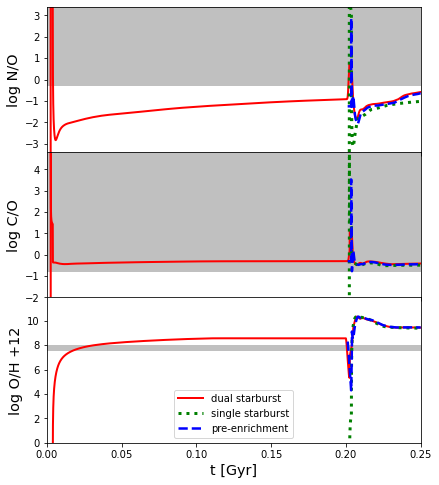
- GN-z11中观测到的CNO元素丰度比值可通过具有100 Myr休眠期的双爆发恒星形成历史成功再现,且与初始分群函数、核合成产出或超大质量恒星无关。
- 沃尔夫-拉叶星(最高达120 M☉)在第二次爆发后立即成为主要富集源,短期内增强氮、氟、钠、铝以及13C和18O等同位素。
- N/O比值在第二次爆发后不到1 Myr内达到峰值,表明这是一种短暂的化学特征,可能迅速被抹除。
- 含极高质量恒星或对不稳定超新星的单次爆发模型无法再现数据:VMS无法充分提升N/O比值,而PISNe反而降低N/O比值。
- 预先富集情景同样无法匹配观测结果,表明必须通过间歇性爆发实现内部富集。
- 该模型预测了高氟丰度,可通过ALMA进行检验,并支持辐射驱动星风的存在,这些星风可清除超早期星系中的尘埃。
更好的研究,从现在开始
从阅读论文到最终审阅,大幅缩短您的研究时间。
无需绑定信用卡
本解读由 AI 生成,并经人工编辑审核。