
[论文解读] Rapid Flood Inundation Forecast Using Fourier Neural Operator
该论文提出了一种基于傅里叶神经算子(FNO)的代理模型,通过学习水动力模拟的映射关系,实现快速、实时的洪水淹没预测。该FNO模型在休斯顿六次历史风暴事件上进行训练,相较于U-Net基线模型表现出更优的性能,在3小时预报提前量下保持高精度(CSI > 0.93),并在未经微调的情况下展现出对新地点的强大泛化能力。
Flood inundation forecast provides critical information for emergency planning before and during flood events. Real time flood inundation forecast tools are still lacking. High-resolution hydrodynamic modeling has become more accessible in recent years, however, predicting flood extents at the street and building levels in real-time is still computationally demanding. Here we present a hybrid process-based and data-driven machine learning (ML) approach for flood extent and inundation depth prediction. We used the Fourier neural operator (FNO), a highly efficient ML method, for surrogate modeling. The FNO model is demonstrated over an urban area in Houston (Texas, U.S.) by training using simulated water depths (in 15-min intervals) from six historical storm events and then tested over two holdout events. Results show FNO outperforms the baseline U-Net model. It maintains high predictability at all lead times tested (up to 3 hrs) and performs well when applying to new sites, suggesting strong generalization skill.
研究动机与目标
- 解决实时、高分辨率洪水淹没预测的迫切需求,以支持应急规划与风险缓解。
- 克服城市环境中高分辨率水动力建模(如二维浅水方程)带来的计算瓶颈。
- 开发一种数据驱动的代理模型,保持物理一致性,并在不同风暴事件和地点间实现泛化。
- 证明使用傅里叶神经算子(FNO)进行多提前时间洪水范围与深度预测的可行性。
- 与U-Net基线模型对比评估模型性能,并评估其在无微调情况下的跨域可迁移性。
提出的方法
- 在休斯顿六次历史风暴事件的15分钟时间序列模拟水深数据上训练FNO模型。
- 采用物理信息损失函数,对水深误差和空间梯度误差进行惩罚,以嵌入物理一致性。
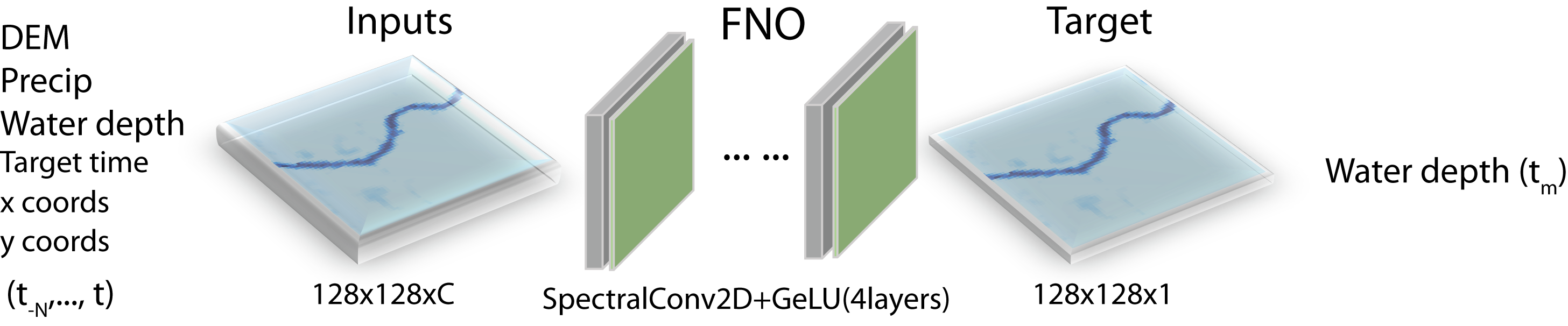
- 将静态地理空间特征(如数字高程模型)和动态输入(如降雨量、流量)作为多通道输入。
- 通过傅里叶变换实现谱卷积,高效学习无限维函数空间之间的映射。
- 采用12帧回看窗口(180分钟)获取时间上下文,同时通过消融实验研究更长回看(24帧)和仅降水输入的影响。
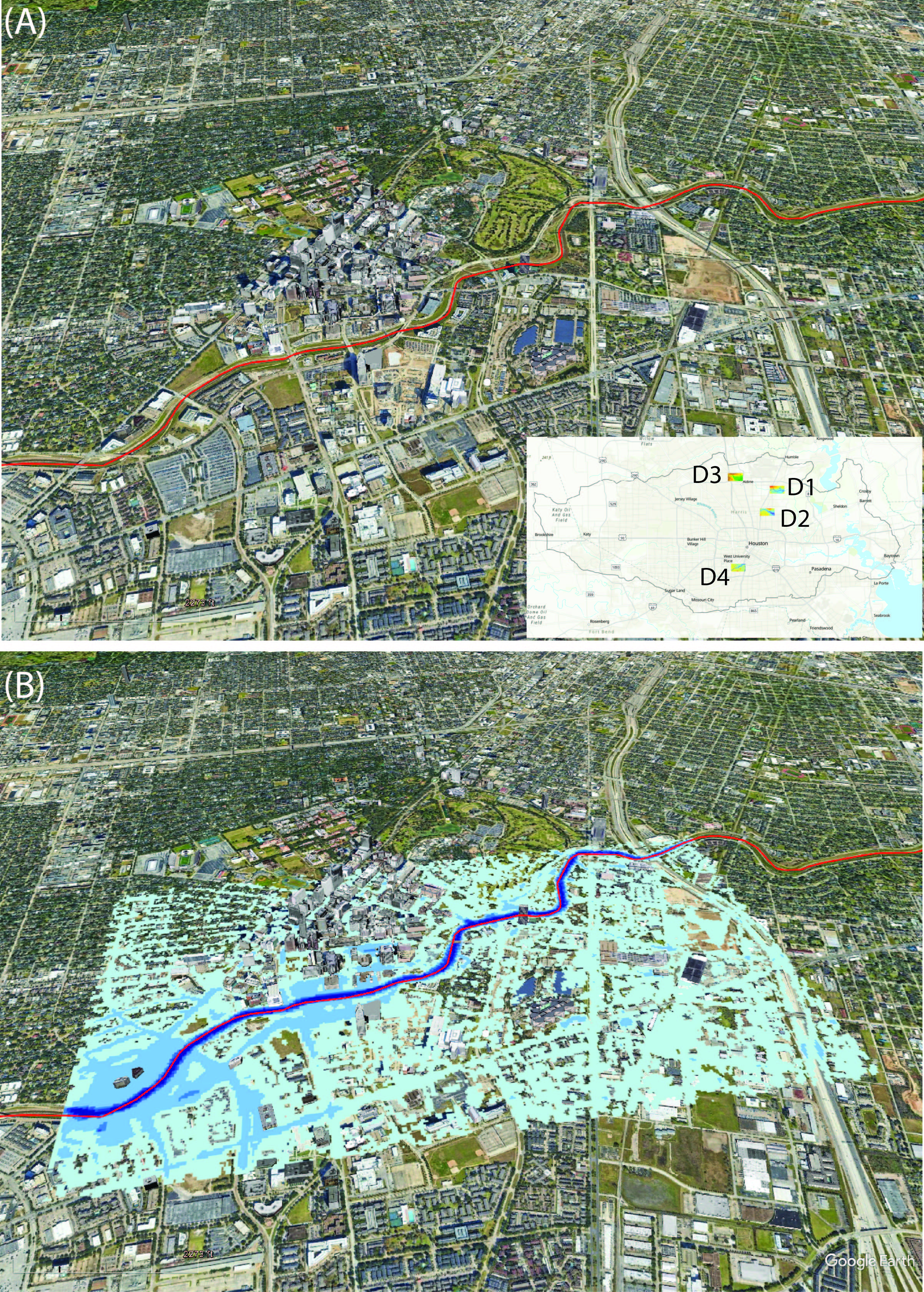
- 在多个领域(D1–D3)上预训练FNO,并将模型迁移至新领域(D4)以评估零样本泛化能力。
实验结果
研究问题
- RQ1基于FNO的代理模型能否在街道级分辨率下实现准确、实时的洪水淹没预测,并支持多提前时间预报?
- RQ2与U-Net基线相比,FNO模型在预测精度和推理效率方面表现如何?
- RQ3物理信息损失函数在多大程度上提升了模型的泛化能力和物理合理性?
- RQ4在相似领域上预训练的FNO模型能否在无微调情况下有效迁移到新的、未见过的城市区域?
- RQ5将前期水深而非仅降水作为输入,对模型性能有何影响?
主要发现
- 在2019/05/08事件中,FNO模型在15分钟提前量下达到CSI 0.9808和MAE 0.0044,优于U-Net基线模型(CSI: 0.9752,MAE: 0.0056)。
- 在3小时提前量下,FNO模型仍保持CSI 0.9324和MAE 0.0153,表现出在长提前时间下的稳定性能。
- 采用24帧回看(6小时)的FNO模型未提升性能,表明在此情境下更长记忆并无显著益处。
- 仅使用降水输入的FNO变体(FNO-12P)性能显著下降(15分钟时CSI: 0.4861),凸显前期水深输入的重要性。
- 多领域FNO模型(FNO-MD)在D1–D3上预训练后直接应用于D4(无微调),在15分钟时达到CSI 0.9659,180分钟时达到CSI 0.9032,展现出强大的零样本泛化能力。
- FNO模型的推理时间仅为每样本0.002秒,支持实时部署;在RTX 3090 GPU上,每轮训练耗时72秒。
更好的研究,从现在开始
从阅读论文到最终审阅,大幅缩短您的研究时间。
无需绑定信用卡
本解读由 AI 生成,并经人工编辑审核。