
[论文解读] Rateless Coding for MIMO Block Fading Channels
本文提出了一种用于MIMO块衰落信道的无速率编码方案,通过将单位长度的置换码转换为可变速率码,实现了香农容量-复 multiplexing tradeoff (DMT) 性能极限。结果表明,在低复 multiplexing 增益时,无速率码相比传统方案具有更高的有效复 multiplexing 增益,但当速率超过某一阈值后性能开始下降。
In this paper the performance limits and design principles of rateless codes over fading channels are studied. The diversity-multiplexing tradeoff (DMT) is used to analyze the system performance for all possible transmission rates. It is revealed from the analysis that the design of such rateless codes follows the design principle of approximately universal codes for parallel multiple-input multiple-output (MIMO) channels, in which each sub-channel is a MIMO channel. More specifically, it is shown that for a single-input single-output (SISO) channel, the previously developed permutation codes of unit length for parallel channels having rate LR can be transformed directly into rateless codes of length L having multiple rate levels (R, 2R, . . ., LR), to achieve the DMT performance limit.
研究动机与目标
- 分析有限块长衰落信道中无速率码的分集-复 multiplexing tradeoff (DMT) 性能。
- 确定无速率码在复 multiplexing 增益与分集增益方面是否优于传统固定速率编码方案。
- 确定在无需瞬时信道状态信息(CSI)于发射端的条件下,实现DMT性能极限的无速率码设计原则。
- 揭示码设计参数(L, rₙ)与有效系统复 multiplexing 增益 r 之间的关系。
- 提出一类新型无速率码,结合MIMO空时码与并行信道码,适用于衰落信道。
提出的方法
- 将先前为并行信道设计的单位长度置换码转换为具有多个速率层级(R, 2R, ..., LR)的L长度无速率码。
- 采用分集-复 multiplexing tradeoff (DMT) 作为性能度量,通过信噪比(SNR)趋于无穷时的误码率与速率极限来定义。
- 应用Fano不等式推导误码率的下界,并利用渐近分析(虚线等号 ≲)刻画分集阶数。
- 将误码率表示为各块中译码失败事件的总和,每一块对整体中断与误码概率均有贡献。
- 通过证明在任意衰落分布下误码率均呈指数衰减,建立近似通用性,从而确保在各种信道条件下具有鲁棒性能。
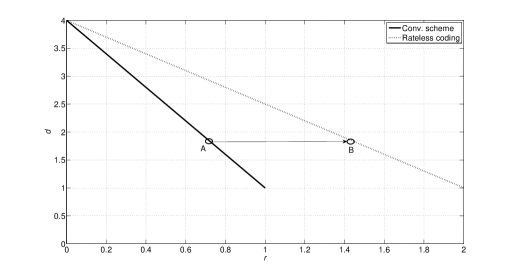
- 推导出低rₙ时的有效复 multiplexing 增益为r = L·rₙ,而当rₙ较高时,其退化为r = L·rₙ / k,其中k为译码所需块数。
实验结果
研究问题
- RQ1在有限块长的MIMO块衰落信道中,无速率码的DMT性能极限是什么?
- RQ2在不同速率范围内,无速率码的有效复 multiplexing 增益与传统固定速率码相比如何?
- RQ3无速率码是否可在不依赖发射端瞬时CSI的条件下实现DMT性能极限?
- RQ4块数L对系统复 multiplexing 增益与分集增益有何影响?
- RQ5码设计参数(L与rₙ)如何影响有效复 multiplexing 增益r与系统的DMT曲线?
主要发现
- 当低复 multiplexing 增益满足rₙ < min(M,N)/L时,无速率码可实现有效复 multiplexing 增益r = L·rₙ,且分集增益为f(rₙ),与DMT性能极限一致。
- 当rₙ超过min(M,N)/L时,有效复 multiplexing 增益退化为r = L·rₙ / k(k ≥ 2),这是由于译码延迟与误码率增加所致。
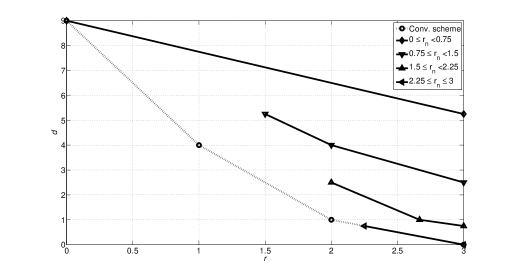
- 系统DMT曲线为分段函数,在区间r ∈ [(k-1)min(M,N)/k, min(M,N))内,分集阶数为f(r·k/L),其中k = 1, 2, ..., L。
- 增加L可改善整体DMT曲线,但对固定rₙ而言,并不总是提升复 multiplexing 增益,尤其在高码率时更为明显。
- 无速率码可设计为传统MIMO空时码与近似通用并行信道码的组合,从而实现最优DMT性能。
- 所提出的无速率码具有近似通用性,其误码率衰减为e^(-η^δ),确保在各类衰落分布下均具备鲁棒性。
更好的研究,从现在开始
从阅读论文到最终审阅,大幅缩短您的研究时间。
无需绑定信用卡
本解读由 AI 生成,并经人工编辑审核。