
[论文解读] Real-time chaotic video encryption based on multithreaded parallel confusion and diffusion
本文提出一种基于多线程并行置乱与扩散的实时混沌视频加密方案,实现高速、安全的视频加密。通过将视频帧划分为子帧,并在多个线程上同时处理,该方法在标准CPU上实现了24 FPS下5轮置乱-扩散操作,达到迄今为止多轮混沌视频加密的最高速度,同时保持了强大的安全性和对噪声及数据丢失的鲁棒性。
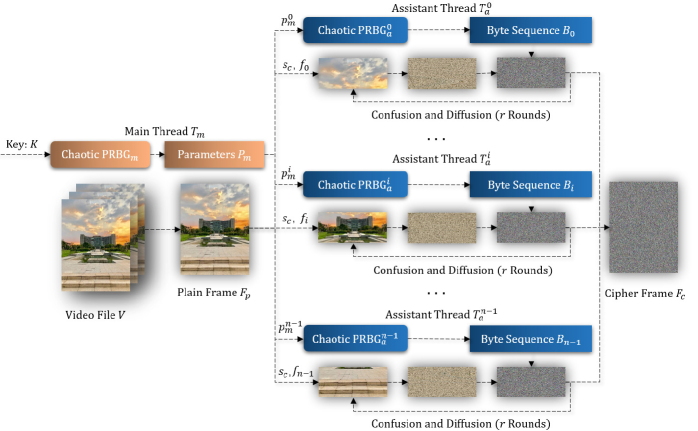
Due to the strong correlation between adjacent pixels, most image encryption schemes perform multiple rounds of confusion and diffusion to protect the image against attacks. Such operations, however, are time-consuming, cannot meet the real-time requirements of video encryption. Existing works, therefore, realize video encryption by simplifying the encryption process or encrypting specific parts of video frames, which results in lower security compared to image encryption. To solve the problem, this paper proposes a real-time chaotic video encryption strategy based on multithreaded parallel confusion and diffusion. It takes a video as the input, splits the frame into subframes, creates a set of threads to simultaneously perform five rounds of confusion and diffusion operations on corresponding subframes, and efficiently outputs the encrypted frames. The encryption speed evaluation shows that our method significantly improves the confusion and diffusion speed, realizes real-time 480x480, 576x576, and 768x768 24FPS video encryption using Intel Core i5-1135G7, Intel Core i7-8700, and Intel Xeon Gold 6226R, respectively. The statistical and security analysis prove that the deployed cryptosystems have outstanding statistical properties, can resist attacks, channel noise, and data loss. Compared with existing works, to the best of our knowledge, the proposed strategy achieves the fastest encryption speed, and realizes the first real-time chaotic video encryption that reaches the security level of image encryption. In addition, it is suitable for many confusion, diffusion algorithms and can be easily deployed with both hardware and software.
研究动机与目标
- 解决缺乏在多轮置乱-扩散过程中保持高安全性的实时、安全视频加密方案的问题。
- 克服传统多轮图像加密方法在应用于视频时因速度过慢而无法实现实时处理的性能瓶颈。
- 开发一种可扩展、高效的视频加密框架,利用并行计算加速字节生成、置乱与扩散操作。
- 确保所提出的系统具备强统计特性,并能有效抵抗常见攻击、噪声和数据丢失,达到或超过图像加密标准。
- 通过在多种硬件平台上实现与评估,证明多轮混沌加密在视频应用中的可行性与优越性。
提出的方法
- 将视频分割为子帧,以支持在多个线程上并行处理。
- 每个线程独立执行五轮置乱与扩散操作,利用混沌系统生成加密密钥并修改像素值。
- 通过伪随机比特生成器(PRBG)生成的混沌序列对像素位置进行置乱。
- 通过迭代五轮的XOR操作与混沌字节序列修改像素值,实现扩散。
- 该方法兼容多种混沌映射及置乱/扩散技术,支持在软件与硬件平台(如FPGA、ARM)中灵活集成。
- 在Intel Core i5-1135G7、i7-8700和Xeon Gold 6226R处理器上,使用480×480、576×576和768×768视频分辨率在24 FPS下进行性能评估。
实验结果
研究问题
- RQ1能否通过并行计算使多轮置乱-扩散架构在实时视频加密中具备实用性?
- RQ2所提出的并行多线程方法相比串行或单轮方法,在加密速度方面有何提升?
- RQ3该系统在多大程度上保持了优良的统计特性,并能有效抵抗已知攻击、噪声与数据丢失?
- RQ4所提出的方法是否具备可扩展性,并兼容不同混沌映射及实现平台(软件/硬件)?
- RQ5在标准CPU上实现实时性能(即<1000/24 ≈ 41.67 ms)所需的每帧平均加密时间最低为多少?
主要发现
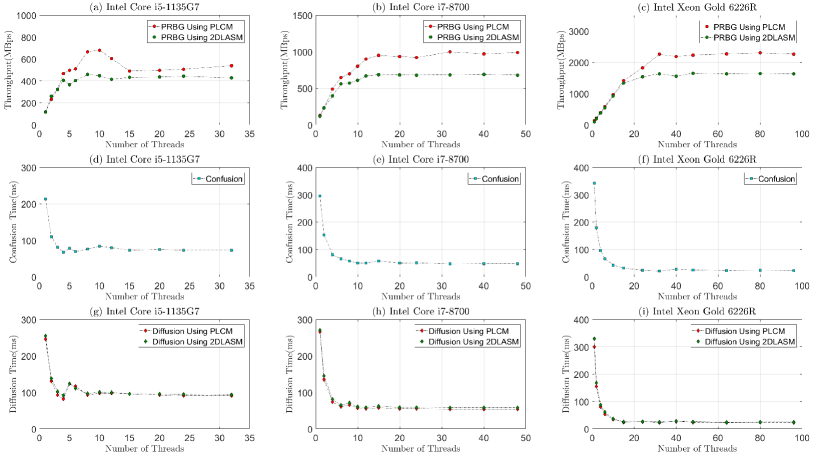
- 所提方法在Intel Core i5-1135G7、i7-8700和Xeon Gold 6226R处理器上,分别实现了480×480、576×576和768×768分辨率下的实时24 FPS视频加密。
- 在i5-1135G7处理器上,480×480分辨率下的每帧平均加密时间分别为36.26 ms(PLCM)和35.49 ms(2DLASM),满足实时阈值<1000/24 ≈ 41.67 ms的要求。
- 统计分析表明,加密输出具有优异的均匀性与随机性,NPCR与UACI值高,符合强扩散特性。
- 系统对差分攻击、信道噪声和数据丢失表现出强健性,在恶劣条件下仍保持高安全性。
- 该方法是首个实现基于五轮置乱-扩散架构的实时混沌视频加密,其速度与安全性均优于先前工作。
- 该方法具有高度可扩展性,支持多种混沌映射及置乱/扩散技术,且可在ARM、FPGA等软件与硬件平台中实现。
更好的研究,从现在开始
从阅读论文到最终审阅,大幅缩短您的研究时间。
无需绑定信用卡
本解读由 AI 生成,并经人工编辑审核。