
[论文解读] Real-time End-to-End Federated Learning: An Automotive Case Study
本文提出了一种异步、实时端到端联邦学习框架,适用于自动驾驶场景,采用滑动窗口与基于版本的聚合机制,在异构边缘设备上实现高效、隐私保护的模型训练。与集中式学习相比,训练速度提升70%,带宽使用降低60%,预测准确率与同步联邦学习及集中式方法相当或更优。
With the development and the increasing interests in ML/DL fields, companies are eager to apply Machine Learning/Deep Learning approaches to increase service quality and customer experience. Federated Learning was implemented as an effective model training method for distributing and accelerating time-consuming model training while protecting user data privacy. However, common Federated Learning approaches, on the other hand, use a synchronous protocol to conduct model aggregation, which is inflexible and unable to adapt to rapidly changing environments and heterogeneous hardware settings in real-world scenarios. In this paper, we present an approach to real-time end-to-end Federated Learning combined with a novel asynchronous model aggregation protocol. Our method is validated in an industrial use case in the automotive domain, focusing on steering wheel angle prediction for autonomous driving. Our findings show that asynchronous Federated Learning can significantly improve the prediction performance of local edge models while maintaining the same level of accuracy as centralized machine learning. Furthermore, by using a sliding training window, the approach can minimize communication overhead, accelerate model training speed and consume real-time streaming data, proving high efficiency when deploying ML/DL components to heterogeneous real-world embedded systems.
研究动机与目标
- 为解决同步联邦学习在真实世界异构边缘环境中的不灵活性,特别是在设备能力与网络条件多变的车载系统中。
- 实现在边缘设备流数据上无需集中原始数据的实时、端到端机器学习模型训练,保护隐私。
- 通过用异步协议替代同步聚合,提升训练效率与可扩展性,以适应设备异构性与动态工作负载。
- 在真实世界车载应用场景——方向盘转角预测中验证该方法,证明其性能与集中式学习相当,优于同步联邦学习。
- 通过采用滑动窗口机制处理流数据,降低通信开销与训练时间。
提出的方法
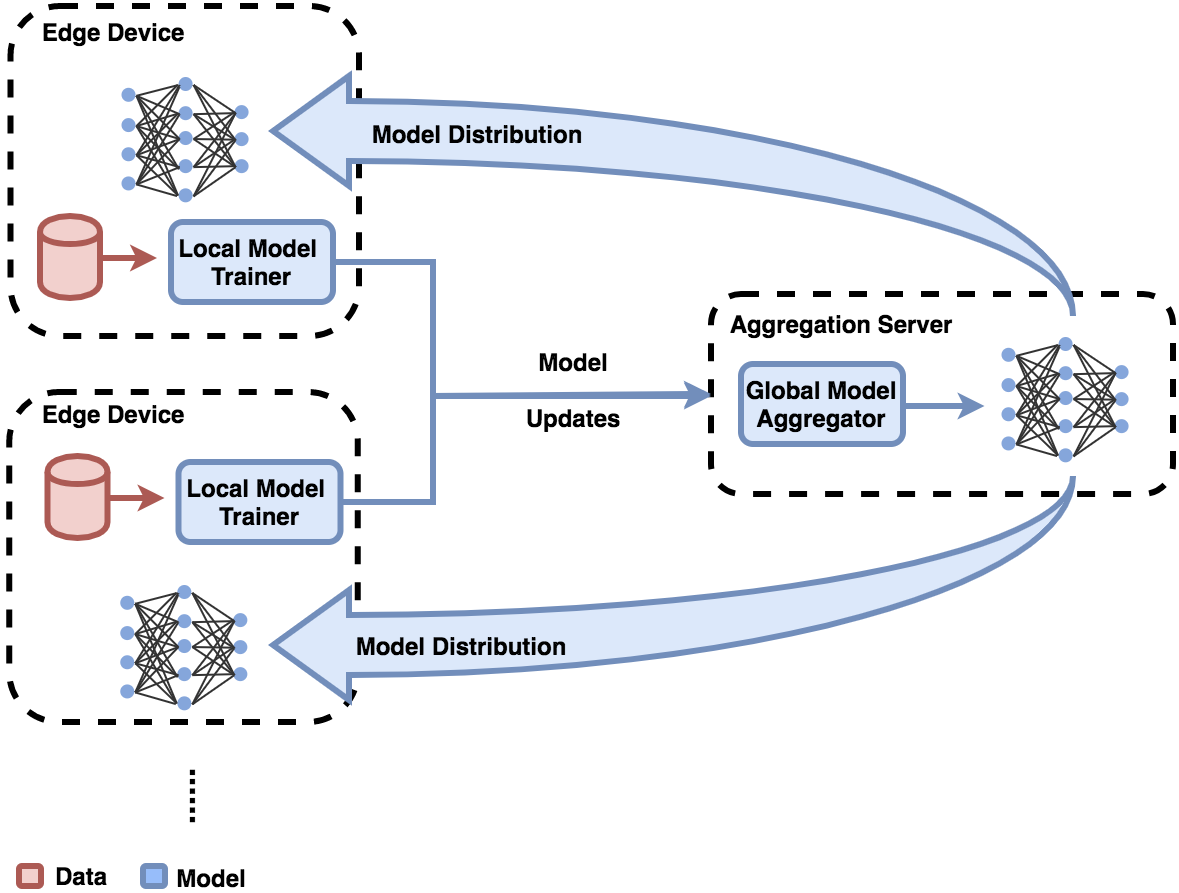
- 该方法采用基于版本的异步模型聚合协议,使服务器可在设备更新到达时立即接收,无需等待所有设备完成。
- 使用滑动窗口机制处理实时流数据,最小化存储需求,支持持续模型训练。
- 采用双流3D-CNN模型端到端训练,直接从视频输入预测方向盘转角,充分利用时空特征。
- 系统采用混合训练架构:配备GPU(V100和T4)的边缘车辆本地训练,服务器基于版本化更新异步聚合模型。
- 聚合协议受下限频率阈值(a_l)和上限频率阈值(a_u)约束,以控制更新频率并减少通信开销。
- 模型更新以压缩的权重向量形式传输,相比完整模型传输显著降低带宽成本。
实验结果
研究问题
- RQ1在自动驾驶场景中,采用实时流数据的异步联邦学习能否实现与集中式学习相当或更优的预测准确率?
- RQ2与同步联邦学习及集中式训练相比,所提出的异步聚合协议在训练速度与通信效率方面表现如何?
- RQ3滑动窗口机制在边缘模型训练中在多大程度上减少了存储与通信开销?
- RQ4在真实车载部署中,系统如何应对设备异构性与多变的网络条件?
- RQ5在分布式实时环境中,基于版本的聚合协议对收敛速度与模型性能有何影响?
主要发现
- 与集中式学习相比,异步联邦学习将总训练时间减少了约70%,收敛速度比基线模型快70%。
- 与集中式学习相比,该方法将带宽消耗减少了约60%,四辆车辆间仅传输了0.78 GB数据。
- 异步方法的回归误差比同步联邦学习低0.2–0.4,表明其预测性能更优。
- 模型准确率与集中式学习及同步联邦学习相当或更优,证明在分布式训练下仍能实现性能对等。
- 滑动窗口机制实现了对实时流数据的高效处理,无需在单个边缘设备上存储大规模数据。
- 在训练效率与收敛速度方面,系统优于同步联邦学习与本地独立训练。

更好的研究,从现在开始
从阅读论文到最终审阅,大幅缩短您的研究时间。
无需绑定信用卡
本解读由 AI 生成,并经人工编辑审核。