
[论文解读] REBELS-IFU: Dust Build-up in Massive Galaxies at Redshift 7
本论文利用 JWST/NIRSpec 金属丰度与 ALMA 尘埃与气体测量,分析 z~6.5–7.7 的12个 REBELS 星系中的尘埃、气体与金属含量,以约束早期宇宙中的尘埃与气-尘比、尘埃与金属比、尘埃与恒星质量比的关系。
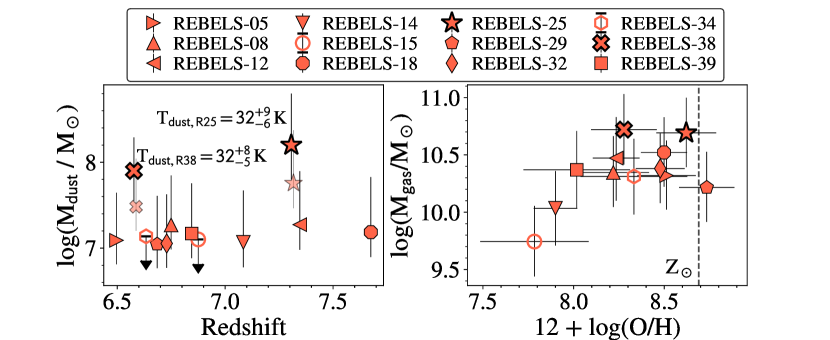
In recent years, observations with the JWST have started to map out the rapid metal enrichment of the early Universe, while (sub)millimeter observations have simultaneously begun to reveal the ubiquity of dust beyond $z\gtrsim6$. However, the pathways that led to the assembly of early dust reservoirs remain poorly quantified, and require pushing our understanding of key scaling relations between dust, gas and metals into the early Universe. We investigate the dust build-up in twelve $6.5 \lesssim z \lesssim 7.7$ galaxies drawn from the REBELS survey that benefit from (i) JWST/NIRSpec strong-line metallicity measurements, (ii) ALMA [CII]-based redshifts and gas masses, and (iii) dust masses from single- or multi-band ALMA continuum observations. Combining these measurements, we investigate the dust-to-gas (DtG), dust-to-metal (DtM), and dust-to-stellar mass (DtS) ratios of our sample as a function of metallicity. While our analysis is limited by systematic uncertainties related to the [CII]-to-H$_2$ conversion factor and dust temperature, we explore a wide range of possible values, and carefully assess their impact on our results. Under a fiducial set of assumptions, we find an average $\log(\mathrm{DtG}) = -3.02 \pm 0.23$, only slightly below that of local metal-rich galaxies. On the other hand, at fixed metallicity our average $\log(\mathrm{DtS}) = -2.15 \pm 0.42$ is significantly larger than that of low-redshift galaxies. Finally, through a comparison to various theoretical models of high-redshift dust production, we find that assembling the dust reservoirs in massive galaxies at $z\approx7$ likely requires the combination of rapid supernova enrichment and efficient ISM dust growth.
研究动机与目标
- 在使用联合 JWST/NIRSpec 和 ALMA 数据的前提下,量化 z>6 的大质量星系的尘埃、气体与金属含量。
- 检查尘埃-气体、尘埃-金属、尘埃-恒星质量之比随金属丰度的标度关系。
- 评估 SN 富集与 ISM 尘埃增长在产生早期尘埃储备中的作用。
- 在合理的参数范围内评估系统性不确定性,包括 [C II]-to-H2 转换与尘埃温度等因素。
提出的方法
- 将 ALMA 的 [C II]-基于气体质量与来自连续观测的尘埃质量结合起来,推导 DtG、DtM、DtS 比率。
- 使用 Zanella et al. (2018) 的 [C II]-to-H2 标定将 [C II] 光度转化为分子气体质量。
- 采用 JWST/NIRSpec 的强线诊断(R23、O32、R3 在适用时)得到的金属丰度,并与替代标定进行交叉检验。
- 在一个基准假设集合下计算尘埃-气体、尘埃-金属、尘埃-恒星质量比,并探索广泛的尘埃温度及其他不确定参数的影响。
- 假设分子气体在早期星系中为主导气体成分( HI 可忽略),并检视对尘埃生长模型的含义。
实验结果
研究问题
- RQ1z~6.5–7.7 星系的观测到的 DtG、DtM、DtS 比率是什么,它们如何随气体相金属丰度标度?
- RQ2快速的 SN 富集与 ISM 尘埃增长能否共同解释早期大型星系推断的尘埃储备?
- RQ3关于 [C II]-to-H2 转换、尘埃温度与尘埃性质的假设如何影响推断的尘埃标度关系?
- RQ4观测到的尘埃和金属含量是否倾向于某些高红移尘埃产生理论模型而非其他?
主要发现
- 平均 DtG 约为 log(DtG) ≈ -3.02,散度约 ≈0.23 dex,略低于本地富金属星系。
- 在固定金属度下的平均 DtS 约为 log(DtS) ≈ -2.15,散度约 ≈0.42 dex,高于典型的低红移星系。
- DtM 与 DtS 关系表明这些 z~7 系统中尘埃相对于金属含量的质量占比较大,暗示尘埃处理效率较高。
- 结果对 [C II]-to-H2 转换与假定尘埃温度仍然敏感;进行了广泛参数探索以量化影响。
- 与理论模型的比较表明,需要快速的 SN 富集与高效的 ISM 尘埃增长的组合,才能在 z~7 前构建观测到的尘埃储备。
![Figure 2: The effect of the adopted $\alpha_{\text{[C\,{\sc ii}]{}}}$ and $T_{\mathrm{dust}}$ on the inferred dust-to-gas ratio of a hypothetical galaxy at the median redshift ( $z=6.8$ ) and [C ii ] luminosity [ $\log(L_{\text{[C\,{\sc ii}]{}}}/L_{\odot})=8.9$ ] of our sample. The thickest contour](https://ar5iv.labs.arxiv.org/html/2501.10508/assets/x2.png)
更好的研究,从现在开始
从论文设计到论文写作,大幅缩短您的研究时间。
无需绑定信用卡
本解读由 AI 生成,并经人工编辑审核。