
[论文解读] Recent Advances in Deep Learning Based Dialogue Systems: A Systematic Survey
对基于深度学习的对话系统的全面综述,按模型类型和系统类别分析模型,并覆盖评估方法与数据集,洞察未来趋势。
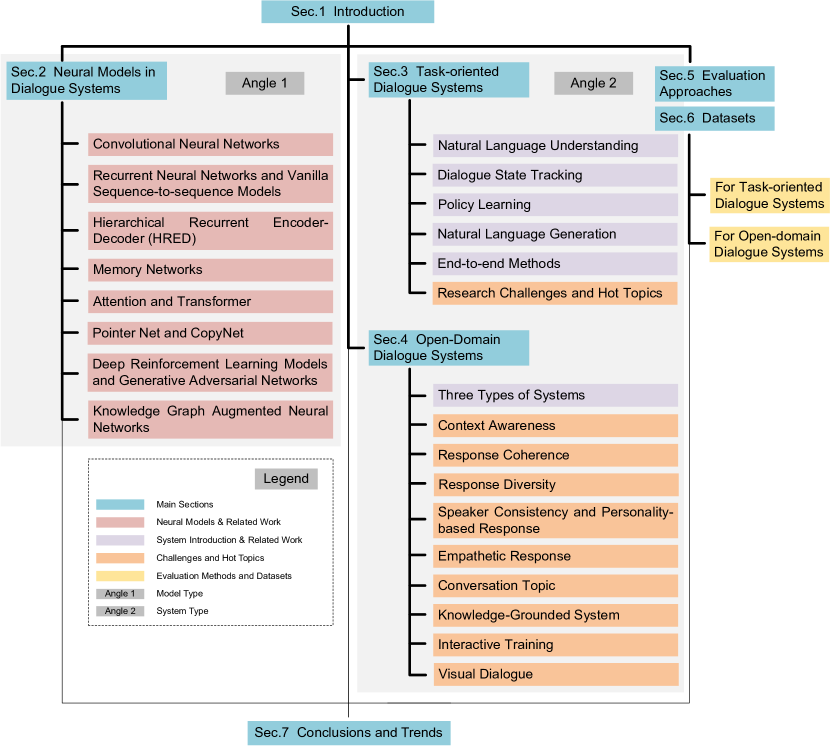
Dialogue systems are a popular natural language processing (NLP) task as it is promising in real-life applications. It is also a complicated task since many NLP tasks deserving study are involved. As a result, a multitude of novel works on this task are carried out, and most of them are deep learning based due to the outstanding performance. In this survey, we mainly focus on the deep learning based dialogue systems. We comprehensively review state-of-the-art research outcomes in dialogue systems and analyze them from two angles: model type and system type. Specifically, from the angle of model type, we discuss the principles, characteristics, and applications of different models that are widely used in dialogue systems. This will help researchers acquaint these models and see how they are applied in state-of-the-art frameworks, which is rather helpful when designing a new dialogue system. From the angle of system type, we discuss task-oriented and open-domain dialogue systems as two streams of research, providing insight into the hot topics related. Furthermore, we comprehensively review the evaluation methods and datasets for dialogue systems to pave the way for future research. Finally, some possible research trends are identified based on the recent research outcomes. To the best of our knowledge, this survey is the most comprehensive and up-to-date one at present for deep learning based dialogue systems, extensively covering the popular techniques. We speculate that this work is a good starting point for academics who are new to the dialogue systems or those who want to quickly grasp up-to-date techniques in this area.
研究动机与目标
- 评估对话系统中的最前沿深度学习方法。
- 从模型类型和系统类型的角度分析对话模型。
- 综述对话系统研究中使用的评估方法和数据集。
- 识别该领域的新兴研究趋势与潜在方向。
提出的方法
- 调查了神经网络结构(卷积神经网络 CNNs、循环神经网络 RNNs、序列到序列 seq2seq、层次化对话 HRED、memory networks、注意力、Transformer、GANs、KG增强网络)。
- 讨论了传统的任务导向对话系统与端到端对话系统以及开放域对话系统。
- 评审了对话系统的评估指标和数据集。
- 整合相关对话任务和跨领域联系,以将当前方法置于背景中。
- 确定了热议话题和潜在未来方向,如领域自适应、效率、可控生成,以及多模态/对话对齐的设置。
实验结果
研究问题
- RQ1在任务导向和开放域对话系统中,当前占主导地位的深度学习模型有哪些?
- RQ2任务导向与开放域对话系统的架构与优化是如何进行的,包括端到端与模块化管道?
- RQ3用于评估对话系统的方法和数据集有哪些,它们的局限性是什么?
- RQ4最近的深度学习对话系统文献提出了哪些趋势和未来方向?
主要发现
- 该综述全面覆盖了在对话系统中广泛使用的神经网络体系结构及其应用。
- 它分析了任务导向和开放域对话系统范式及其向端到端设计的演变。
- 强调了记忆网络、层次模型和知识驱动的方法作为融合外部信息的关键技术。
- 总结了对话系统的评估方法和数据集生态系统,为将来基准测试提供指导。
- 作者指出了诸如领域自适应、效率提升、可控生成以及多模态对话研究等新兴趋势。
更好的研究,从现在开始
从论文设计到论文写作,大幅缩短您的研究时间。
无需绑定信用卡
本解读由 AI 生成,并经人工编辑审核。