
[论文解读] Recipe recommendation using ingredient networks
本文提出了一种食谱推荐系统,利用食材网络——互补网络(用于捕捉共现食材)和替代网络(用于捕捉用户建议的食材替换)——来预测食谱评分。通过将这些网络的结构特征与营养数据结合,该模型实现了0.792的预测准确率,其中84%的预测能力仅来自食材网络本身。
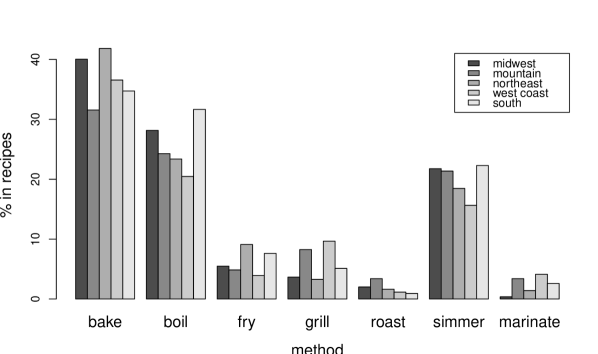
The recording and sharing of cooking recipes, a human activity dating back thousands of years, naturally became an early and prominent social use of the web. The resulting online recipe collections are repositories of ingredient combinations and cooking methods whose large-scale and variety yield interesting insights about both the fundamentals of cooking and user preferences. At the level of an individual ingredient we measure whether it tends to be essential or can be dropped or added, and whether its quantity can be modified. We also construct two types of networks to capture the relationships between ingredients. The complement network captures which ingredients tend to co-occur frequently, and is composed of two large communities: one savory, the other sweet. The substitute network, derived from user-generated suggestions for modifications, can be decomposed into many communities of functionally equivalent ingredients, and captures users' preference for healthier variants of a recipe. Our experiments reveal that recipe ratings can be well predicted with features derived from combinations of ingredient networks and nutrition information.
研究动机与目标
- 通过分析大规模在线食谱集合中的食材关系,建立用户在食谱选择中的偏好模型。
- 从用户生成的内容中识别食材共现模式(互补网络)和用户建议的替换模式(替代网络)。
- 利用食材网络的结构特征与营养信息,开发食谱评分的预测模型。
- 评估食材网络与营养数据在预测食谱受欢迎程度中的相对贡献。
- 通过识别可修改的食材和基于用户行为的健康替代方案,实现智能食谱推荐。
提出的方法
- 从Allrecipes.com(一个大规模食谱分享网站)提取食材列表和用户评论。
- 基于食谱中食材的频繁共现关系构建互补网络,揭示出两个主导社区:咸味和甜味。
- 基于用户生成的修改建议(例如“用碎火鸡代替牛肉”)构建替代网络,识别出功能等价的食材社区。
- 应用奇异值分解(SVD)降低网络特征的维度,通过交叉验证确定最优k=50。
- 将互补网络、替代网络和营养网络的SVD降维后特征合并为单个特征向量,用于食谱评分预测。
- 使用组合特征集训练回归模型预测食谱评分,并通过相关性分析和相对重要性分析评估性能。
实验结果
研究问题
- RQ1在线食谱中的食材共现模式在多大程度上反映了地域性或基于口味的偏好?
- RQ2用户建议的食材替换在多大程度上揭示了功能等价性以及健康意识的偏好?
- RQ3与传统的营养特征相比,食材网络的结构特征是否能更有效地预测食谱评分?
- RQ4在互补网络、替代网络和营养网络中,哪一类网络对评分预测准确率的贡献最大?
- RQ5食材网络的降维表示在多大程度上提升了泛化能力和预测性能?
主要发现
- 互补网络(捕捉频繁共现的食材)形成了两个主导社区:一个为咸味,一个为甜味,反映出基于口味的分组特征。
- 替代网络揭示了多个功能等价的食材社区,如甜味剂和油类,反映出用户对更健康或更易获取替代品的偏好。
- 通过结合食材网络和营养数据的特征,食谱评分的预测准确率达到0.792。
- 仅食材网络就贡献了84%的预测能力,优于营养数据,表明共现与替换模式编码了显著的偏好信号。
- 仅互补网络的预测性能优于单独使用替代网络或营养网络,尤其在低维特征情况下表现更优。
- 替代网络的前五个SVD分量突出了关键社区(如甜味剂和油类替代品),其特征对评分预测具有高度信息量。
更好的研究,从现在开始
从阅读论文到最终审阅,大幅缩短您的研究时间。
无需绑定信用卡
本解读由 AI 生成,并经人工编辑审核。