
[论文解读] ReContrast: Domain-Specific Anomaly Detection via Contrastive Reconstruction
ReContrast 将编码器和解码器联合优化,以实现领域特定的异常检测,通过在特征重构中嵌入对比学习元素,提高从预训练自然图像编码器到工业与医疗UAD任务的迁移。
Most advanced unsupervised anomaly detection (UAD) methods rely on modeling feature representations of frozen encoder networks pre-trained on large-scale datasets, e.g. ImageNet. However, the features extracted from the encoders that are borrowed from natural image domains coincide little with the features required in the target UAD domain, such as industrial inspection and medical imaging. In this paper, we propose a novel epistemic UAD method, namely ReContrast, which optimizes the entire network to reduce biases towards the pre-trained image domain and orients the network in the target domain. We start with a feature reconstruction approach that detects anomalies from errors. Essentially, the elements of contrastive learning are elegantly embedded in feature reconstruction to prevent the network from training instability, pattern collapse, and identical shortcut, while simultaneously optimizing both the encoder and decoder on the target domain. To demonstrate our transfer ability on various image domains, we conduct extensive experiments across two popular industrial defect detection benchmarks and three medical image UAD tasks, which shows our superiority over current state-of-the-art methods.
研究动机与目标
- 解决冻结的 ImageNet 编码器向目标 UAD 领域(工业/医疗)转移能力差的问题。
- 提出对编码器和解码器进行端到端训练,结合对比重构,以减少对自然图像的偏见。
- 将对比学习要素(全局余弦距离、停止梯度、两视图表示)整合到特征重构中。
- 通过困难挖掘和无增强对比对来缓解训练不稳定性和模式崩塌。
- 在工业和医疗 UAD 基准上展示优越的性能。
提出的方法
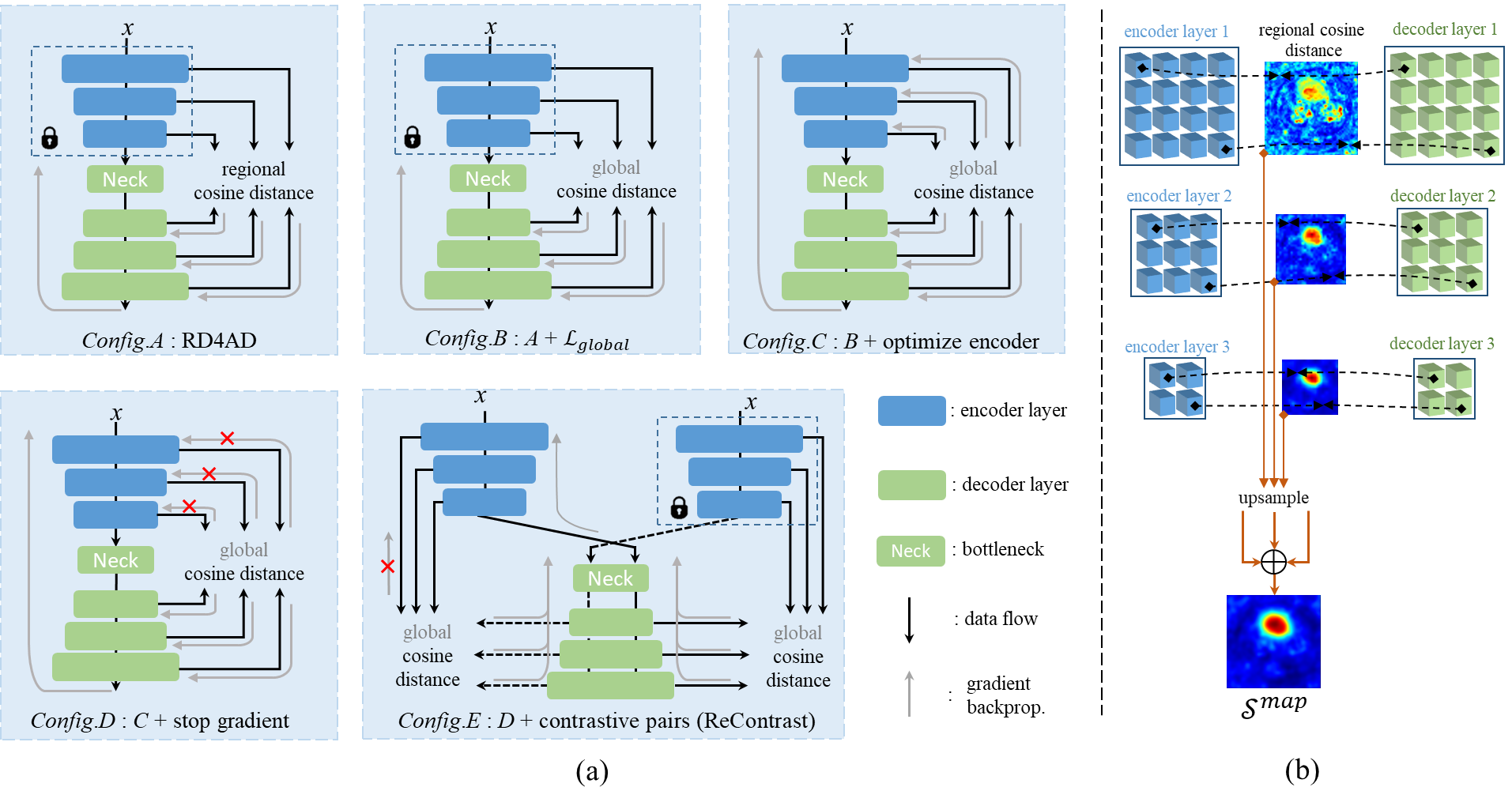
- 以特征重构基线(RD4AD)为出发点,并将三种受对比学习启发的要素整合到训练中。
- 引入全局余弦距离目标以模拟 GAP,同时保持逐点对应。
- 在全局余弦损失中应用 stop-gradient,以防止特征图层级崩溃。
- 利用领域自适应编码器和冻结编码器在不使用图像增强的情况下创建两视图表示,以形成跨视图重构。
- 添加困难挖掘策略(L_global-hm),以将训练聚焦于困难的正常区域,并拓宽认知/本征误差之比。
- 展示对编码器和解码器的端到端优化,以适应目标域同时避免简单解。
![Figure 1: Comparison of architectures. (a) Contrastive learning [ 16 ; 17 ] . (b) Feature reconstruction UAD [ 2 ; 9 ] . (c) Proposed ReContrast. Two decoders share the same weights. z is the output of encoder. q is the output of predictor or decoder. z’ and q’ is another view of z and q, respective](https://ar5iv.labs.arxiv.org/html/2306.02602/assets/figure1.png)
实验结果
研究问题
- RQ1对编码器和解码器进行端到端优化是否能够克服预训练自然图像特征与目标 UAD 领域之间的域间差距?
- RQ2全局与区域余弦距离目标如何影响训练稳定性和异常检测性能?
- RQ3引入 stop-gradient 和无增强对比对是否能防止模式崩塌并提高迁移性?
- RQ4硬-正常挖掘是否能改善 UAD 中 epistemic 与 intrinsic 重构误差的分离?
主要发现
- 在工业 UAD 上达到高图像级 AUROC:在 MVTec AD 上达到 99.5% 的 I-AUROC,将之前的最好错误约减少一半(相对降至 0.5%)。
- 在 MVTec AD 上使用 P-AUROC 与 AUPRO 指标实现最先进的异常分割性能(AUPRO 95.2%)。
- 在 VisA 上达到 I-AUROC 97.5%(比 SOTA 高出 1.5%),AUPRO 92.6%(比 PatchCore 高出 1.3–1.4%)。
- 统一多类设置在 MVTec AD 上实现 I-AUROC 98.2%(对比 UniAD 的 96.5%),在 VisA 上实现 95.1%(对比 RD4AD 基线的 UniAD 91.5%)。
- 医疗影像结果在 APTOS、OCT2017、ISIC2018 数据集上显示最佳或具有竞争力的表现,展现跨领域适应性。
更好的研究,从现在开始
从论文设计到论文写作,大幅缩短您的研究时间。
无需绑定信用卡
本解读由 AI 生成,并经人工编辑审核。