
[论文解读] Relaxation and Dephasing in a Two-electron 13C Nanotube Double Quantum Dot
本研究通过电荷传感的泡利阻塞方法,测量了双电子 13C 纳米管双量子点中的弛豫时间(T₁)和去相位时间(T₂*)。研究发现自旋-轨道耦合是主要的弛豫机制,T₁ 在 1.4 T 处出现最小值,而 T₂* ≈ 3.2 ns 与超精细耦合一致,表明需要使用同位素纯化的纳米管以延长相干时间。
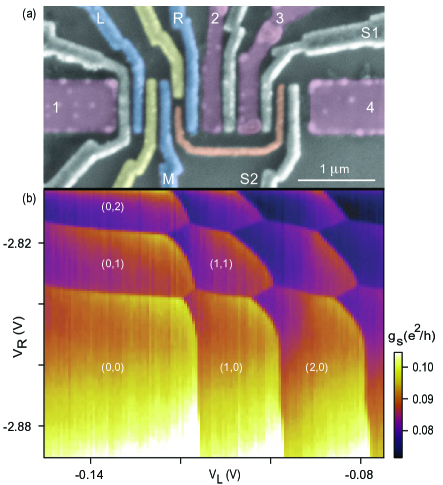
We use charge sensing of Pauli blockade (including spin and isospin) in a two-electron 13C nanotube double quantum dot to measure relaxation and dephasing times. The relaxation time, T1, first decreases with parallel magnetic field then goes through a minimum in a field of 1.4 T. We attribute both results to the spin-orbit-modified electronic spectrum of carbon nanotubes, which suppresses hyperfine mediated relaxation and enhances relaxation due to soft phonons. The inhomogeneous dephasing time, T2*, is consistent with previous data on hyperfine coupling strength in 13C nanotubes.
研究动机与目标
- 测量双电子 13C 纳米管双量子点中的弛豫和去相位时间,以实现自旋量子比特应用。
- 研究自旋-轨道耦合与超精细相互作用在弛豫和去相位机制中的作用。
- 确定同位素富集的 13C 纳米管相比自然丰度材料是否能减少退相干。
- 通过非均匀去相位时间 T₂* 评估核自旋涨落对量子比特相干性的影响。
- 验证自旋-轨道耦合与超精细耦合在碳纳米管量子点中的理论模型。
提出的方法
- 通过电容耦合量子点进行电荷传感,检测 (1,1) 和 (0,2) 电荷态中的隧穿阻塞。
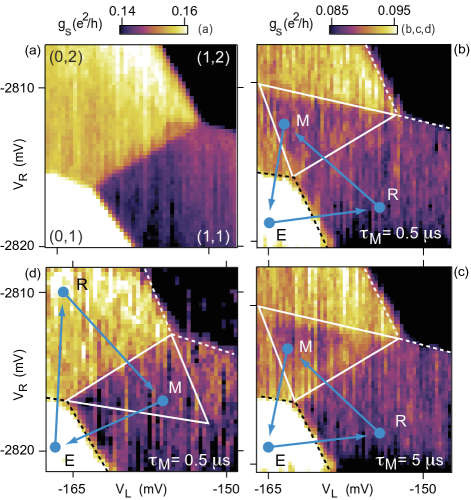
- 施加快速栅极脉冲,循环 (1,1) → (0,2) 态,利用返回概率测量弛豫时间 T₁。
- 使用脉冲序列制备 (0,2) 态,将电子分离至 (1,1) 态,并通过返回概率推断 T₂*。
- 将 T₁ 的磁场依赖性与包含自旋-轨道分裂 ΔSO 和磁场错位角 θ 的模型进行拟合。
- 校准传感器电导 gₛ 以提取返回概率,并通过高斯衰减拟合提取 T₂*。
- 通过非线性输运测量提取隧穿电容耦合和杠杆臂比,以确定能量尺度。
实验结果
研究问题
- RQ1双电子 13C 纳米管双量子点中,弛豫时间 T₁ 如何随外加磁场变化?
- RQ2在 1.4 T 处观察到的 T₁ 最小值的成因是什么?其与自旋-轨道耦合有何关联?
- RQ3超精细耦合在该系统中对弛豫和去相位的贡献有多大?
- RQ4非均匀去相位时间 T₂* 与基于核自旋涨落的理论预测相比如何?
- RQ5仅通过自旋-轨道耦合与超精细相互作用能否解释观测到的 T₁ 和 T₂*,还是需要额外机制?
主要发现
- 弛豫时间 T₁ 随平行磁场增加而减小,并在 1.4 T 处出现最小值,表明其磁场依赖性非单调。
- T₁ 最小值归因于自旋-轨道耦合:在低场下抑制超精细介导的弛豫,而在高场下增强软声子介导的弛豫。
- 测量得到的 T₁ 可通过包含自旋-轨道分裂 ΔSO 和磁场错位角 θ 的模型良好拟合,比例因子为 C = 65 ns/√μeV。
- 非均匀去相位时间 T₂* 测得为 3.2 ns,与近期在 13C 纳米管中测得的超精细耦合结果一致。
- 推断的核磁场涨落强度 δB||^|| = 1.8 mT 约为单量子点核磁场估计值的一半,提示可能存在各向异性或偶极耦合被抑制。
- 饱和返回概率为 0.17,低于 GaAs 中自旋三重态-单重态系统预期的 1/3,可能由于碳纳米管中存在额外的同位旋自由度。
更好的研究,从现在开始
从阅读论文到最终审阅,大幅缩短您的研究时间。
无需绑定信用卡
本解读由 AI 生成,并经人工编辑审核。