
[论文解读] Relaxation of Multitime Statistics in Quantum Systems
本文表明,在一般孤立的量子多体系统中,即使系统初始处于非平衡态,多时间关联函数在长时间演化后仍会趋于热化过程的关联函数。通过将有效维度作为关键参数,作者证明了除非进行指数级数量的测量,否则大多数多时间可观测量与平衡态下的结果无法区分,这意味着非平衡特征在典型测量中实际上被隐藏。
Equilibrium statistical mechanics provides powerful tools to understand physics at the macroscale. Yet, the question remains how this can be justified based on a microscopic quantum description. Here, we extend the ideas of pure state quantum statistical mechanics, which focus on single time statistics, to show the equilibration of isolated quantum processes. Namely, we show that most multitime observables for sufficiently large times cannot distinguish a nonequilibrium process from an equilibrium one, unless the system is probed for an extremely large number of times or the observable is particularly fine-grained. A corollary of our results is that the size of non-Markovianity and other multitime characteristics of a nonequilibrium process also equilibrate.
研究动机与目标
- 理解孤立系统中幺正量子动力学如何涌现出平衡统计力学。
- 研究多时间关联函数(超越单次测量期望值)能否区分非平衡过程与平衡过程。
- 确定多时间可观测量在何种条件下实现平衡化,特别是在非马尔可夫性与操作性量子过程的背景下。
- 建立一个通用框架,利用过程张量和仪器分析操作性量子特征的平衡化。
- 量化在何种条件下,尽管理论上存在,非平衡特征在实践中变得不可检测。
提出的方法
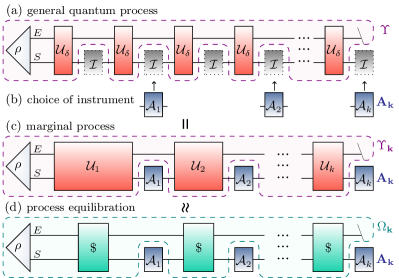
- 作者将多时间关联函数重新表述为作用于过程张量上的单个算符的期望值,从而实现对时间有序可观测量的分析。
- 他们将平衡过程 Ω 定义为原始幺正过程 Υ 的去相位版本,使用相对于系统哈密顿量的去相位映射。
- 关键分析工具是有效维度 $ d_{\mathrm{eff}}[\sigma] = 1 / \mathrm{tr}[\$(\sigma)^2] $,该量量化了量子态的复杂性,并决定了平衡化的速率。
- 他们使用随机矩阵哈密顿量和随机初始态进行数值模拟,测试在不同环境维数下非马尔可夫性和多时间可观测量的平衡化。
- 通过多时间仪器(例如测量序列)探测该过程,并计算原始过程 Υ 与平衡过程 Ω 之间的差异,适用于多种仪器。
- 分析涵盖长时间和有限时间区域,结果对多个系统-环境哈密顿量和初始态的随机实现取平均。
实验结果
研究问题
- RQ1在孤立量子系统中,多时间关联函数能否区分非平衡过程与平衡过程?
- RQ2多时间可观测量在何种条件下实现平衡化?有效维度如何影响这一平衡化过程?
- RQ3非平衡特征(如非马尔可夫性)在多大程度上对典型测量而言实际上被隐藏?
- RQ4检测多时间过程中非平衡行为所需的测量次数如何随系统规模增长?
- RQ5多时间统计的平衡化是否是通用多体量子系统的一般特征?
主要发现
- 对于大多数多时间仪器,非平衡幺正过程 Υ 中可观测量的期望值与平衡去相位过程 Ω 中的值无法区分,误差由 $ 1/d_{\mathrm{eff}} $ 限定。
- 幺正过程 Υℓ 与平衡过程 Ω 之间非马尔可夫性差异的平均绝对值为 $ \sigma_{\rm av} = 1.8 \times 10^{-4} $,而 Υℓ 的值为 $ 1.0 \times 10^{-3} $,表明存在强烈的平衡化。
- 平衡化误差与有效维度 $ d_{\mathrm{eff}} $ 成反比,而该维度在真实多体系统中随系统尺寸呈指数增长。
- 对单个量子比特耦合到随机矩阵环境的数值模拟表明,非马尔可夫性在长时间下趋于平衡,而短时间过程仍对初始条件敏感。
- 结果表明,在典型情况下,检测多时间过程中非平衡特征需要指数级数量的测量,使其在实际中几乎不可观测。
- 该框架成功捕捉了非马尔可夫性等操作性相关特征的平衡化,证实这些性质同样会弛豫至平衡值。

更好的研究,从现在开始
从阅读论文到最终审阅,大幅缩短您的研究时间。
无需绑定信用卡
本解读由 AI 生成,并经人工编辑审核。