
[论文解读] Reliability of lattice gauge theories in the thermodynamic limit
本文证明,在热力学极限下,晶格规范场论中的能量惩罚保护即使在大自旋-S表示下也能保持规范不变性。它通过解析方法识别出两种涌现的有效理论——修正的规范理论和重正化的规范理论——其动力学分别准确描述了系统在与$\sqrt{V/V_0^3}$和$\exp(V/V_0)/V_0$成比例的时间尺度内的行为,其中保护强度$V$与$S^2$成正比,且与体积无关。
Although gauge invariance is a postulate in fundamental theories of nature such as quantum electrodynamics, in quantum-simulation implementations of gauge theories it is compromised by experimental imperfections. In a recent work [Halimeh and Hauke, \href{https://journals.aps.org/prl/abstract/10.1103/PhysRevLett.125.030503}{Phys. Rev. Lett. extbf{125}, 030503 (2020)}], it has been shown in finite-size spin-$1/2$ quantum link lattice gauge theories that upon introducing an energy-penalty term of sufficiently large strength $V$, unitary gauge-breaking errors at strength $λ$ are suppressed $\proptoλ^2/V^2$ up to all accessible evolution times. Here, we show numerically that this result extends to quantum link models in the thermodynamic limit and with larger spin-$S$. As we show analytically, the dynamics at short times is described by an extit{adjusted} gauge theory up to a timescale that is at earliest $τ_ ext{adj}\propto\sqrt{V/V_0^3}$, with $V_0$ an energy factor. Moreover, our analytics predicts that a renormalized gauge theory dominates at intermediate times up to a timescale $τ_ ext{ren}\propto\exp(V/V_0)/V_0$. In both emergent gauge theories, $V$ is volume-independent and scales at worst $\sim S^2$. Furthermore, we numerically demonstrate that robust gauge invariance is also retained through a single-body gauge-protection term, which is experimentally straightforward to implement in ultracold-atom setups and NISQ devices.
研究动机与目标
- 建立在实验不完美导致规范不变性被破坏的条件下,晶格规范场论在热力学极限下的可靠性。
- 研究先前在有限尺寸系统中证明有效的能量惩罚保护,在热力学极限下及更大自旋-S表示下是否依然有效。
- 通过解析推导,在保护下由规范破坏误差产生的有效动力学,识别出由修正和重正化规范理论支配的不同时间尺度。
- 验证保护强度$V$保持与体积无关,并且最坏情况下与$S^2$成正比,从而在量子模拟器中实现可扩展性。
- 证明单体规范保护项在超冷原子和NISQ设备实现中的鲁棒性。
提出的方法
- 使用无限矩阵乘积态(iMPS)进行数值模拟,研究热力学极限下自旋-S量子链模型的淬火动力学。
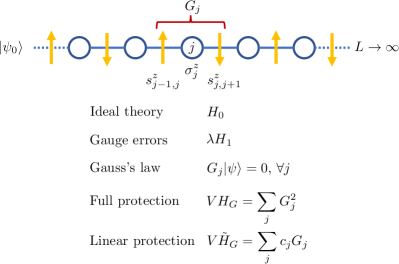
- 应用完整的能量惩罚$V H_G = V \sum_j G_j^2$和线性保护项$V \tilde{H}_G = V \sum_j c_j G_j$,其中$c_j$被选择以诱导量子Zeno效应。
- 将Abanin-De Roeck-Ho-Huveneers(ARHH)方法适配,推导出在局部、无阻抗且具有能隙的保护哈密顿量下受约束量子动力学的普适界限。
- 解析推导修正规范理论哈密顿量$H_{\text{adj}} = H_0 + \lambda \mathcal{P}_0 H_1 \mathcal{P}_0$,其在时间尺度$\tau_{\text{adj}} \propto \sqrt{V/V_0^3}$内有效,其中$\mathcal{P}_0$为物理子空间的投影算符。
- 识别出在中间时间尺度上占主导地位的重正化规范理论,其时间尺度为$\tau_{\text{ren}} \propto \exp(V/V_0)/V_0$,源于保护强度的非微扰效应。
- 利用量子Zeno效应证明线性保护的有效性,误差界限为$\sim t V_0^2 L^2 / V$,时间尺度为$\propto V/(V_0 L)^2$。
实验结果
研究问题
- RQ1在更大自旋-S表示下,能量惩罚保护能否在晶格规范场论的热力学极限中维持规范不变性?
- RQ2在强保护下,由规范破坏误差产生的有效动力学是什么?它们如何依赖于保护强度$V$?
- RQ3这些有效动力学保持有效的时标是否与体积无关,并且能否随$S$扩展?
- RQ4量子Zeno效应在直线保护方案中如何贡献于规范保护?其结果误差界限为何?
- RQ5单体规范保护项能否在实验可行的设置(如超冷原子系统和NISQ设备)中提供鲁棒保护?
主要发现
- 系统动力学在时间尺度$\tau_{\text{adj}} \propto \sqrt{V/V_0^3}$内可被修正规范理论$H_{\text{adj}} = H_0 + \lambda \mathcal{P}_0 H_1 \mathcal{P}_0$准确描述,误差界限为$\sim t^2 V_0^3 / V$。
- 对于物理误差项$\lambda H_1$,由于$\mathcal{P}_0 H_1 \mathcal{P}_0 = 0$,修正哈密顿量退化为$H_0$,表明在此阶次无有效修正。
- 在中间时间尺度上,重正化规范理论占主导,其时间尺度为$\tau_{\text{ren}} \propto \exp(V/V_0)/V_0$,表明规范不变性通过非微扰机制得到稳定。
- 保护强度$V$与体积无关,在大$S$极限下最坏情况与$S^2$成正比,确保了在量子模拟中的可扩展性。
- 单体规范保护项——特别是采用非合规序列$c_j = (-1)^{j+1}$的线性保护——通过量子Zeno效应实现鲁棒的规范不变性,误差界限为$\sim t V_0^2 L^2 / V$。
- 数值结果证实,完整保护和线性保护方案均能保持鲁棒的规范不变性,且在iMPS模拟中通过不同键维数的收敛性得到验证。
![Figure 2: (Color online). Gauge violation as given in Eq. ( 6 ) as function of gauge-spin length $S$ [(a) $S=1/2$ , (b) $S=1$ , (c) $S=3/2$ , and (d) $S=2$ ], computed in the thermodynamic limit using iMPS. The initial state, outlined in Fig. 1 , is quenched with Hamiltonian $H_{0}+\lambda H_{1}+VH_](https://ar5iv.labs.arxiv.org/html/2104.07040/assets/x2.png)
更好的研究,从现在开始
从阅读论文到最终审阅,大幅缩短您的研究时间。
无需绑定信用卡
本解读由 AI 生成,并经人工编辑审核。