
[论文解读] Reprogramming Pretrained Language Models for Protein Sequence Representation Learning
该论文提出R2DL框架,通过在英语词汇嵌入与蛋白质序列嵌入之间学习稀疏线性映射,实现对预训练英语语言模型的重编程,以进行蛋白质序列表征学习。R2DL在多种蛋白质性质与功能预测任务中实现了最先进性能,相较于标准监督学习与预训练基线模型,数据效率最高提升10⁵倍。
Machine Learning-guided solutions for protein learning tasks have made significant headway in recent years. However, success in scientific discovery tasks is limited by the accessibility of well-defined and labeled in-domain data. To tackle the low-data constraint, recent adaptions of deep learning models pretrained on millions of protein sequences have shown promise; however, the construction of such domain-specific large-scale model is computationally expensive. Here, we propose Representation Learning via Dictionary Learning (R2DL), an end-to-end representation learning framework in which we reprogram deep models for alternate-domain tasks that can perform well on protein property prediction with significantly fewer training samples. R2DL reprograms a pretrained English language model to learn the embeddings of protein sequences, by learning a sparse linear mapping between English and protein sequence vocabulary embeddings. Our model can attain better accuracy and significantly improve the data efficiency by up to $10^5$ times over the baselines set by pretrained and standard supervised methods. To this end, we reprogram an off-the-shelf pre-trained English language transformer and benchmark it on a set of protein physicochemical prediction tasks (secondary structure, stability, homology, stability) as well as on a biomedically relevant set of protein function prediction tasks (antimicrobial, toxicity, antibody affinity).
研究动机与目标
- 为解决蛋白质机器学习中标签数据有限的挑战,实现数据高效的表征学习。
- 开发一种轻量级替代方案,以替代计算成本高昂、领域特定的大型蛋白质语言模型预训练方法。
- 通过重新利用高容量、现成的英语语言模型,探索跨领域迁移学习在蛋白质序列中的应用。
- 在不从零开始训练模型的前提下,提升蛋白质表征学习的数据效率。
- 在极小标签数据条件下,实现高性能的蛋白质性质与功能预测。
提出的方法
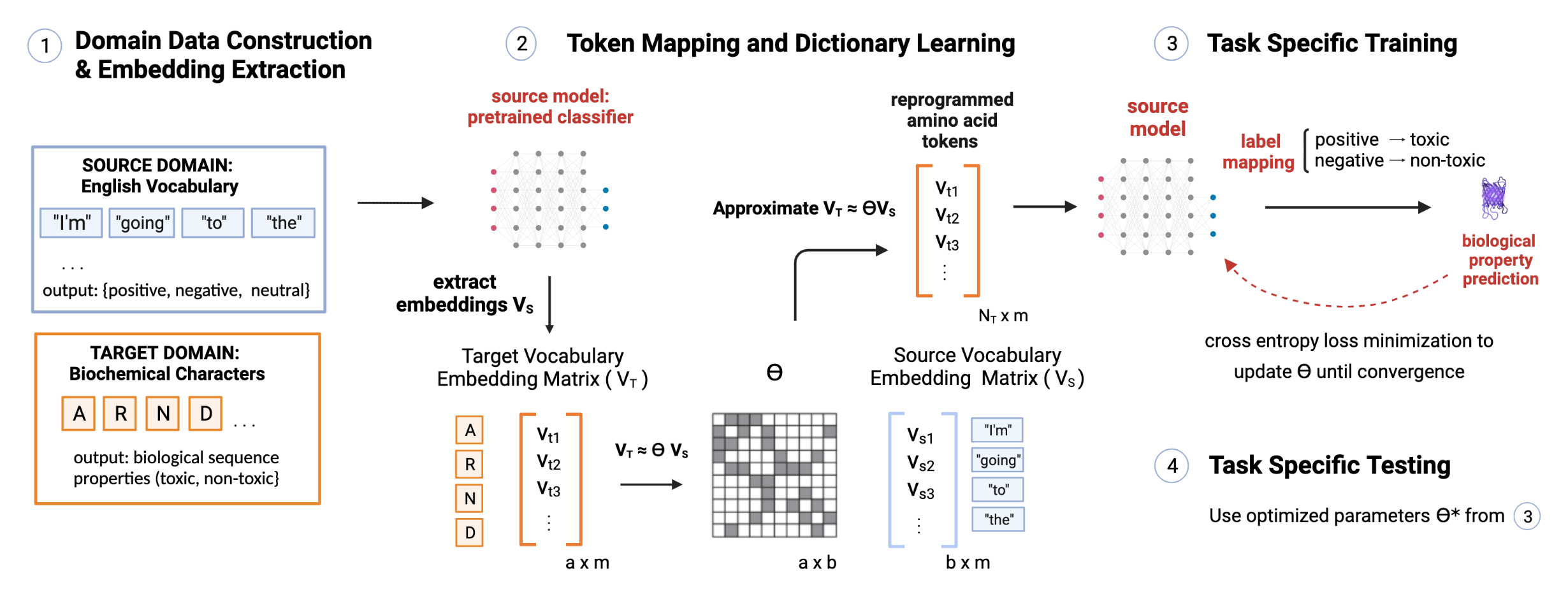
- R2DL通过学习其标记嵌入与蛋白质序列嵌入之间的稀疏线性变换,对预训练英语Transformer模型进行重编程。
- 该方法采用基于k-SVD的字典学习,以从英语语言模型嵌入学习到蛋白质序列嵌入的稀疏映射。
- 通过引入L₀范数的正则化目标函数,强制学习到的变换矩阵保持稀疏性,以提升泛化能力与数据效率。
- 该框架在蛋白质序列上端到端训练,使用学习到的映射关系,且不微调原始语言模型。
- 该模型利用英语语言模型预训练的语言归纳偏差,捕捉蛋白质序列中具有生物学意义的表征。
- 该方法在多个蛋白质任务上进行了评估,包括二级结构、稳定性、溶解度、同源性及功能预测(抗菌、毒性、抗体亲和力)等。
![Figure 1 : Left: Descriptions of considered predictive tasks. We select the set of physicochemical property prediction tasks from the well-studied domains in [ 6 ] , and the biomedical function prediction tasks from works with biomedically relevant small-szied labeled datasets [ 3 ; 14 ] . Center: W](https://ar5iv.labs.arxiv.org/html/2301.02120/assets/new_figs/fig_1.png)
实验结果
研究问题
- RQ1未经微调的预训练英语语言模型能否被有效重编程,以学习有意义的蛋白质序列表征?
- RQ2从自然语言到蛋白质序列的跨领域迁移学习,在多大程度上能提升蛋白质机器学习任务的数据效率?
- RQ3在低数据环境下,R2DL的性能与标准监督训练及领域特定预训练方法相比如何?
- RQ4在蛋白质语言模型嵌入与蛋白质序列之间采用稀疏线性映射,能否在多样化的生物任务中取得具有竞争力的结果?
- RQ5通过重编程基础模型,在蛋白质表征学习中可实现的数据效率上限是多少?
主要发现
- R2DL在所有评估的蛋白质预测任务中均达到最先进性能,包括二级结构、稳定性、溶解度、同源性、抗菌活性、毒性及抗体亲和力预测。
- 与标准监督学习和预训练基线相比,该模型的数据效率最高提升10⁵倍,可在极小标签数据下实现高精度。
- 在抗菌活性预测任务中,R2DL仅使用6,489个训练样本即达到88%准确率,性能与预训练Transformer相当,但数据需求显著更低。
- 在毒性预测任务中,R2DL仅用8,153个标签样本即达到93.78%准确率,在低数据设置下优于标准监督方法。
- 在同源性分类任务中,R2DL使用10,438个训练样本达到26%的Top-1准确率,性能与LSTM基线相当,但框架效率更高。
- 该框架在多种生物任务中展现出广泛适应性,包括理化性质预测与具有临床意义的功能预测,且在数据效率方面持续取得提升。
更好的研究,从现在开始
从阅读论文到最终审阅,大幅缩短您的研究时间。
无需绑定信用卡
本解读由 AI 生成,并经人工编辑审核。