
[论文解读] Resolving the nature and putative nebular emission of GS9422: an obscured AGN without exotic stars
该研究利用 JWST 对 GS9422 在 z=5.943 的成像与光谱,表明星云发射并未主导连续谱,且该星系包含一个遮蔽的 II 型 AGN 以及阻尼 Ly-α 云。
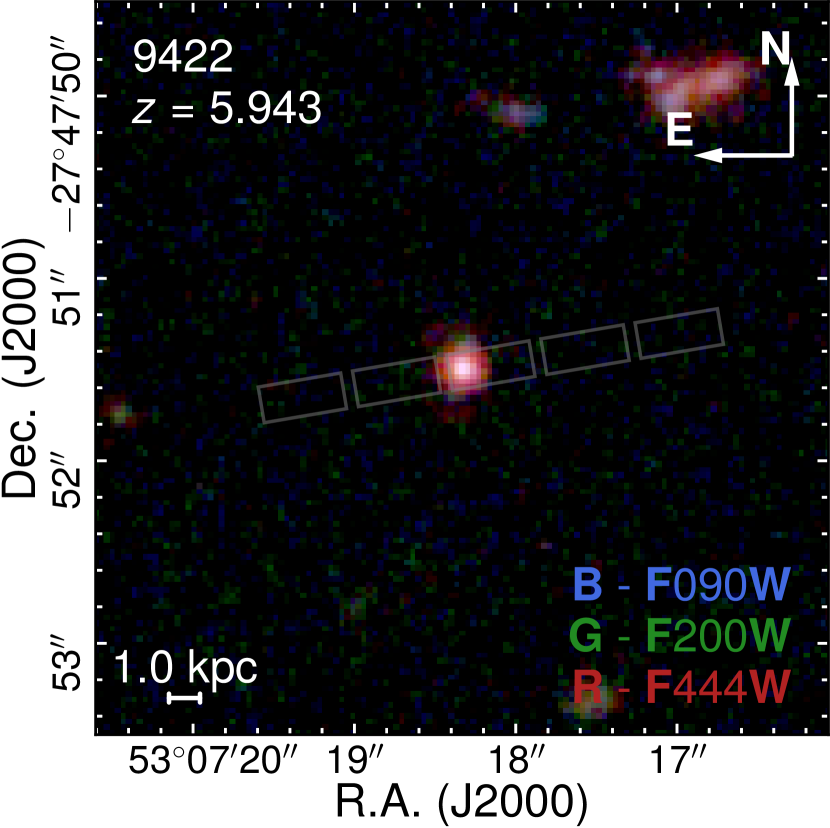
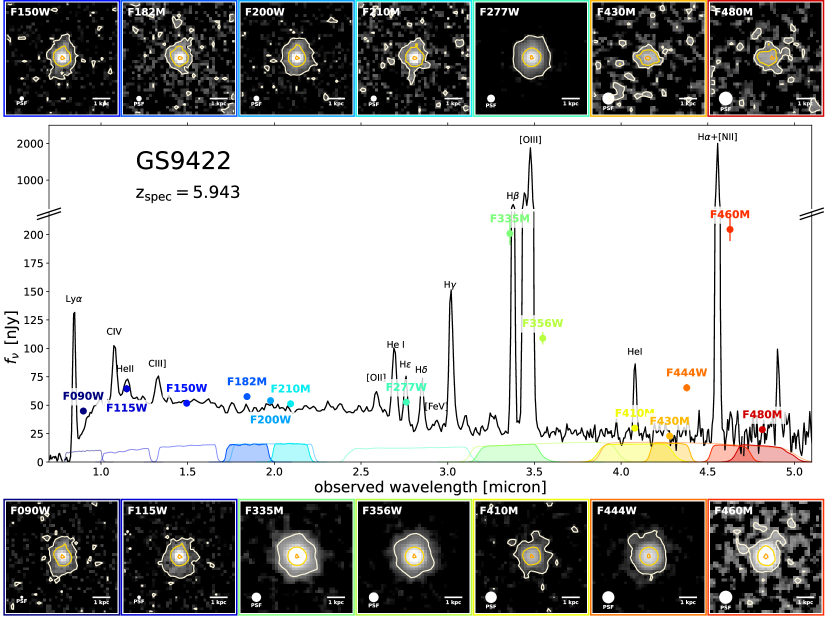
Understanding the sources that power nebular emission in high-redshift galaxies is fundamentally important not only for shedding light onto the drivers of reionisation, but to constrain stellar populations and the growth of black holes. Here we focus on an individual object, GS9422, a galaxy at $z_{ m spec}=5.943$ with exquisite data from the JADES, JEMS and FRESCO surveys, including 14-band JWST/NIRCam photometry and deep NIRSpec prism and grating spectroscopy. We map the continuum emission and nebular emission lines across the galaxy on 0.2-kpc scales. GS9422 has been claimed to have nebular-dominated continuum and an extreme stellar population with top-heavy initial mass function. We find clear evidence for different morphologies in the emission lines, the rest-UV and rest-optical continuum emission, demonstrating that the full continuum cannot be dominated by nebular emission. While multiple models reproduce the spectrum reasonably well, our preferred model with a type-2 active galactic nucleus (AGN) and local damped Ly-$α$ (DLA) clouds can explain both the spectrum and the wavelength-dependent morphology. The AGN powers the off-planar nebular emission, giving rise to the Balmer jump and the emission lines, including Ly-$α$, which therefore does not suffer DLA absorption. A central, young stellar component dominates the rest-UV emission and -- together with the DLA clouds -- leads to a spectral turn-over. A disc-like, older stellar component explains the flattened morphology in the rest-optical continuum. We conclude that GS9422 is consistent with being a normal galaxy with an obscured, type-2 AGN -- a simple scenario, without the need for exotic stellar populations.
研究动机与目标
- 研究 GS9422 中星云发射的起源,并评估其连续谱是否被星云支配。
- 测试竞争情景(恒星、AGN,或混合)以解释光谱与形态。
- 确定发射线、rest-UV 与 rest-optical 连续体的空间分布,以推断供能源。
- 利用 14 波段 NIRCam 光度测量与深度 NIRSpec 光谱,约束恒星与星际介质属性。
- 评估是否需要特殊恒星群体(如顶重 IMF)来解释观测结果。
提出的方法
- 利用 14 波段 JWST/NIRCam 光度测量结合深度 NIRSpec 棱镜与光栅光谱,在 ~0.2 kpc 尺度上绘制连续谱与星云线的分布。
- 在 rest-UV 连续体、rest-optical 连续体与发射线上执行非参数(等光度)与参数化(Sérsic)形态分析。
- 按示踪物(Ly-α、rest-UV、发射线、rest-optical 连续体)对影像进行堆叠以比较形态。
- 使用 PySersic(以及 ForcePho)前向建模 PSF 卷积光强轮廓,以推导每个示踪物的半光半径、Sérsic 指数、椭圆度和位置角。
- 利用中等带成像的 EW 图与 Balmer 跳跃评估来测试星云-连续光及 AGN 贡献。
- 探索多种物理模型(仅恒星、仅 AGN,以及包含 DLAs 的 AGN+恒星)以拟合光谱与波长相关的形态。
实验结果
研究问题
- RQ1在 GS9422 的 rest-frame 连续体是否被星云发射主导,还是恒星分量有显著贡献?
- RQ2观测到的波长相关形态是否可用单一供能源(如遮蔽的 AGN)来解释,而非极端的恒星群体?
- RQ3哪种 AGN 活动、DLAs 与恒星分量的组合最能解释光谱与发射线/连续体的时空分布?
- RQ4NIRCam 中等带测量是否支持 Balmer 跳跃及星云连续光的存在与强度?
- RQ5是否需要顶重 IMF 情景来解释 GS9422 的光谱能量分布与线比?
主要发现
- GS9422 显示发射线、rest-UV 连续体与 rest-optical 连续体具有不同的形态,表明连续体不是星云主导。
- 首选模型是具有局部阻尼 Ly-α 云的 II 型 AGN,能够解释光谱与波长相关形态。
- 中心的年轻恒星分量主导 rest-UV 发射,并与 DLA 云共同驱动向更短波长的光谱转折。
- 一个盘状的较老恒星分量能够解释 flatten 的 rest-optical 连续体形态。
- Ly-α、rest-UV 连续体与发射线具有不同的空间尺度,Ly-α 最为扩展,rest-UV 最为紧凑,而 rest-optical 连续体呈盘状且与 rest-UV/线发射方向约成 90 度。
- GS9422 可被解释为一个普通星系,包含遮蔽的 II 型 AGN,而无需极端的恒星群体或极端 IMF。
更好的研究,从现在开始
从论文设计到论文写作,大幅缩短您的研究时间。
无需绑定信用卡
本解读由 AI 生成,并经人工编辑审核。