
[论文解读] Rethinking Semi-Supervised Medical Image Segmentation: A Variance-Reduction Perspective
ARCO 引入基于方差降低的分层分组采样用于半监督医学影像分割,通过降低梯度估计方差,在多数据集上提升鲁棒性和标注效率。
For medical image segmentation, contrastive learning is the dominant practice to improve the quality of visual representations by contrasting semantically similar and dissimilar pairs of samples. This is enabled by the observation that without accessing ground truth labels, negative examples with truly dissimilar anatomical features, if sampled, can significantly improve the performance. In reality, however, these samples may come from similar anatomical regions and the models may struggle to distinguish the minority tail-class samples, making the tail classes more prone to misclassification, both of which typically lead to model collapse. In this paper, we propose ARCO, a semi-supervised contrastive learning (CL) framework with stratified group theory for medical image segmentation. In particular, we first propose building ARCO through the concept of variance-reduced estimation and show that certain variance-reduction techniques are particularly beneficial in pixel/voxel-level segmentation tasks with extremely limited labels. Furthermore, we theoretically prove these sampling techniques are universal in variance reduction. Finally, we experimentally validate our approaches on eight benchmarks, <i>i.e</i>., five 2D/3D medical and three semantic segmentation datasets, with different label settings, and our methods consistently outperform state-of-the-art semi-supervised methods. Additionally, we augment the CL frameworks with these sampling techniques and demonstrate significant gains over previous methods. We believe our work is an important step towards semi-supervised medical image segmentation by quantifying the limitation of current self-supervision objectives for accomplishing such challenging safety-critical tasks.
研究动机与目标
- 激发在极少量标签下的半监督医学影像分割的鲁棒性和标注效率。
- 开发一个方差降低采样框架,用于引导对比学习中的像素/体素选择。
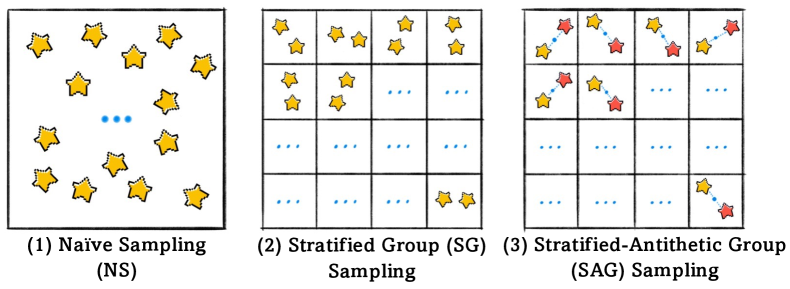
- 提出 Stratified Group (SG) 和 Stratified-Antithetic Group (SAG) 采样,以提高梯度方差和收敛性。
- 展示跨数据集与跨架构的鲁棒性,以及在2D/3D医学与语义分割基准上的竞争性表现。
提出的方法
- 将 ARCO 构建为基于方差降低估计的半监督对比学习框架。
- 引入 Stratified Group (SG) 采样,将图像划分为基于类别的网格,在每个网格内进行采样。
- 通过对称性约束,扩展 SG 为 Stratified-Antithetic Group (SAG) 以进一步降低方差。
- 给出理论保障:相对于朴素采样,SG/SAG 的无偏性和方差降低。
- 将 ARCO 与类似 MONA 的关系预训练以及解剖对比微调相结合,以学习健壮、对尾部敏感的表征。
![Figure 1: Pipeline overview. Our semi-supervised segmentation model $F$ takes a 2D/3D medical image $x$ as input and outputs the segmentation map and the representation map. We leverage a simplification of MONA pipeline [ 17 ] which is composed of two stages: (1) relational semi-supervised pre-train](https://ar5iv.labs.arxiv.org/html/2302.01735/assets/x1.png)
实验结果
研究问题
- RQ1在极端标签稀缺下,方差降低采样能否提升半监督医学影像分割的鲁棒性和收敛性?
- RQ2SG 和 SAG 是否为像素/体素级对比学习提供无偏、较低方差的梯度估计?
- RQ3在不同标签比例的多样化2D/3D医学和语义分割基准上,ARCO 的表现如何?
- RQ4将 ARCO 集成到现有 SSL 框架中,是否带来在分割准确度和边界界定上的一致提升?
主要发现
- ARCO 方法在八个基准和多种标签比下实现更优的分割性能,超越最先进的 SSL 方法。
- ARCO-SG 与 ARCO-SAG 在1%、5%和10%标签设置下相较于 MONA 显示显著的 Dice 分数提升(在报道的案例中相对 Dice 提升约0.3%–4.1%)。
- 理论上,SG 是无偏的,方差不大于 Naive Sampling;SAG 的方差在 SG 的两倍之内,展示了普遍的方差降低收益。
- 经验结果表明由于梯度方差降低,收敛更快、学习更稳定,并且在解剖结构的边界准确性上有所提升。
- 一项关键声称结果是在分割鲁棒性基准上 Dice 绝对提升高达 11.08%。
更好的研究,从现在开始
从论文设计到论文写作,大幅缩短您的研究时间。
无需绑定信用卡
本解读由 AI 生成,并经人工编辑审核。