
[论文解读] Rigid Body Flows for Sampling Molecular Crystal Structures
本论文引入针对三维中多刚体(分子)采样位置和方向的 normalizing flows,使用双覆盖四元数表示来对 SO(3) 密度进行平滑且精确建模。它演示了 Boltzmann generator-style sampling,用于四面体系统和 TIP4P 的 ice XI,能够在分子晶体中实现高效的自由能差估计。
Normalizing flows (NF) are a class of powerful generative models that have gained popularity in recent years due to their ability to model complex distributions with high flexibility and expressiveness. In this work, we introduce a new type of normalizing flow that is tailored for modeling positions and orientations of multiple objects in three-dimensional space, such as molecules in a crystal. Our approach is based on two key ideas: first, we define smooth and expressive flows on the group of unit quaternions, which allows us to capture the continuous rotational motion of rigid bodies; second, we use the double cover property of unit quaternions to define a proper density on the rotation group. This ensures that our model can be trained using standard likelihood-based methods or variational inference with respect to a thermodynamic target density. We evaluate the method by training Boltzmann generators for two molecular examples, namely the multi-modal density of a tetrahedral system in an external field and the ice XI phase in the TIP4P water model. Our flows can be combined with flows operating on the internal degrees of freedom of molecules and constitute an important step towards the modeling of distributions of many interacting molecules.
研究动机与目标
- Motivate and enable efficient, likelihood-based sampling of joint positions and orientations for many interacting rigid bodies in molecular crystals.
- Develop smooth, invertible flows on the rotation manifold via the quaternion double cover to preserve physical densities and support exact density computation.
- Allow external pose and internal degrees of freedom to be treated independently, enabling integration with prior internal-DOF flow models.
- Demonstrate the approach by constructing Boltzmann generators for multi-modal rotational densities and ice XI phase sampling at different sizes and temperatures.
提出的方法
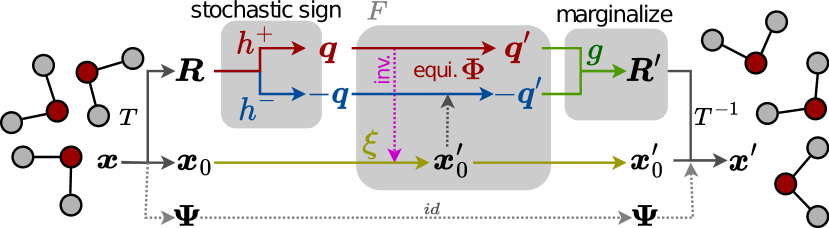
- Represent each rigid body by (x0, R, Psi) where x0 is translation, R in SO(3) is rotation, and Psi are inner degrees of freedom.
- Lift SO(3) rotations to the unit-quaternion 3-sphere S3 using the double cover, enabling smooth, flip-equivariant flows on S3.
- Construct flip-symmetric coupling flows on S3 using two classes: symmetrized Möbius transforms and projective convex gradient maps (with analytic inverse and volume-change formulas).
- Define a coupling-based flow F that updates positions and quaternions while preserving flip-equivariance, ensuring an exact density under the double-cover projection.
- Explain training as Boltzmann Generators: combine maximum likelihood on (biased) MD data with reverse KL minimization or LFEP to estimate free-energy differences.
- Demonstrate two experimental setups: (i) a multi-modal rotational density of a tetrahedral body in an external field, (ii) ice XI in TIP4P water at varying sizes and temperatures.]
- research_questions:["Can smooth, flip-equivariant flows on the quaternion double cover accurately represent multi-modal rotational densities for rigid bodies?","How well do rigid-body normalizing flows sample molecular crystals and allow accurate estimation of free-energy differences (ΔF) compared with MD-based references?","Can the framework be combined with internal DOF flows to model interacting molecules in crystals?","What is the impact of using SO(3) representations via S3 on training efficiency and density accuracy for crystal systems?"]
- key_findings:[
- Projective convex gradient maps and flip-equivariant symmetrized Möbius transforms can faithfully reconstruct multi-modal rotational densities, outperforming affine quaternion layers in a tetrahedron in external field test.
- For ice XI sampling with TIP4P water, the flow-based LFEP estimates ΔF per molecule that closely match MBAR references across various system sizes and target temperatures.
- The method yields close overlap between base-flow mapped energies and target MD distributions, and reweighting recovers radial distribution functions with high fidelity.
- The approach enables efficient estimation of free-energy differences with a single MD trajectory used for training and LFEP evaluation, reducing the need for laddered MD simulations.
- The architecture supports independence of external pose and inner DOFs, and is compatible with permutation-equivariant and scalable flow designs for larger crystal systems.
更好的研究,从现在开始
从论文设计到论文写作,大幅缩短您的研究时间。
无需绑定信用卡
本解读由 AI 生成,并经人工编辑审核。