
[论文解读] Robustness and Directed Structures in Ecological Flow Networks
本文研究了生态流网络中现实网络结构对随机弧失效下鲁棒性的影响,重点关注两种功能:通过侧向连通性实现的协调性(coherence)和通过强连通性实现的循环性(circulation)。基于配置模型的理论渗透模型分析表明,现实度分布能增强协调性鲁棒性,但会降低循环性鲁棒性,揭示了生物系统网络设计中的根本性权衡。
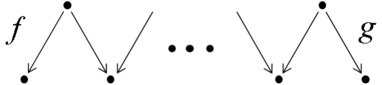
Robustness of ecological flow networks under random failure of arcs is considered with respect to two different functionalities: coherence and circulation. In our previous work, we showed that each functionality is associated with a natural path notion: lateral path for the former and directed path for the latter. Robustness of a network is measured in terms of the size of the giant laterally connected arc component and that of the giant strongly connected arc component, respectively. We study how realistic structures of ecological flow networks affect the robustness with respect to each functionality. To quantify the impact of realistic network structures, two null models are considered for a given real ecological flow network: one is random networks with the same degree distribution and the other is those with the same average degree. Robustness of the null models is calculated by theoretically solving the size of giant components for the configuration model. We show that realistic network structures have positive effect on robustness for coherence, whereas they have negative effect on robustness for circulation.
研究动机与目标
- 理解生态流网络的现实结构特征如何影响其在随机弧失效下的鲁棒性。
- 区分有向生态网络中协调性(侧向连通性)与循环性(强连通性)的鲁棒性差异。
- 通过与两种零模型比较,量化现实网络结构的影响:一种具有相同的度分布,另一种具有相同的平均度。
- 揭示现实网络特征是否增强或降低生态系统中不同功能角色的鲁棒性。
提出的方法
- 对具有任意联合入度与出度分布的有向网络,在配置模型上进行理论渗透分析。
- 使用生成函数推导在随机弧移除下巨侧向连通弧分量(GLCC)与巨强连通弧分量(GSCC)的大小。
- 应用配置模型计算零模型的鲁棒性度量:一种具有相同度分布,另一种具有相同平均度。
- 通过模拟方法估计真实生态网络中GLCC与GSCC的大小,方法为对1000次随机弧移除序列取平均。
- 定义鲁棒性互补比,用于将真实网络与零模型进行比较,从而隔离现实结构的影响。
- 使用生成函数形式推导配置模型中临界阈值与分量大小的解。
实验结果
研究问题
- RQ1现实网络结构如何影响生态流网络在协调性(侧向连通性)方面的鲁棒性?
- RQ2现实网络结构如何影响生态流网络在循环性(强连通性)方面的鲁棒性?
- RQ3度分布本身在多大程度上可以解释真实网络与零模型之间鲁棒性差异的成因?
- RQ4生态网络中协调性鲁棒性与循环性鲁棒性之间是否存在权衡关系?
- RQ5配置模型能否准确预测真实生态流网络在随机失效下的鲁棒性行为?
主要发现
- 现实网络结构显著增强了协调性鲁棒性,以巨侧向连通分量(GLCC)为度量,鲁棒性互补比显示其具有强烈正向影响。
- 相反,现实度分布降低了循环性鲁棒性,表现为巨强连通分量(GSCC)的鲁棒性下降,鲁棒性互补比 $ R_S $ 在大多数情况下为负值。
- GLCC的鲁棒性增益在所有网络类型中几乎达到单位值,因为即使泊松零模型也已实现 $ R_L \approx 0.5 $,表明现实结构仅带来边际但一致的改进。
- 对于GSCC,现实度分布是降低鲁棒性的主导因素,所有10个分析网络的 $ R_S $ 值均持续低于1。
- 协调性与循环性鲁棒性呈现相反趋势,揭示了根本性权衡:尽管失效机制相同,生态网络在某一功能上具有鲁棒性,但在另一功能上则表现脆弱。
- 结果支持生态网络的‘自催化观点’,即复杂且非随机的结构可能在某些动态模式下促进稳定性,同时在其他模式下增加脆弱性。
更好的研究,从现在开始
从阅读论文到最终审阅,大幅缩短您的研究时间。
无需绑定信用卡
本解读由 AI 生成,并经人工编辑审核。