
[论文解读] Role of left-hand cut contributions on pole extractions from lattice data: Case study for $T_{cc}(3875)^+$
本文表明,来自一费米子交换(OPE)的左手Cut(LHC)对近阈值强子分子(如$T_{cc}^+(3875)^+$)的格点QCD数据中共振极点提取有显著影响。当π介子质量超过$D^* - D$质量差时,LHC会靠近$DD^*$阈值,导致有效范围展开失效,必须在散射振幅中显式包含OPE以实现可靠的极点确定——这揭示了格点分析中新型子态时一个此前被忽视的关键系统误差来源。
We discuss recent lattice data for the $T_{cc}(3875)^+$ state to stress, for the first time, a potentially strong impact of left-hand cuts from the one-pion exchange on the pole extraction for near-threshold exotic states. In particular, if the left-hand cut is located close to the two-particle threshold, which happens naturally in the $DD^*$ system for the pion mass exceeding its physical value, the effective-range expansion is valid only in a very limited energy range up to the cut and as such is of little use to reliably extract the poles. Then, an accurate extraction of the pole locations requires the one-pion exchange to be implemented explicitly into the scattering amplitudes. Our findings are general and potentially relevant for a wide class of hadronic near-threshold states.
研究动机与目标
- 研究来自一费米子交换(OPE)的左手Cut(LHC)对近阈值强子分子(如$T_{cc}^+(3875)^+$)的格点QCD数据中共振极点提取的影响。
- 评估当LHC靠近两体阈值时,有效范围展开(ERE)是否仍有效,特别是在非物理π介子质量区域。
- 证明当LHC靠近阈值时,显式包含OPE相互作用对可靠极点确定至关重要,从而挑战基于标准ERE的拟合程序的有效性。
- 为其他近阈值奇特强子态提供一个通用框架,其中类似LHC效应可能扭曲极点提取。
提出的方法
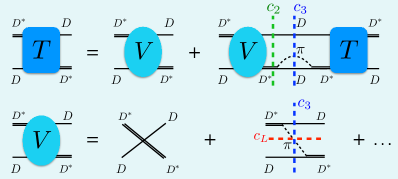
- 作者使用$T_{cc}^+(3875)^+$态的格点QCD数据,聚焦于$S$波通道中$DD^*$的散射振幅。
- 他们使用包含显式一费米子交换(OPE)的相互作用势,通过李普曼-施温格方程建模散射振幅。
- 通过卢舍尔方法从格点数据中提取$p\cot\delta(p^2)$函数,并采用贝叶斯方法对1000组准数据集进行拟合,以考虑非高斯不确定性。
- 拟合过程最小化模型预测与准数据之间的$\chi^2$,其中参数$c_0$和$c_2$代表势能的低能常数。
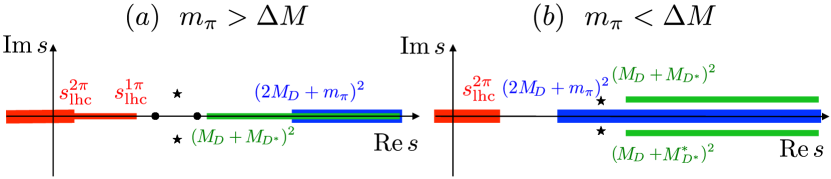
- 计算左手Cut分支点位置作为π介子质量的函数,并分析当$m_\pi > \Delta M$时其与$DD^*$阈值的接近程度。
- 研究OPE强度变化(分别缩放为1/10和5倍)的影响,以隔离其在移动极点和残差方面的作用。
实验结果
研究问题
- RQ1一费米子交换产生的左手Cut如何影响从格点QCD数据中提取共振极点时有效范围展开的可靠性?
- RQ2当左手Cut位于$DD^*$阈值附近时(如在$m_\pi > \Delta M$时),$p\cot\delta(p^2)$函数的极点结构会发生什么变化?
- RQ3一费米子交换相互作用在多大程度上决定了散射振幅中极点的存在与位置,特别是当OPE强度被改变时?
- RQ4当左手Cut靠近物理阈值时,基于有效范围展开的标准拟合程序能否提供可靠的极点位置?
主要发现
- 当π介子质量超过$D^* - D$质量差($m_\pi > \Delta M$)时,左手Cut分支点靠近$DD^*$阈值,导致在有限能量范围内有效范围展开失效。
- 来自一费米子交换的左手Cut成为散射振幅中非解析性的主导来源,当Cut靠近阈值时会扭曲极点提取。
- 随着OPE强度降低,$p\cot\delta(p^2)$中的极点向左手Cut移动,当关闭OPE时极点完全消失,证明OPE对极点形成至关重要。
- 在物理π介子耦合下,极点与左手Cut几乎重合,表明存在一种微妙的平衡,若未显式建模,可能误导极点提取。
- 在$m_\pi = 280$ MeV及更小的 charm 夸克质量下,对格点数据的拟合显示出一致行为:LHC效应显著,不可忽略。
- 本研究结论为:在近阈值奇特强子态中,显式包含一费米子交换对可靠极点提取至关重要,尤其在非物理π介子质量区域。
更好的研究,从现在开始
从阅读论文到最终审阅,大幅缩短您的研究时间。
无需绑定信用卡
本解读由 AI 生成,并经人工编辑审核。