
[论文解读] Running vacuum in Brans-Dicke theory: a possible cure for the $σ_8$ and $H_0$ tensions
该论文在布兰斯-狄克理论(Brans-Dicke theory)框架下提出了一种运行真空模型(BD-RVM),以同时缓解宇宙学中的 $\sigma_8$ 和 $H_0$ 紧张问题。通过允许牛顿耦合常数 $G_N$ 和真空能量密度 $\rho_{\rm vac}$ 通过 $\delta\rho_{\rm vac} \propto \nu\,m_{\rm Pl}^2(H^2 - H_0^2)$ 动态演化,该模型在拟合宇宙学数据方面显著优于标准 $\Lambda$CDM 模型,且有强烈统计证据($\Delta$AIC、$\Delta$DIC > 12)支持 BD-RVM 场景,尤其在引入 $H_0$ 或 $S_8$ 先验时更为明显。
Extensions of the gravitational framework of Brans-Dicke (BD) are studied by considering two different scenarios: i) `BD-$Λ$CDM', in which a rigid cosmological constant, $Λ$, is included, thus constituting a BD version of the vanilla concordance $Λ$CDM model (the current standard model of cosmology with flat three-dimensional geometry), and ii) `BD-RVM', a generalization of i) in which the vacuum energy density (VED), $ρ_{ extrm{vac}}$, is a running quantity evolving with the square of the Hubble rate: $δρ_{ extrm{vac}}(H)\propto ν\, m^2_{ extrm{Pl}} (H^2-H_0^2)$ (with $|ν|\ll 1$). This dynamical scenario is motivated by recent studies of quantum field theory (QFT) in curved spacetime, which lead to the running vacuum model (RVM). We solve the background as well as the perturbation equations for each cosmological model and test their performance against the modern wealth of cosmological data, namely a compilation of the latest SNIa+$H(z)$+BAO+LSS+CMB observations. We utilize the AIC and DIC statistical information criteria in order to determine if they can fit better the observations than the concordance model. The two BD extensions are tested by considering three different datasets. According to the AIC and DIC criteria, both BD extensions i) and ii) are competitive, but the second one (the BD-RVM scenario) is particularly favored when it is compared with the vanilla model. This fact may indicate that the current observations favor a mild dynamical evolution of the Newtonian coupling $G_N$ as well as of the VED. This is in agreement with recent studies suggesting that the combination of these two features can be favorable for a possible resolution of the $σ_8$ and $H_0$ tensions. In this work, we show that the Brans-Dicke theory with running vacuum has the potential to alleviate the two tensions at the same time.
研究动机与目标
- 通过在布兰斯-狄克理论中引入动态真空能量密度,解决宇宙学中持续存在的 $\sigma_8$ 和 $H_0$ 紧张问题。
- 检验在布兰斯-狄克框架下,运行真空模型(RVM)是否能比标准 $\Lambda$CDM 模型更好地拟合当前宇宙学数据。
- 检验动态牛顿耦合常数 $G_N$ 与随时间演化的真空能量密度 $\rho_{\rm vac}$ 作为统一解决方案,对缓解多种宇宙学紧张问题的可行性。
- 利用信息准则(AIC、DIC)和观测数据集(包括 SNIa、$H(z)$、BAO、LSS 和 CMB)评估 BD-RVM 模型相对于标准 $\Lambda$CDM 模型的统计偏好。
提出的方法
- 构建一个在布兰斯-狄克理论中引入运行真空能量密度(BD-RVM)的理论框架,其中 $\delta\rho_{\rm vac} \propto \nu\,m_{\rm Pl}^2(H^2 - H_0^2)$,且 $|\nu| \ll 1$,其动机来自弯曲时空中的量子场论。
- 构建一个基准模型(BD-$\Lambda$CDM),在布兰斯-狄克框架中引入常数 $\Lambda$ 项,用于与动态 RVM 扩展进行比较。
- 在空间平直的弗里德曼-勒梅特-罗伯逊-沃尔克(FLRW)框架下,求解两种模型的背景方程和扰动方程。
- 利用综合数据集(SNIa、$H(z)$、BAO、LSS 和 Planck 2018 CMB 数据(TT、TE、EE、弱引力透镜))约束模型参数。
- 应用赤池信息准则(AIC)和偏差信息准则(DIC)对模型性能进行统计比较,以评估其相对于标准 $\Lambda$CDM 模型的表现。
- 通过引入 $H_0$ 和 $S_8$ 的外部先验,测试模型的稳健性,以评估其对参数拟合和统计偏好的影响。
实验结果
研究问题
- RQ1在布兰斯-狄克理论中,运行真空模型能否同时缓解宇宙学数据中观测到的 $\sigma_8$ 和 $H_0$ 紧张问题?
- RQ2引入随哈勃参数演化而变化的动态真空能量密度,是否能导致相对于标准 $\Lambda$CDM 模型的统计优选模型?
- RQ3当引入 $H_0$ 或 $S_8$ 的外部先验时,$\epsilon$(与 $G_N$ 演化相关)和 $\nu$(与 $\rho_{\rm vac}$ 运行相关)的参数如何约束该模型?
- RQ4CMB 极化数据的引入在多大程度上增强了 BD-RVM 模型相对于标准模型的统计偏好?
- RQ5BD-RVM 模型中 $\nu$ 和 $\epsilon$ 的非零拟合值具有何种意义?它们是否表明该模型与标准模型存在根本性偏离?
主要发现
- 当引入 $H_0$ 或 $S_8$ 先验时,BD-RVM 模型相对于标准 $\Lambda$CDM 模型表现出强烈的统计偏好,$\Delta$AIC 和 $\Delta$DIC 均超过 12。
- 拟合值 $\nu = 0.00348^{+0.00077}_{-0.00064}$ 对应于 4.94$\sigma$ 的置信水平,强烈表明存在非零且动态演化的真空能量密度。
- 参数 $\epsilon = -0.0077^{+0.0012}_{-0.0021}$ 在 4.67$\sigma$ 置信水平下被约束,支持非零且演化的牛顿耦合常数 $G_N$。
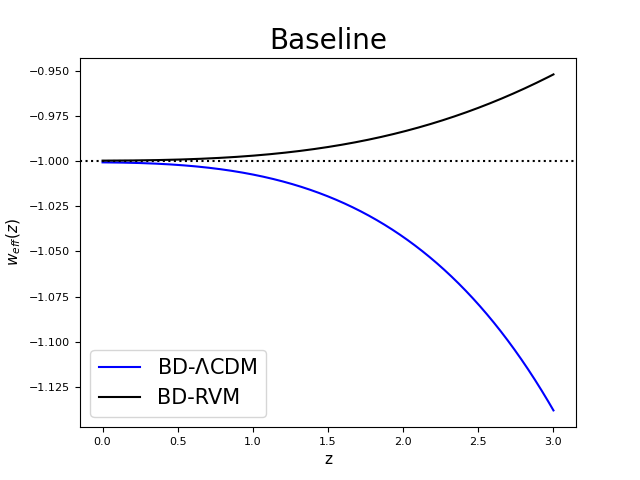
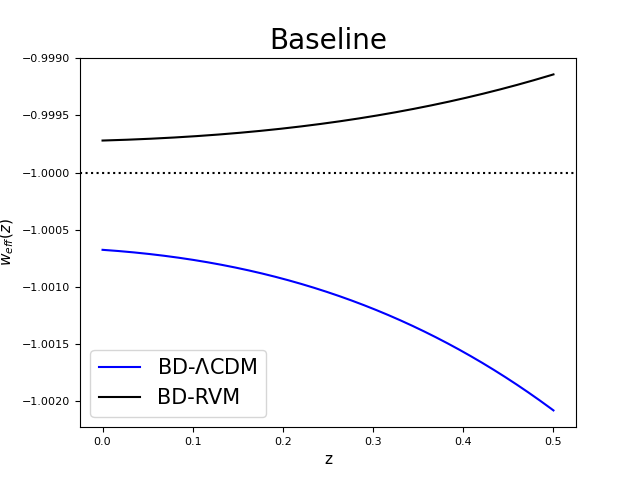
- 当引入 $H_0$ 先验时,BD-RVM 模型成功容纳了高 $H_0 \approx 70.47^{+0.70}_{-0.59}$ km/s/Mpc 和低 $\sigma_8 \approx 0.762 \pm 0.018$,从而同时解决了两种紧张问题。
- CMB 极化数据的引入增强了两种 BD 模型的统计表现,尤其在 Baseline+ $S_8$ 情况下,BD-RVM 模型表现出特别强的证据($\Delta$AIC、$\Delta$DIC $\sim$ 14)。
- 即使在应用 $H_0$ 先验时,BD-RVM 模型依然占优,而 BD-$\Lambda$CDM 模型则失去了统计偏好,凸显了运行真空在缓解 $H_0$ 紧张问题上的独特能力。
更好的研究,从现在开始
从阅读论文到最终审阅,大幅缩短您的研究时间。
无需绑定信用卡
本解读由 AI 生成,并经人工编辑审核。