
[论文解读] Sciences with the 2.5-meter Wide Field Survey Telescope (WFST)
WFST 是一台2.5米口径的宽视场光学望远镜,配备0.73吉像素相机,专为在u、g、r和i波段对北天进行深度、高时间分辨率的测光巡天而设计。它每年将探测数千个暂现源,包括引力波事件的电磁对应体、快速光学暂现源和潮汐破坏事件,同时提供持续6年的遗产数据集,达到g ≈ 25.8等,显著推动北半球时域天文学与宇宙学的发展。
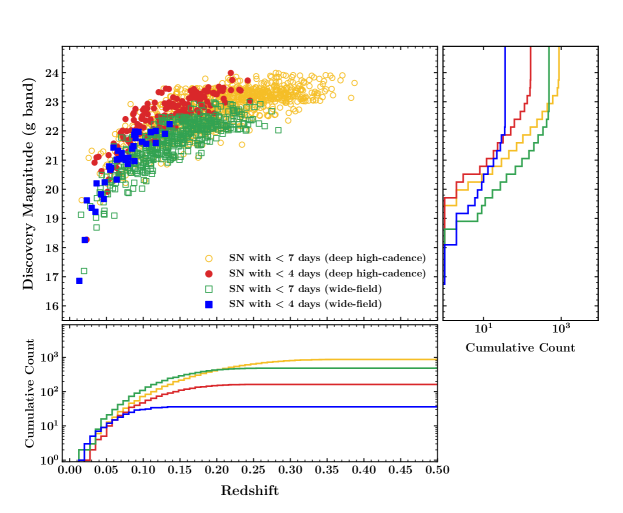
The Wide Field Survey Telescope (WFST) is a dedicated photometric surveying facility being built jointly by the University of Science and Technology of China and the Purple Mountain Observatory. It is equipped with a 2.5-meter diameter primary mirror, an active optics system, and a mosaic CCD camera with 0.73 gigapixels on the primary focal plane for high-quality image capture over an FOV of 6.5-square-degree. It is anticipated that WFST will be set up at the Lenghu site in the summer of 2023 and begin to observe the northern sky in four optical bands (u, g, r, and i) with a range of cadences, from hourly/daily in the Deep High-Cadence Survey (DHS) program to semiweekly in the Wide-Field Survey (WFS) program, three months later. During a photometric night, a nominal 30 s exposure in the WFS program will reach a depth of 22.27, 23.32, 22.84, and 22.31 (AB magnitudes) in these four bands, respectively, allowing for the detection of a tremendous amount of transients in the low-z universe and a systematic investigation of the variability of Galactic and extragalactic objects. In the DHS program, intranight 90 s exposures as deep as 23 (u) and 24 mag (g), in combination with target of opportunity follow-ups, will provide a unique opportunity to explore energetic transients in demand for high sensitivities, including the electromagnetic counterparts of gravitational wave events, supernovae within a few hours of their explosions, tidal disruption events and fast, luminous optical transients even beyond a redshift of unity. In addition, the final 6-year co-added images, anticipated to reach g=25.8 mag in WFS or 1.5 mags deeper in DHS, will be of fundamental importance to general Galactic and extragalactic science. The highly uniform legacy surveys of WFST will serve as an indispensable complement to those of LSST that monitor the southern sky.
研究动机与目标
- 在北半球建立一个专用的、高时间分辨率的测光巡天设施,以填补时域天文学与多信使天文学中的关键空白。
- 探测并表征诸如超新星、潮汐破坏事件(TDEs)以及引力波和高能中微子事件电磁对应体等高能暂现源。
- 以比以往巡天更高的深度和均匀性,绘制银河系三维尘埃分布、恒星族和卫星矮星系。
- 为罗伯特·伯尔顿天文台的LSST提供互补的遗产数据集,通过与其他巡天联合分析,增强宇宙学约束。
- 改进对太阳系小天体(包括近地天体、彗星和海王星外天体)的探测与表征,以检验第九行星假说。
提出的方法
- 为2.5米望远镜配备主动光学系统和0.73吉像素马赛克CCD相机,实现6.5平方度的视场。
- 开展两种主要巡天模式:半周一次的宽视场巡天(WFS)和每晚多次90秒曝光的深空高时间分辨率巡天(DHS)。
- 在光度条件良好时,实现u、g、r和i波段30秒曝光深度分别为22.27、23.32、22.84和22.31 AB等。
- 生成6年累积图像,WFS中g ≈ 25.8等,DHS中更深1.5个星等,支持深场星系和暗弱天体的巡天。
- 与未来的光谱巡天(如LAMOST II、MUST)集成,实现对暂现源和变星源的红移与物理特性表征。
- 利用堆叠成像数据,绘制三维尘埃消光图,识别恒星集团,并研究星系-晕连接与宇宙大尺度结构形成。
实验结果
研究问题
- RQ1在低红移宇宙中,快速明亮光学暂现源(FLTs)和引力波事件电磁对应体的事件率与源分布如何?
- RQ2大规模TDE样本如何揭示休眠超大质量黑洞的群体特征,并探测中等质量黑洞(IMBHs)的存在?
- RQ3活动星系核(AGNs)中极端光学变异性现象的物理起源是什么,特别是在强引力透镜和吸积物理背景下的表现?
- RQ4WFST的深度、均匀测光如何改善对银河系中缺失卫星问题和三维尘埃分布的约束?
- RQ5当与BAO、Ia型超新星、CMB和弱引力透镜巡天联合分析时,WFST的遗产成像数据能在多大程度上增强宇宙学约束?
主要发现
- WFST每年将探测约100至200个TDE,将可探测事件的红移范围扩展至z ≈ 1.0,从而支持对黑洞群体特征与吸积物理的研究。
- 在深空高时间分辨率巡天(DHS)中,WFST将实现u波段23等、g波段24等的深度,可探测爆炸后数小时内出现的超新星及红移z > 1的快速光学暂现源。
- 最终的6年累积图像在宽视场巡天中达到g ≈ 25.8等,深场巡天更深1.5个星等,其深度与均匀性超过DES和HSC-SSP。
- WFST的u波段覆盖巴耳末发射线,可精确测量年轻恒星对象与AGNs中的吸积率,提升尘埃消光建模精度。
- 六年内将产生约3拍字节的成像数据,覆盖WFS 8,000平方度、DHS 1,000平方度,为多波段与多信使研究奠定基础性遗产数据。
- WFST数据将通过提升对银河系晕中低面亮度矮星系的探测能力,直接检验缺失卫星问题,其r波段测光深度比Pan-STARRS1深2–3个星等。
更好的研究,从现在开始
从阅读论文到最终审阅,大幅缩短您的研究时间。
无需绑定信用卡
本解读由 AI 生成,并经人工编辑审核。