
[论文解读] Scientific CMOS sensors in Astronomy: IMX455 and IMX411
本文评估了基于索尼 IMX455 和 IMX411 传感器的 QHY600M Pro 和 QHY411M 科学 CMOS 相机在天文观测中的表现。研究展示了其在 −10°C 时暗电流极低(0.007–0.011 e⁻ px⁻¹ s⁻¹)、热点像素稳定,且测光精度在几毫星等以内,证明其适用于大视场、高时间分辨率的巡天观测,尽管存在随机电报噪声和盐粒状缺陷等挑战。
Scientific complementary metal-oxide-semiconductor (CMOS) detectors have developed quickly in recent years thanks to their low cost and high availability. They also have some advantages over charge-coupled devices (CCDs), such as high frame rate or typically lower readout noise. These sensors started to be used in astronomy following the development of the first back-illuminated models. Therefore, it is worth studying their characteristics, advantages, and weaknesses. One of the most widespread CMOS sensors are those from the Sony IMX series, which are included in large astronomical survey projects based on small and fast telescopes because of their low cost, and capability for wide-field and high-cadence surveys. In this paper, we aim to characterize the IMX455M and IMX411M sensors, which are integrated into the QHY600 and QHY411 cameras, respectively, for use in astronomical observations. These are large (36 $ imes$ 24 and 54 $ imes$ 40 mm) native 16 bit sensors with 3.76 $μ$m pixels and are sensitive in the optical range. We present the results of the laboratory characterization of both cameras. They showed a very low dark current of 0.011 and 0.007 e$^{-}$ px$^{-1}$ s$^{-1}$ @$-$10 C for the QHY600 and QHY411 cameras, respectively. They also show the presence of warm pixels, $\sim$0.024% in the QHY600 and 0.005% in the QHY411. Warm pixels proved to be stable and linear with exposure time, and are therefore easily corrected using dark frames. Pixels affected by the Salt \& Pepper noise are $\sim$2% of the total and a method to correct for this effect is presented. Both cameras were attached to night telescopes and several on-sky tests were performed to prove their capabilities. On-sky tests demonstrate that these CMOS behave as well as CCDs of similar characteristics and (for example) they can attain photometric accuracies of a few milli-magnitudes.
研究动机与目标
- 评估配备 IMX455 和 IMX411 sCMOS 传感器的 QHY600M Pro 和 QHY411M 相机在科学天文成像中的适用性。
- 在实验室和实际观测条件下,表征关键性能参数,如暗电流、读出噪声、线性度及非均匀性。
- 评估随机电报噪声和盐粒状缺陷等噪声源对测光精度的影响。
- 通过使用快速和慢速望远镜的实际天文观测,测试相机的性能表现。
- 识别处理大尺寸 16 位 sCMOS 数据集时的计算挑战,并提出基于 GPU 加速的高效处理方法。
提出的方法
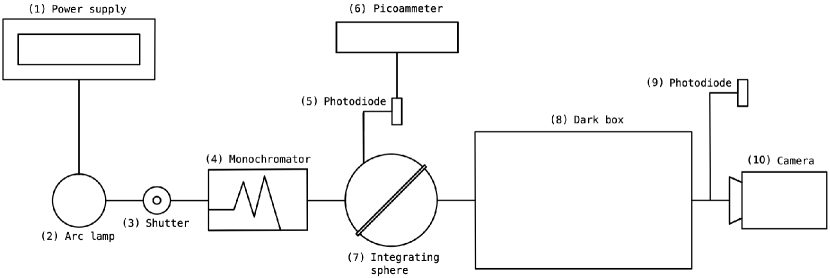
- 利用校准的光学测试平台(配备单色仪、积分球和参考光电二极管)对 QHY600M Pro 和 QHY411M 相机进行实验室表征。
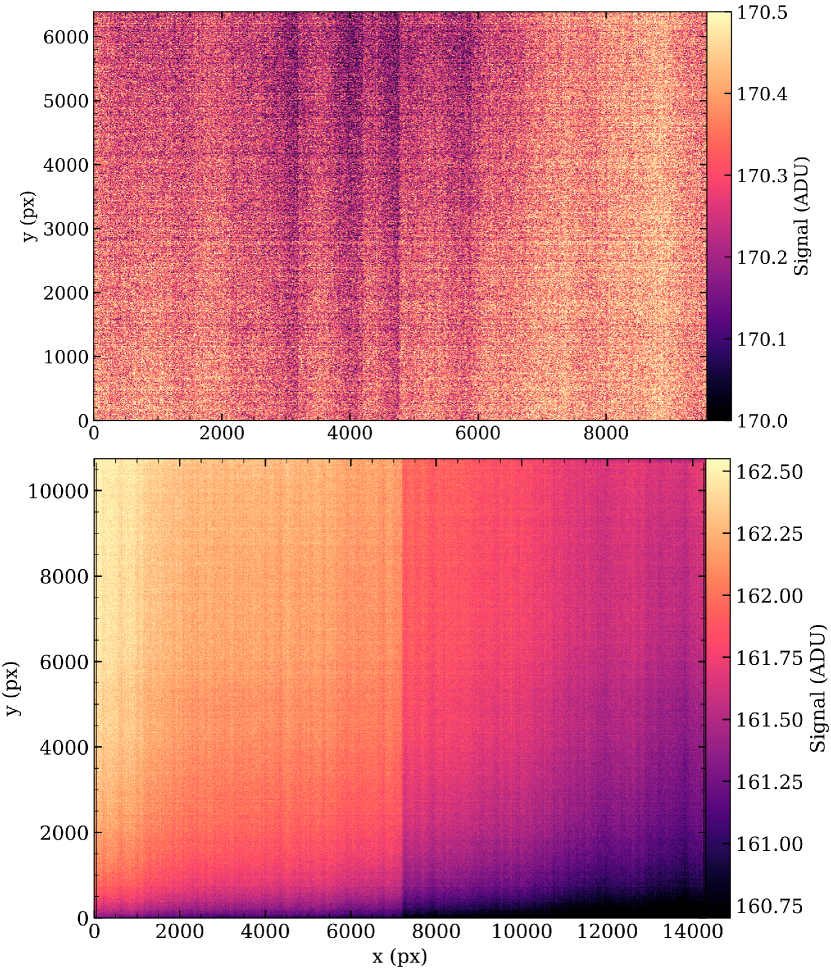
- 在 −10°C 条件下,通过多次曝光测量暗电流和偏置水平,以评估其时间稳定性与线性度。
- 在特内里费天文台的两米双子望远镜上开展实际天空观测,以验证测光性能。
- 采用暗帧减除法校正热点像素,并利用中值滤波和帧间差分法减轻盐粒状噪声影响。
- 评估 sigma 截断法与基于卷积的算法在高帧率序列中降噪的有效性。
- 探索基于 GPU 的处理流水线,以高效处理 120–300 MB 的原始图像文件,尤其适用于高时间分辨率巡天。
实验结果
研究问题
- RQ1在受控实验室条件下,IMX455 和 IMX411 sCMOS 传感器在暗电流、读出噪声和线性度方面的表现如何?
- RQ2热点像素和盐粒状噪声在多大程度上影响测光精度?是否可有效校正?
- RQ3在实际天文观测中,这些 sCMOS 相机能否实现与传统 CCD 相当的测光精度?
- RQ4处理高帧率、16 位 sCMOS 数据时面临哪些计算挑战?基于 GPU 的算法如何提升处理效率?
- RQ5在使用快速望远镜的大视场、高时间分辨率巡天场景中,这些传感器的表现如何?
主要发现
- QHY600M Pro 和 QHY411M 相机在 −10°C 时分别表现出极低的暗电流,分别为 0.011 e⁻ px⁻¹ s⁻¹ 和 0.007 e⁻ px⁻¹ s⁻¹,且随时间保持稳定和线性。
- QHY600M Pro 中热点像素占比为 0.024%,QHY411M 中为 0.005%,其信号随曝光时间线性增长,可通过暗帧减除法有效校正。
- 盐粒状噪声影响约 2% 的像素,本研究提出一种方法,通过中值插值或基于帧的滤波对这些像素进行掩蔽与校正。
- 实际天空测试表明测光精度在几毫星等以内,性能与同规格 CCD 相当。
- 传感器无电荷拖影或边缘辉光现象,量子效率在约 475 nm 处达到峰值 80%,在 700 nm 处降至 40%,在 900 nm 处降至 10%。
- 随机电报噪声在低信号区域引入显著的测光偏差,简单的平均或 sigma 截断法不足以有效抑制其影响。
更好的研究,从现在开始
从阅读论文到最终审阅,大幅缩短您的研究时间。
无需绑定信用卡
本解读由 AI 生成,并经人工编辑审核。