
[论文解读] Search for new phenomena in two-body invariant mass distributions using unsupervised machine learning for anomaly detection at $\sqrt{s} = 13$ TeV with the ATLAS detector
本研究利用无监督机器学习方法,在13 TeV下通过ATLAS探测器对两体不变质量分布中的异常现象进行模型无关的新物理搜索。自编码器在标准模型事例上进行训练,用于识别动量特征的偏离;在140 fb⁻¹的数据中未观测到显著异常,从而对多种基准新物理模型设定了新物理的限制。
Searches for new resonances are performed using an unsupervised anomaly-detection technique. Events with at least one electron or muon are selected from 140 fb$^{-1}$ of $pp$ collisions at $\sqrt{s} = 13$ TeV recorded by ATLAS at the Large Hadron Collider. The approach involves training an autoencoder on data, and subsequently defining anomalous regions based on the reconstruction loss of the decoder. Studies focus on nine invariant mass spectra that contain pairs of objects consisting of one light jet or $b$-jet and either one lepton ($e$, $μ$), photon, or second light jet or $b$-jet in the anomalous regions. No significant deviations from the background hypotheses are observed.
研究动机与目标
- 开发一种基于无监督机器学习的、与模型无关的新物理搜索策略,以超越标准模型的新物理为研究目标。
- 在不假设信号末态结构的前提下,检测两体不变质量分布中的异常现象。
- 应用基于自编码器的重建损失方法,识别偏离标准模型预期的事件。
- 评估该方法在多种具有接近2 TeV共振态的基准新物理模型中的灵敏度。
- 基于140 fb⁻¹的13 TeV质子-质子碰撞数据,设定新物理过程的排除极限。
提出的方法
- 在140 fb⁻¹的ATLAS数据上训练自编码器(AE),数据富含标准模型背景事例。
- 自编码器对输入事例进行重建,重建损失被用作异常评分,以识别非典型的事件。
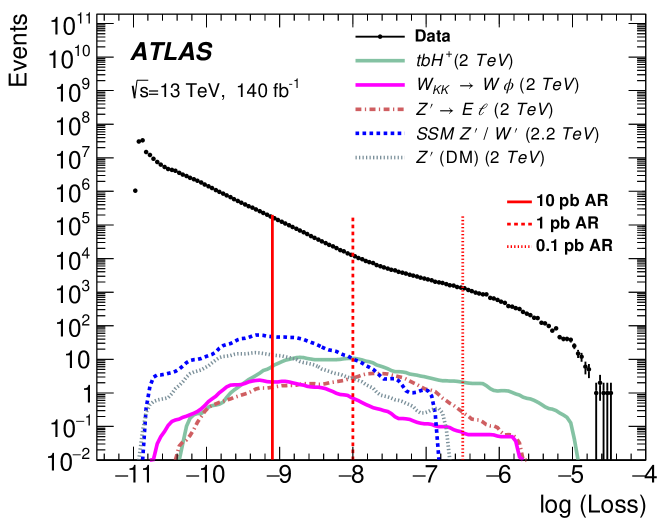
- 异常区域(ARs)基于高重建损失定义,与不变质量分布无关。
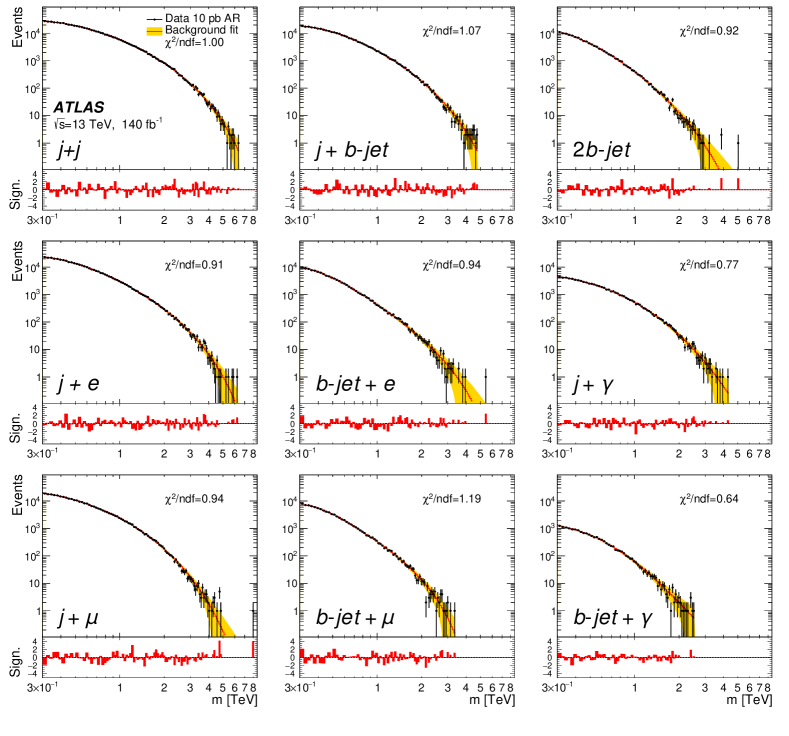
- 研究了九种两体末态:喷注+轻子、光子或第二喷注(轻子喷注或b-夸克喷注),选择领先或次领先对象。
- 通过孤立电子或μ子触发,可访问低于1 TeV的低质量共振态,避免触发阈值效应。
- 通过模拟基准新物理模型(如带电希格斯粒子、W'K、Z'、暗物质模型等)评估灵敏度并定义异常区域。
实验结果
研究问题
- RQ1无监督机器学习能否在不假设特定信号模型的前提下,检测两体不变质量谱中的新物理信号?
- RQ2基于自编码器的异常检测方法在多变量事件拓扑结构中,识别偏离标准模型背景的偏离现象的效率如何?
- RQ3该方法对具有接近2 TeV共振态的多种基准新物理模型的灵敏度极限是什么?
- RQ4与喷注触发搜索相比,轻子触发在探索低质量共振态方面有何优势?
- RQ5在不同末态和基准模型中,异常评分分布的观测显著性如何?
主要发现
- 在所研究的九种两体末态中,未观测到任何显著偏离标准模型背景假设的现象。
- 五种基准新物理模型(如H⁺、W'K、Z'、W'、Z'暗物质)的异常评分分布与背景预期一致,异常区域中无超额现象。
- 异常区域中可见截面的观测极限范围为0.05至0.5 fb,具体取决于模型和末态。
- 该方法成功识别出与标准模型预期不一致的动量特征,重建损失作为稳健的异常度量指标。
- 该搜索对质量约为2 TeV的共振态具有灵敏度,涵盖包括轻子末态、强子末态和二光子末态在内的多种末态。
- 未观测到显著信号,为新物理模型设定了新的排除极限,尤其针对衰变为包含b-夸克喷注、光子和轻子末态的共振态。
更好的研究,从现在开始
从阅读论文到最终审阅,大幅缩短您的研究时间。
无需绑定信用卡
本解读由 AI 生成,并经人工编辑审核。