
[论文解读] Search for Non-Tensorial Gravitational-Wave Backgrounds in the NANOGrav 15-Year Data Set
本研究利用贝叶斯模型比较方法,对NANOGrav 15年脉冲星计时阵列数据中的非张量引力波背景进行了研究。结果表明,标量横向(ST)与张量横向(TT)相关性的证据相当,贝叶斯因子约2.5支持ST模式;而矢量纵向(VL)和标量纵向(SL)模式则不被支持,其上限分别为$\mathcal{A}_{̅{VL}}^{95\%}≈ 1.7\times 10^{-15}$和$\mathcal{A}_{̅{SL}}^{95\%}≈ 7.4\times 10^{-17}$。广义横向(GT)模型的最优参数为$\alpha = 1.74^{+1.18}_{-1.41}$,在90%置信水平下既排除了TT模式($\alpha=3$)也排除了ST模式($\alpha=0$),表明数据尚不足以明确证实广义相对论所预测的引力波背景相关性。
The recent detection of a stochastic signal in the NANOGrav 15-year data set has aroused great interest in uncovering its origin. However, the evidence for the Hellings-Downs correlations, a key signature of the gravitational-wave background (GWB) predicted by general relativity, remains inconclusive. In this letter, we search for an isotropic non-tensorial GWB, allowed by general metric theories of gravity, in the NANOGrav 15-year data set. Our analysis reveals a Bayes factor of approximately 2.5, comparing the quadrupolar (tensor transverse, TT) correlations to the scalar transverse (ST) correlations, suggesting that the ST correlations provide a comparable explanation for the observed stochastic signal in the NANOGrav data. We obtain the median and the $90\%$ equal-tail amplitudes as $\mathcal{A}_\mathrm{ST} = 7.8^{+5.1}_{-3.5} imes 10^{-15}$ at the frequency of 1/year. Furthermore, we find that the vector longitudinal (VL) and scalar longitudinal (SL) correlations are weakly and strongly disfavoured by data, respectively, yielding upper limits on the amplitudes: $\mathcal{A}_\mathrm{VL}^{95\%} \lesssim 1.7 imes 10^{-15}$ and $\mathcal{A}_\mathrm{SL}^{95\%} \lesssim 7.4 imes 10^{-17}$. Lastly, we fit the NANOGrav data with the general transverse (GT) correlations parameterized by a free parameter $α$. Our analysis yields $α=1.74^{+1.18}_{-1.41}$, thus excluding both the TT ($α=3$) and ST ($α=0$) models at the $90\%$ confidence level.
研究动机与目标
- 检验NANOGrav 15年数据集中随机引力波背景(GWB)信号是否与广义相对论所预测的张量横向(TT)极化模式一致,或存在其他非张量模式。
- 评估标量横向(ST)、矢量纵向(VL)和标量纵向(SL)极化模式作为观测信号解释的可行性。
- 通过贝叶斯模型比较与后验推断,约束非张量引力波背景的振幅。
- 评估数据是否更倾向于采用以$\alpha$为参数的广义横向(GT)相关性模型,该模型在TT与ST极限之间插值。
提出的方法
- 使用贝叶斯因子进行贝叶斯模型比较,评估TT、ST、VL、SL及GT极化模式相对于数据的证据强度。
- 为GT模型采用参数化重叠相关函数(ORF),其中$\alpha$为自由参数,用于在TT($\alpha=3$)与ST($\alpha=0$)相关性之间插值。
- 采用分层贝叶斯推断框架,对每种极化模型的振幅$A$与幂律指数$\gamma$估计后验分布。
- 基于后验分布,计算VL与SL模式在95%可信区间的上限。
- 利用NANOGrav 15年计时残差数据集(包括脉冲星距离与色散量)计算每种极化类型的关联矩阵。
- 通过后验等高线图与模型比较指标(包括贝叶斯因子与可信区间)验证结果。
实验结果
研究问题
- RQ1NANOGrav 15年数据集中的随机信号是否更宜用张量横向(TT)相关性还是标量横向(ST)相关性来解释?
- RQ2矢量纵向(VL)与标量纵向(SL)极化模式是否与观测数据一致,还是被排除?
- RQ3描述数据的最优重叠相关函数是什么?它是否倾向于TT与ST之间的中间极化态?
- RQ4数据能否明确排除SL或VL等非张量引力波背景模型,还是仅能提供上限?
- RQ5广义横向(GT)模型(含自由参数$\alpha$)是否比标准TT或ST模型提供更优的拟合?
主要发现
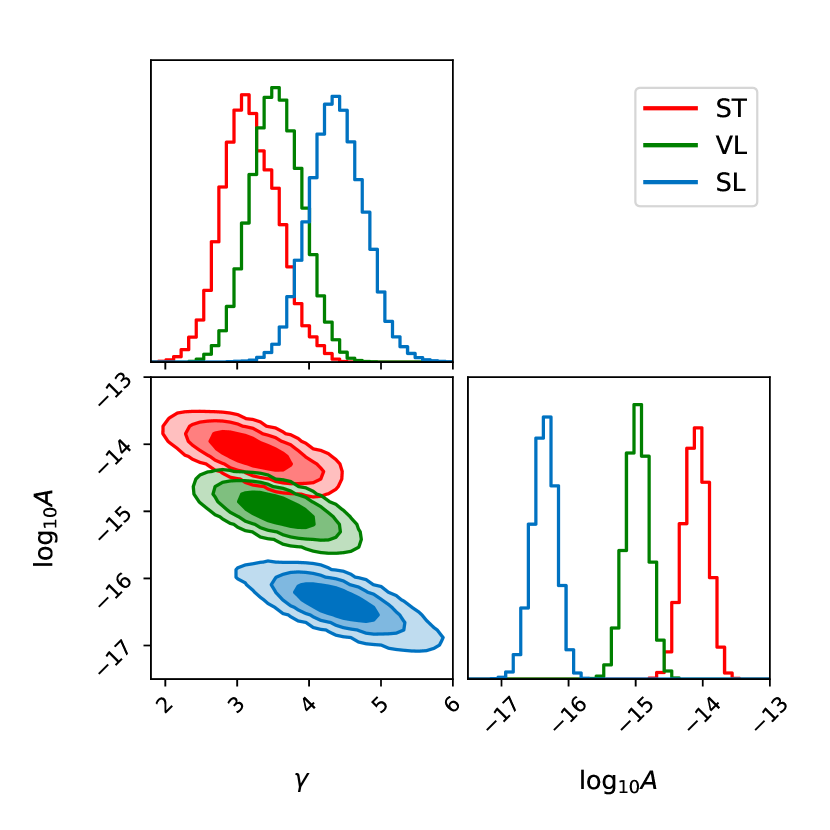
- 标量横向(ST)与张量横向(TT)相关性之间的贝叶斯因子约为2.5,表明ST相关性对观测到的随机信号具有可比的解释力。
- ST模式的中位振幅为$\mathcal{A}_{̅{ST}} = 7.8^{+5.1}_{-3.5} \times 10^{-15}$(频率为1/年),90%可信区间内。
- VL模式被弱排斥,相对于TT的贝叶斯因子为$0.12 \pm 0.02$,导致其上限为$\mathcal{A}_{̅{VL}}^{95\%} \lesssim 1.7 \times 10^{-15}$。
- SL模式被强烈排斥,相对于TT的贝叶斯因子为$0.002 \pm 0.001$,导致其上限极为严格,为$\mathcal{A}_{̅{SL}}^{95\%} \lesssim 7.4 \times 10^{-17}$。
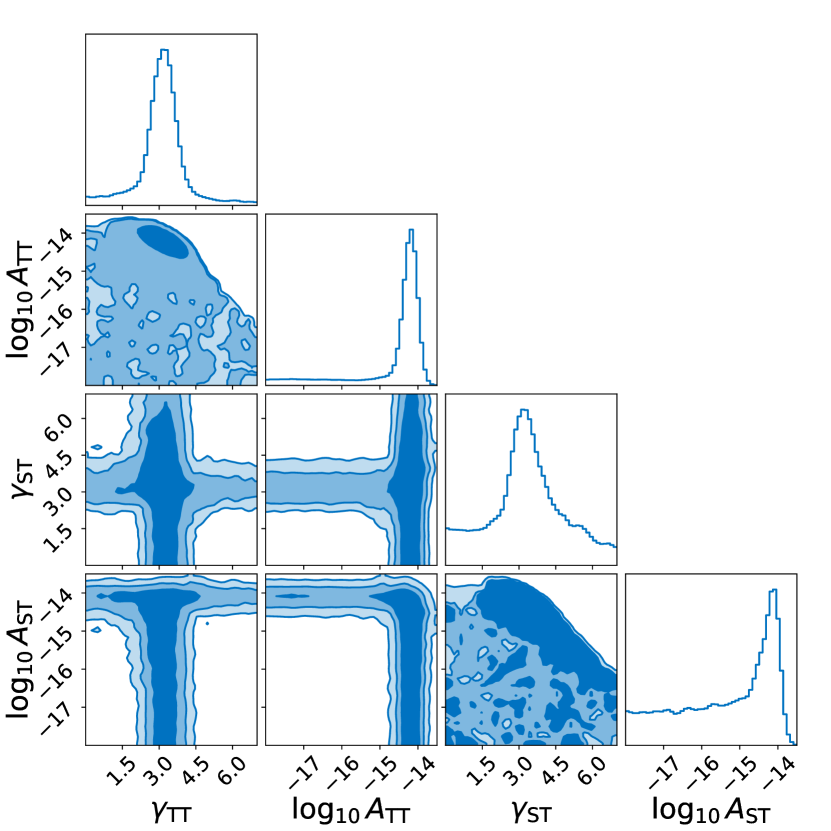
- 在广义横向(GT)模型中,最优拟合的$\alpha$为$1.74^{+1.18}_{-1.41}$,在90%置信水平下既排除了TT模式($\alpha=3$)也排除了ST模式($\alpha=0$)。
- GT最优模型与TT模型之间的贝叶斯因子为$3.9 \pm 0.3$,表明数据更偏好广义相关性模型而非标准的Hellings-Downs(TT)相关性。
更好的研究,从现在开始
从阅读论文到最终审阅,大幅缩短您的研究时间。
无需绑定信用卡
本解读由 AI 生成,并经人工编辑审核。