
[论文解读] Search for supersymmetry in final states with disappearing tracks in proton-proton collisions at $\sqrt{s}$ = 13 TeV
本论文利用CMS探测器,在√s = 13 TeV的质子-质子碰撞中搜索超对称性,重点关注长寿命带电sparticle(charginos)产生的消失轨迹末态。通过采用先进的轨迹重建技术、dE/dx测量以及基于机器学习的分类方法,该分析显著提升了对wino和higgsino型charginos的探测灵敏度,对胶球和squark对产生以及电弱ino产生设定了迄今为止最严格的限制,且未观测到显著超出背景的信号。
A search is presented for charged, long-lived supersymmetric particles in final states with one or more disappearing tracks. The search is based on data from proton-proton collisions at a center-of-mass energy of 13 TeV collected with the CMS detector at the CERN LHC between 2016 and 2018, corresponding to an integrated luminosity of 137 fb$^{-1}$. The search is performed over final states characterized by varying numbers of jets, b-tagged jets, electrons, and muons. The length of signal-candidate tracks in the plane perpendicular to the beam axis is used to characterize the lifetimes of wino- and higgsino-like charginos produced in the context of the minimal supersymmetric standard model. The d$E$/d$x$ energy loss of signal-candidate tracks is used to increase the sensitivity to charginos with a large mass and thus a small Lorentz boost. The observed results are found to be statistically consistent with the background-only hypothesis. Limits on the pair production cross section of gluinos and squarks are presented in the framework of simplified models of supersymmetric particle production and decay, and for electroweakino production based on models of wino and higgsino dark matter. The limits presented are the most stringent to date for scenarios with light third-generation squarks and a wino- or higgsino-like dark matter candidate capable of explaining the known dark matter relic density.
研究动机与目标
- 利用2016至2018年间在√s = 13 TeV下由CMS探测器收集的137 fb⁻¹质子-质子碰撞数据,搜索长寿命超对称粒子,特别是具有消失轨迹末态的charginos。
- 通过引入dE/dx测量和基于机器学习的轨迹分类方法,提升对wino和higgsino型charginos的探测灵敏度。
- 将搜索扩展至新的末态,包括电子+DTk和μ子+DTk通道,以探测轻子衰变模式。
- 对超对称粒子产生简化模型及电弱ino暗物质情景设定迄今为止最严格的排除极限。
提出的方法
- 利用2016至2018年间在√s = 13 TeV下由CMS探测器收集的137 fb⁻¹质子-质子碰撞数据。
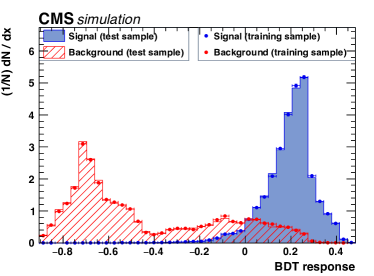
- 应用基于机器学习的轨迹分类算法,以提高识别消失轨迹的效率并增强对背景的抑制能力。
- 利用信号候选轨迹的dE/dx测量,提升对低洛伦兹因子(尤其在高质质量下)charginos的探测灵敏度。
- 根据喷注、b夸克标记喷注、电子和μ子的多重性定义搜索区域,以区分强相互作用与电弱相互作用产生机制。
- 使用模拟事件样本对信号和标准模型背景进行建模,并进行详细的系统误差评估。
- 执行统计检验,将观测数据与仅含背景的假设进行比较,结果表明与无新物理信号一致。
实验结果
研究问题
- RQ1在超对称性简化模型中,基于消失轨迹信号,对胶球和squark对产生设定了怎样的最严格排除极限?
- RQ2在电弱ino介导的场景中,引入电子+DTk和μ子+DTk末态如何提升对长寿命charginos的探测灵敏度?
- RQ3dE/dx测量在多大程度上提升了对低洛伦兹因子高质质量charginos的探测灵敏度?
- RQ4基于长寿命charginos衰变的纯wino和higgsino暗物质模型的排除极限是多少?
- RQ5结果如何约束具有轻量第三代squark及wino或higgsino型LSP的物理情景?
主要发现
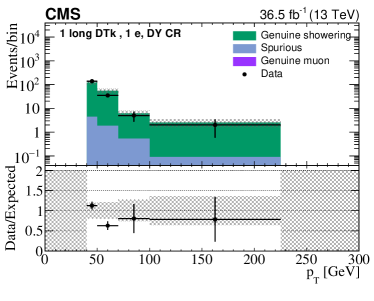
- 观测数据在统计上与仅含背景的假设一致,未发现表明存在新物理的显著过量。
- 该分析对具有轻量第三代squark及wino或higgsino型暗物质候选者的场景设定了迄今为止最严格的排除极限。
- 对于纯wino暗物质模型,charginos的排除质量上限达到650 GeV。
- 对于纯higgsino暗物质模型,charginos的排除质量上限达到210 GeV。
- 引入电子+DTk和μ子+DTk通道,结合基于dE/dx的选择方法,显著提升了对高质质量和低洛伦兹因子charginos的探测灵敏度。
- 基于机器学习的轨迹分类方法提高了信号效率并增强了背景抑制能力,从而整体提升了搜索的灵敏度。
更好的研究,从现在开始
从阅读论文到最终审阅,大幅缩短您的研究时间。
无需绑定信用卡
本解读由 AI 生成,并经人工编辑审核。