
[论文解读] Secrecy Outage Analysis of Energy Harvesting Relay-based Mixed UOWC-RF Network with Multiple Eavesdroppers
本文分析了在存在多个窃听者的情况下,混合水下光通信(UOWC)-射频(RF)网络中能量采集中继的物理层安全性能。推导了在合谋与非合谋窃听者场景下,保密中断概率、严格正保密容量概率以及有效保密吞吐量的闭式表达式,结果表明合谋窃听者会严重降低保密性能,而外差检测与分集合并技术则能显著提升安全性。
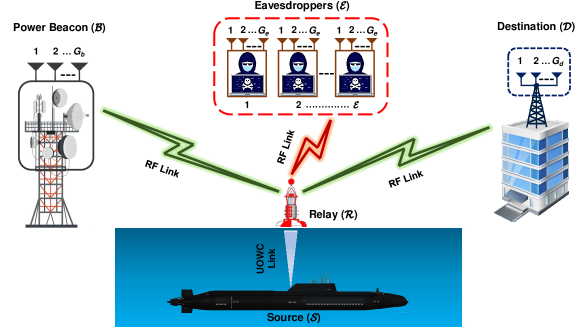
This work deals with the physical layer security performance of a dual-hop underwater optical communication (UOWC)-radio frequency (RF) network under the intruding attempts of multiple eavesdroppers via RF links. The intermediate decode and forward relay node between the underwater source and the destination transforms the optical signal into electrical form and re-transmits it to the destination node with the help of harvested energy by the relay from an integrated power beacon within the system. The source-to-relay link (UOWC) follows a mixture exponential generalized Gamma turbulence with pointing error impairments whereas all the remaining links (RF) undergo $κ-μ$ shadowed fading. With regards to the types of intruders, herein two scenarios are considered, i.e., colluding ( extit{Scenario-I}) and non-colluding ( extit{Scenario-II}) eavesdroppers and the analytical expressions of secure outage probability, probability of strictly positive secrecy capacity, and effective secrecy throughput are derived in closed form for each scenario. Furthermore, the impacts of UOWC and RF channel parameters as well as detection techniques on secrecy capacity are demonstrated, and following this a comparison between the two considered scenarios is demonstrated that reveals the collusion between the eavesdroppers imposes the most harmful threat on secrecy throughput but a better secrecy level can be attained adopting diversity at the destination and power beacon nodes along with heterodyne detection rather than intensity modulation and direct detection technique. Finally, all the derived expressions are corroborated via Monte Carlo simulations.
研究动机与目标
- 评估采用能量采集解码转发中继的双跳UOWC-RF网络的物理层安全性能。
- 建立并比较合谋与非合谋窃听者对混合UOWC-RF环境中保密性能指标的影响。
- 研究信道参数(如衰落严重性、指向误差)以及检测技术对保密吞吐量和中断性能的影响。
- 证明在接收端和能量信标节点采用分集合并,以及使用外差检测,可显著提升保密性能。
提出的方法
- 采用带有指向误差影响的混合指数广义伽马分布建模源节点到中继节点的链路,以表征UOWC衰落特性。
- 采用κ-μ阴影衰落分布建模中继节点到目的地和中继节点到窃听者节点的链路,以表征RF信道特性。
- 针对合谋(场景-I)与非合谋(场景-II)窃听者情况,推导保密中断概率(SOP)、严格正保密容量概率(SPSC)以及有效保密吞吐量(EST)的闭式表达式。
- 利用统计信道模型与基于矩生成函数(MGF)的技术,在信道状态信息不完美条件下推导解析表达式。
- 通过在各种信道条件与系统参数下进行蒙特卡洛仿真,验证所有解析结果的准确性。
- 比较不同检测技术(外差检测与IM/DD)以及不同系统配置(分集、信标功率)下的保密性能。
实验结果
研究问题
- RQ1在具有能量采集功能的UOWC-RF混合网络中,合谋与非合谋窃听者场景下的保密中断概率如何变化?
- RQ2UOWC湍流与指向误差对实现严格正保密容量概率的影响是什么?
- RQ3RF链路中的衰落参数(κ, μ, m)如何影响有效保密吞吐量?
- RQ4与强度调制与直接检测(IM/DD)相比,外差检测在多大程度上提升了保密性能?
- RQ5在接收端和能量信标节点采用分集合并,能否缓解窃听者合谋带来的负面影响?
主要发现
- 合谋窃听者场景下的保密性能显著劣于非合谋场景,由于协同解码导致EST值更低。
- 中继到目的地和中继到窃听者链路的κ和μ参数增大,可提高严格正保密容量概率(SPSC),表明中继链路中更高的衰落严重性反而有助于提升保密性。
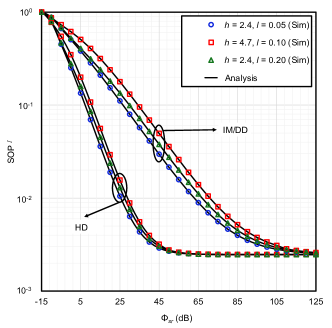
- 外差检测在高指向误差与湍流条件下,相比IM/DD可实现更高的有效保密吞吐量。
- 中继的能量转换效率(ηr)提高可显著改善保密中断概率(SOP),表明更高的采集能量可带来更可靠的传输。
- 在接收端和能量信标节点采用分集合并可显著增强保密性能,尤其在高窃听攻击场景下效果明显。
- 系统的保密性能由性能较差的链路主导,而源节点到中继节点(UOWC)链路因湍流与指向误差成为最关键的瓶颈。
更好的研究,从现在开始
从阅读论文到最终审阅,大幅缩短您的研究时间。
无需绑定信用卡
本解读由 AI 生成,并经人工编辑审核。