
[论文解读] Security Enhancement for Coupled Phase-Shift STAR-RIS Networks
本文提出了一种基于惩罚的保密波束成形(PSB)算法,用于耦合相移智能反射面(STAR-RIS)网络,以最大化室内与室外用户之间的最小保密容量,确保公平性与安全性。该方法在相位耦合约束下联合优化了发射波束成形与相移系数,仅通过4位量化即实现了接近连续相移性能。
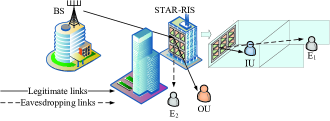
The secure transmission of the simultaneously transmitting and reflecting reconfigurable intelligent surface (STAR-RIS) aided communication system is investigated. Considering the coupled phase shifts of STAR-RISs and the fair secrecy requirement of users, a novel secure beamforming design is proposed for addressing the unique full-space mutual eavesdropping of STAR-RIS aided communication. In particular, a penalty based secrecy beamforming algorithm is developed to solve the resulting non-convex optimization problem, where the closed-form solutions of the coupled transmission/reflection coefficients are obtained in each iteration. Numerical results demonstrate that 1) the proposed scheme achieves higher secrecy capacity than conventional RIS; 2) 4-bit discrete phase shifters are sufficient for secrecy guarantee.
研究动机与目标
- 解决STAR-RIS网络中因同时传输与反射导致全空间窃听风险增加的安全挑战。
- 设计一种安全波束成形方案,在相位耦合约束下确保室内与室外用户之间的保密容量公平性。
- 构建一种优化框架,联合设计发射波束成形与STAR-RIS反射/透射系数,考虑实际相位耦合与量化约束。
- 评估STAR-RIS相较于传统RIS的保密性能增益,并确定实现近似最优性能所需的最小相位量化位数。
提出的方法
- 提出一种基于惩罚的保密波束成形(PSB)算法,以解决具有耦合相移约束的非凸优化问题。
- 在外部循环中使用增广拉格朗日(AL)松弛方法处理耦合相移约束。
- 在内部循环中应用半定松弛(SDR)以获得秩一的发射波束成形向量。
- 利用一阶最优性条件推导出耦合透射与反射系数的闭式解。
- 通过最大化所有用户之间的最小保密容量,确保收敛性并维持公平性。
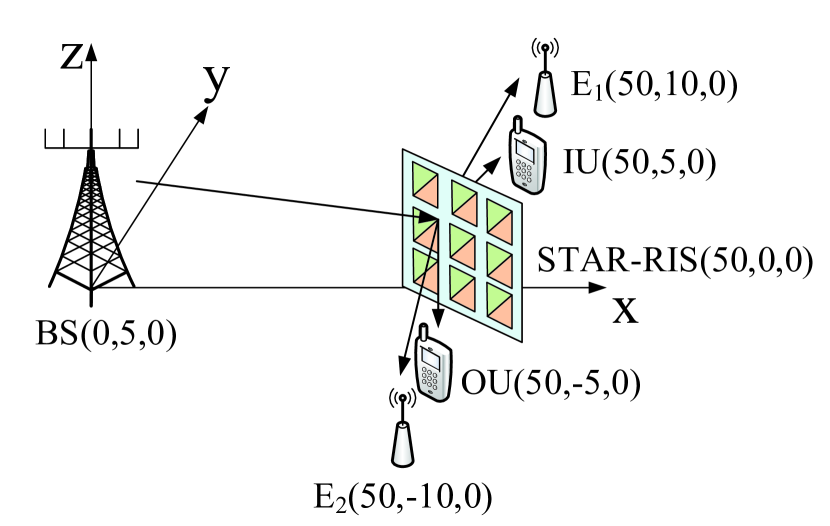
- 系统模型假设为莱斯衰落信道,并在功率与相位耦合约束下联合优化波束成形与STAR-RIS相移。
实验结果
研究问题
- RQ1在传输与反射系数固有耦合的耦合相移STAR-RIS网络中,如何增强物理层安全性?
- RQ2在公平性约束下,何种波束成形策略可最大化室内与室外用户之间的最小保密容量?
- RQ3相位量化如何影响耦合相移STAR-RIS系统中的保密性能?
- RQ4在保密容量方面,连续相移与离散相移之间的性能差距是多少?
主要发现
- 所提出的PSB算法在保密容量方面优于传统RIS,证明了STAR-RIS在安全通信中的优越性。
- 该方案通过最大化室内与室外用户之间的最小保密容量,确保了公平性。
- 仅通过4位相位量化,离散STAR-RIS即可实现与连续相移相当的保密性能。
- 耦合相移STAR-RIS优于传统RIS与随机相移方案,尽管由于相位耦合,其性能略逊于独立相移STAR-RIS。
- 在低发射功率区域,时隙切换(TS)方案优于能量分割(ES)方案,因其可实现无干扰解码;而在高功率区域,ES方案表现更优,因其时间利用效率更高。
- 将STAR-RIS部署于用户端可获得更高的保密性能,原因在于级联链路路径损耗更低。
更好的研究,从现在开始
从阅读论文到最终审阅,大幅缩短您的研究时间。
无需绑定信用卡
本解读由 AI 生成,并经人工编辑审核。