
[论文解读] Self-Checker: Plug-and-Play Modules for Fact-Checking with Large Language Models
Self-Checker 是一个即插即用的框架,通过四个基于提示的模块——声明处理、查询生成、证据检索和结论预测——实现使用大语言模型(LLMs)的零样本事实核查。实证结果表明,它在 WiCE 和 Fever 数据集上取得了具有竞争力的性能,尽管仍落后于微调过的最先进模型,凸显了 LLM 提示技术在事实核查中的潜力与当前局限性。
Fact-checking is an essential task in NLP that is commonly utilized for validating the factual accuracy of claims. Prior work has mainly focused on fine-tuning pre-trained languages models on specific datasets, which can be computationally intensive and time-consuming. With the rapid development of large language models (LLMs), such as ChatGPT and GPT-3, researchers are now exploring their in-context learning capabilities for a wide range of tasks. In this paper, we aim to assess the capacity of LLMs for fact-checking by introducing Self-Checker, a framework comprising a set of plug-and-play modules that facilitate fact-checking by purely prompting LLMs in an almost zero-shot setting. This framework provides a fast and efficient way to construct fact-checking systems in low-resource environments. Empirical results demonstrate the potential of Self-Checker in utilizing LLMs for fact-checking. However, there is still significant room for improvement compared to SOTA fine-tuned models, which suggests that LLM adoption could be a promising approach for future fact-checking research.
研究动机与目标
- 开发一种无需训练、高效的事实核查系统,利用大语言模型(LLMs)且无需微调。
- 通过利用外部证据自动验证生成的声明,解决 LLM 幻觉问题。
- 通过基于模块化、提示驱动的组件,实现在低资源或新领域设置下的快速部署。
- 评估纯提示驱动的 LLM 在事实核查方面与微调过的最先进模型相比的效能。
- 识别在使用 LLM 进行验证时,事实核查流程中的主要瓶颈,特别是结论预测环节。
提出的方法
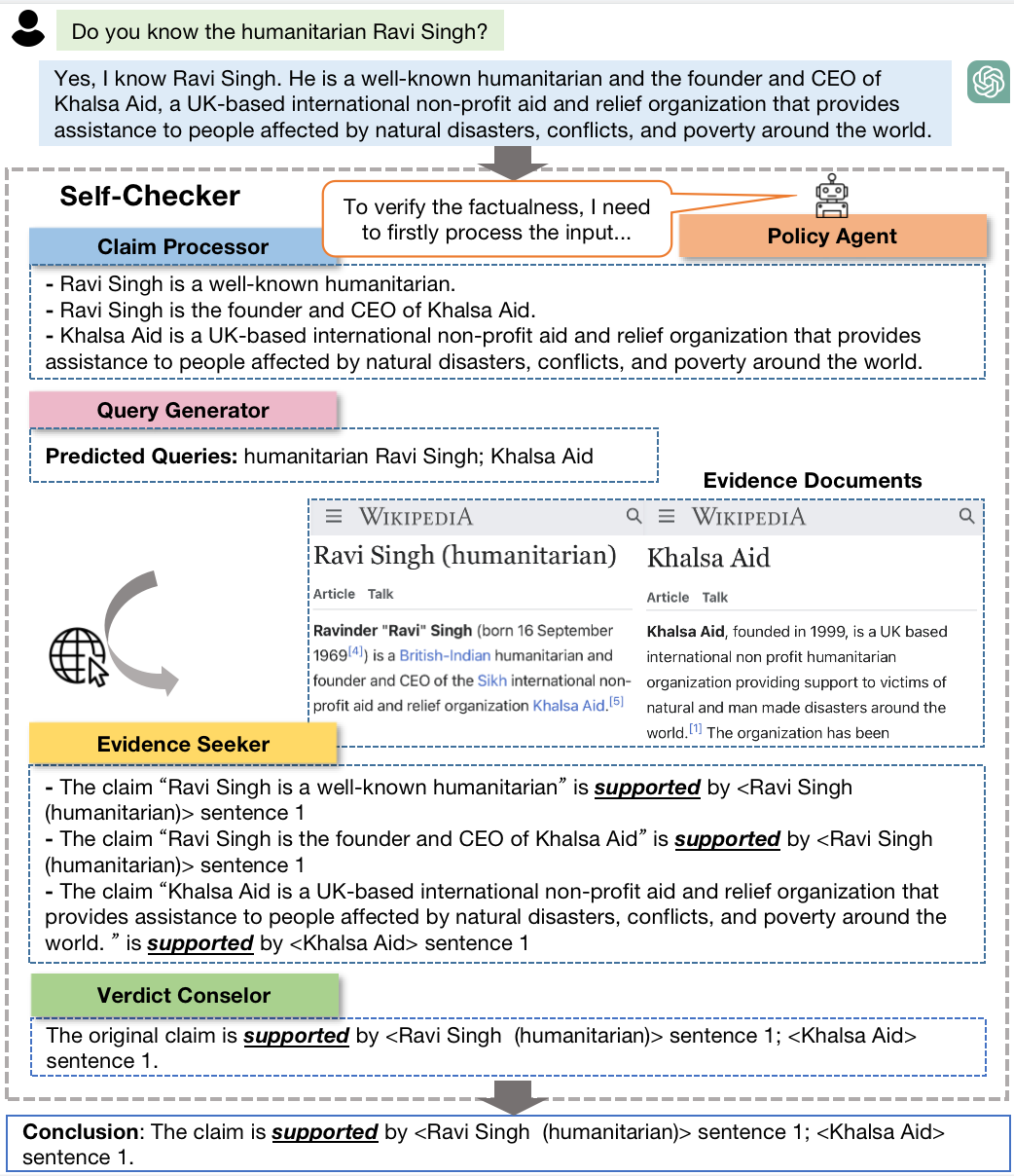
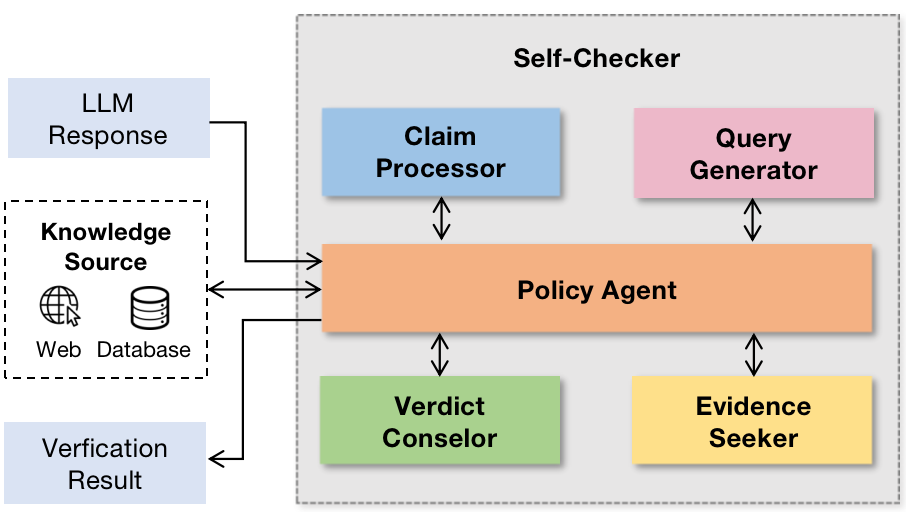
- 使用包含上下文示例提示的声明处理器模块,将复杂声明分解为更简单、可验证的子声明。
- 使用查询生成器模块为每个子声明生成有针对性的搜索查询,从而从维基百科等知识源中检索信息。
- 采用证据搜寻模块,利用 LLM 提示从检索到的文档中提取相关证据句子。
- 使用结论顾问模块基于提取的证据评估声明的真实性,并对多个声明的结果进行聚合。
- 集成策略代理,根据任务指令和上下文示例,协调各模块之间的工作流。
- 通过依赖包含演示的上下文学习,避免模型微调,在近乎零样本的设置下运行。
实验结果
研究问题
- RQ1能否仅通过提示和上下文学习,有效利用 LLM 实现无需微调的事实核查?
- RQ2纯提示驱动的事实核查系统性能与最先进微调模型相比如何?
- RQ3在使用 LLM 进行验证时,事实核查流程中哪个组件是主要瓶颈?
- RQ4声明分解在多大程度上能提升基于 LLM 的事实核查系统中的证据检索和结论预测性能?
- RQ5Self-Checker 的模块化、即插即用设计能否在极低资源需求下有效适配新领域?
主要发现
- Self-Checker 在零样本事实核查中展现出强大潜力,在无需任何模型微调的情况下,于 WiCE 和 Fever 数据集上均取得了合理性能。
- 结论顾问模块被识别为流程中的主要瓶颈,表明基于 LLM 的系统在声明验证方面仍面临关键挑战。
- 证据检索性能并非主要限制因素,因为对证据搜寻模块的改进并未显著提升整体结果。
- 声明分解提升了证据检索和结论预测性能,与先前研究结果一致,并增强了系统的整体准确性。
- 尽管具备高效性和可扩展性,Self-Checker 的性能仍低于最先进微调模型,表明 LLM 提示策略仍有优化空间。
- 该框架支持在低资源环境中快速部署,并通过其模块化、提示驱动的设计,实现新数据或新领域的轻松集成。
更好的研究,从现在开始
从阅读论文到最终审阅,大幅缩短您的研究时间。
无需绑定信用卡
本解读由 AI 生成,并经人工编辑审核。