
[论文解读] Self-Consistent Velocity Matching of Probability Flows
本文提出自洽速度匹配(SCVM),一种无需离散化、可扩展的框架,用于求解如福克-普朗克方程和 Wasserstein 梯度流等质量守恒 PDE。通过使用带偏差梯度估计器的迭代优化,强制速度场与概率流之间保持自洽性,SCVM 在无时间或空间离散化的情况下,实现了高维空间中更优的精度与速度。
We present a discretization-free scalable framework for solving a large class of mass-conserving partial differential equations (PDEs), including the time-dependent Fokker-Planck equation and the Wasserstein gradient flow. The main observation is that the time-varying velocity field of the PDE solution needs to be self-consistent: it must satisfy a fixed-point equation involving the probability flow characterized by the same velocity field. Instead of directly minimizing the residual of the fixed-point equation with neural parameterization, we use an iterative formulation with a biased gradient estimator that bypasses significant computational obstacles with strong empirical performance. Compared to existing approaches, our method does not suffer from temporal or spatial discretization, covers a wider range of PDEs, and scales to high dimensions. Experimentally, our method recovers analytical solutions accurately when they are available and achieves superior performance in high dimensions with less training time compared to alternatives.
研究动机与目标
- 解决现有 PDE 求解器依赖空间或时间离散化所带来的局限,这些局限在高维空间中限制了可扩展性和精度。
- 克服基于伴随法在福克-普朗克方程及相关 PDE 中实现自洽性时的计算低效问题。
- 开发一种统一的、可微分的框架,适用于除福克-普朗克或梯度流之外更广泛的质量守恒 PDE 类。
- 通过神经网络参数化,无需基于网格的表示,实现高维空间中概率流的准确且高效学习。
- 在复杂动力学(如流动喷溅和光滑测度插值)上展示方法的灵活性,这些场景中先前方法失效或产生伪影。
提出的方法
- 将质量守恒 PDE 的求解表述为自洽的固定点问题,其中速度场必须与它所生成的流相匹配。
- 采用迭代优化方案,在每一步中利用神经网络参数化的概率流来优化速度场。
- 使用偏差梯度估计器,避免对伴随微分的依赖,显著提升训练速度与可扩展性。
- 重新表述速度匹配目标,消除福克-普朗克方程中代价高昂的项(如 ∇log p_t),提升计算效率。
- 支持两种参数化模式:时间增量前推(TIPF)与连续速度场(NODE),实现对不同动力学的灵活性支持。
- 通过避免基于网格的离散化,仅依赖神经网络推理与优化,保持完全可微性与可扩展性。

实验结果
研究问题
- RQ1能否设计一种自洽速度匹配框架,在无需时间或空间离散化的情况下求解广泛的质量守恒 PDE?
- RQ2如何利用神经网络与迭代优化,在高维概率流中高效实现自洽性?
- RQ3在 PDE 约束的流学习中,偏差梯度估计器能否在训练速度与性能上超越伴随法?
- RQ4SCVM 在多大程度上能推广到如流动喷溅与光滑测度插值等复杂动力学,而不仅限于标准福克-普朗克或梯度流设定?
- RQ5SCVM 在高维问题中与最先进方法(如 JKO、伴随法与基于粒子的求解器)相比,在定量与定性表现上如何?
主要发现
- SCVM 以高精度恢复质量守恒 PDE 的解析解,在低维空间中性能与或超过先前方法。
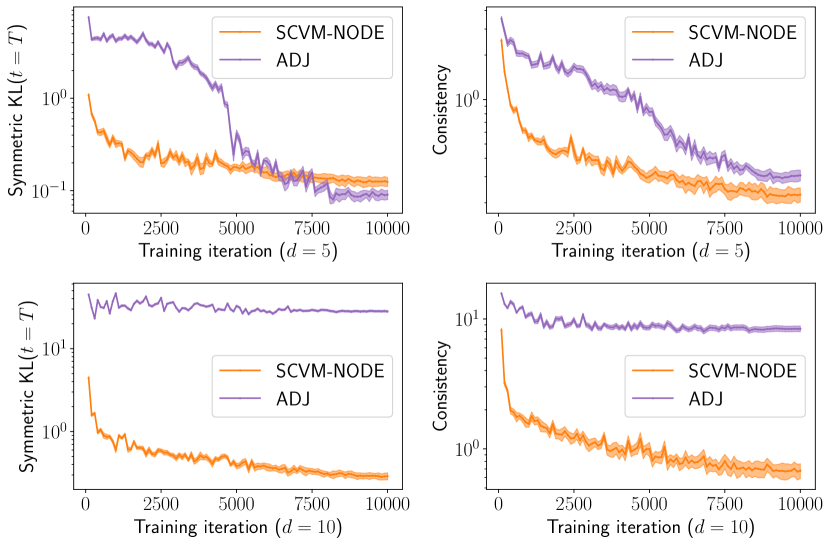
- 在高维设置中(例如 d=10),SCVM 的训练速度比伴随法(ADJ)快 30 倍,且 Wasserstein-2 与 KL 散度指标相当或更优。
- 对于具有谐振漂移的时间依赖福克-普朗克方程,SCVM-TIPF 与 SCVM-NODE 的结果与 ADJ 相当,但训练时间显著减少。
- 在流动喷溅模拟中,SCVM 生成连续且无伪影的粒子轨迹,而 DFE(轨迹不连续)与 SDE-EM(障碍物交叉)则存在缺陷,ADJ 则出现数值不稳定性。
- SCVM 能够成功建模非福克-普朗克动力学(如带有相互作用项的群体行为),证明其在标准 PDE 类之外的广泛适用性。
- 在光滑测度插值任务中,SCVM 实现了新颖的公式(如基于最优传输的公式),这些公式对竞争方法不可行,生成了视觉连贯的形状形变动画。
更好的研究,从现在开始
从阅读论文到最终审阅,大幅缩短您的研究时间。
无需绑定信用卡
本解读由 AI 生成,并经人工编辑审核。