
[论文解读] Self-Interference Channel Characterization in Underwater Acoustic In-Band Full-Duplex Communications Using OFDM
该论文通过湖上实验,利用正交频 division multiplexing (OFDM) 对水下声学同频全双工 (UWA-IBFD) 系统中的自干扰信道冲激响应 (SCIR) 进行表征。结果表明,直射路径强且稳定,而贡献了 16% 自干扰功率的表面反射路径具有约 70 ms 的短相干时间,表现出高度时变特性,难以消除,尽管它是主导的反射路径。
Due to the limited available bandwidth and dynamic channel, data rates are extremely limited in underwater acoustic (UWA) communications. Addressing this concern, in-band fullduplex (IBFD) has the potential to double the efficiency in a given bandwidth. In an IBFD scheme, transmission and reception are performed simultaneously in the same frequency band. However, in UWA-IBFD, because of reflections from the surface and bottom and the inhomogeneity of the water, a significant part of the transmitted signal returns back to the IBFD receiver. This signal contaminates the desired signal from the remote end and is known as the self-interference (SI). With an estimate of the self-interference channel impulse response (SCIR), a receiver can estimate and eliminate the SI. A better understanding of the statistical characteristics of the SCIR is necessary for an accurate SI cancellation. In this article, we use an orthogonal frequency division multiplexing (OFDM) signal to characterize the SCIR in a lake water experiment. To verify the results, SCIR estimation is performed using estimators in both the frequency and time domains. We show that, in our experiment, regardless of the depth of the hydrophone, the direct path of SCIR is strong, stable and easily tracked; however, the reflection paths are weaker and rapidly time-varying making SI cancellation challenging. Among the reflections, the first bounce from the water surface is the prevalent path with a short coherence time around 70 ms.
研究动机与目标
- 理解水下声学同频全双工 (UWA-IBFD) 系统中自干扰信道冲激响应 (SCIR) 的统计特性。
- 通过分析功率延迟分布 (PDP)、自相关函数 (ACF) 和相干时间 (COT),评估自干扰消除的可行性。
- 比较频域与时域 SCIR 估计方法在动态水下环境中的鲁棒性。
- 确定哪些多径分量主导自干扰功率,以及其时变行为如何影响消除性能。
- 评估传统 OFDM 信道估计假设(块内恒定)是否适用于 UWA-IBFD 的 SCIR。
提出的方法
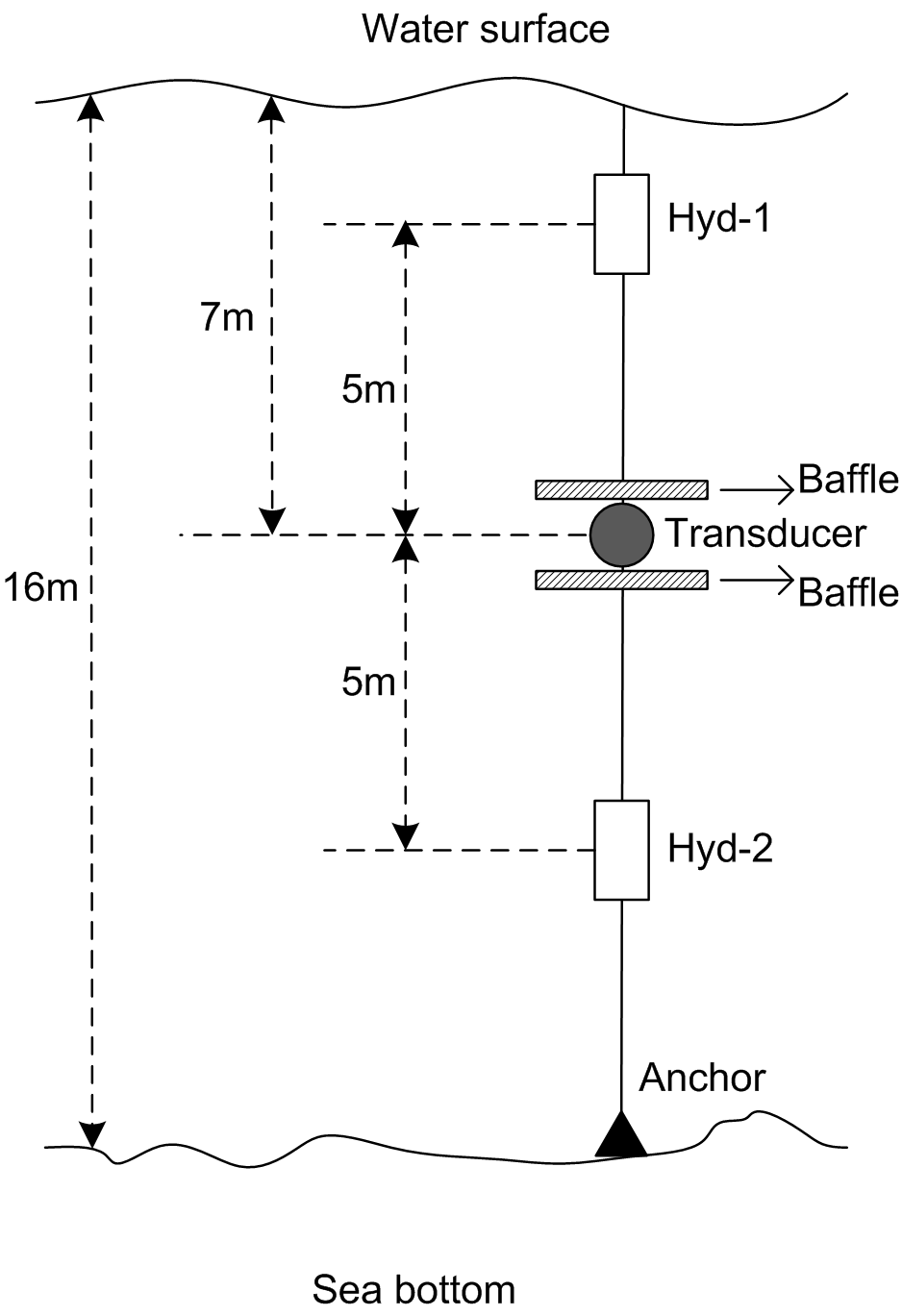
- 在湖面环境中发射 OFDM 信号,分别采用频域 (FD) 和时域 (TD) 方法估计 SCIR。
- 从 SCIR 的幅度中估计功率延迟分布 (PDP),以识别主导多径分量。
- 计算 SCIR 的自相关函数 (ACF),以分析时间相关性并推导相干时间 (COT)。
- 将相干时间估计为 ACF 降至最大值一半时的滞后值,表示信道保持近似恒定的时间尺度。
- 采用窗函数时域方法并减小窗长(36 ms),以验证短时信道稳定性可实现,从而准确估计 COT。
- 理论分析使用公式 $ P_s = \frac{1}{M} \sum_{m=0}^{M-1} p[m] $ 计算总自干扰功率,以及 $ p_{\text{acc}}[j] = \frac{1}{M} \sum_{m=0}^{j-1} p[m] $ 评估早期路径的累积功率贡献。
![Figure 1 : UWA-IBFD system using OFDM for SCIR estimation, where $x[n]$ is the transmitted signal, $y[n]$ is the received signal, ${\hat{s}}[n]$ is the anticipated SI signal, and $e[n]$ denotes the residual.](https://ar5iv.labs.arxiv.org/html/2005.10933/assets/images/fig1.png)
实验结果
研究问题
- RQ1UWA-IBFD 系统的自干扰信道冲激响应 (SCIR) 中,主导多径分量是什么?
- RQ2SCIR 的相干时间在不同路径(尤其是直射路径与表面反射路径)上如何变化?
- RQ3SCIR 的时变特性,特别是表面反射路径,在多大程度上违反了 OFDM 符号块内信道恒定的假设?
- RQ4频域与时域 SCIR 估计方法在真实水下环境中能否提供一致的 SCIR 统计表征?
- RQ5直射路径与表面反射路径分别贡献了总自干扰功率的多少比例?
主要发现
- SCIR 的直射路径强度高、稳定,约占总自干扰功率的 72%,因此相对容易消除。
- 表面反射路径是主导的反射路径,约占总自干扰功率的 16%,并表现出快速时变特性。
- 表面反射路径的相干时间约为 70 ms,短于典型 OFDM 符号块长度,因此信道慢变假设在块内不成立。
- 采用 36 ms 窗口的时域估计方法验证了相干时间估计结果,表明表面反射路径在短时间间隔内保持近似恒定。
- 直射路径与表面反射路径共同贡献了约 88% 的总自干扰功率,意味着准确跟踪这两条路径即可消除绝大部分自干扰。
- 由于 SCIR 具有严重的时变特性,特别是表面反射路径,传统 OFDM 信道估计方法假设块内信道恒定,不适用于 UWA-IBFD 系统。
更好的研究,从现在开始
从阅读论文到最终审阅,大幅缩短您的研究时间。
无需绑定信用卡
本解读由 AI 生成,并经人工编辑审核。