
[论文解读] Self-supervised Dynamic CT Perfusion Image Denoising with Deep Neural Networks
本文提出了一种自监督深度学习方法,用于动态CT灌注图像去噪,通过利用相邻帧之间的时间相关性,在无需高剂量参考图像的情况下进行训练。该方法采用Noise2Noise风格的学习策略,即从相邻帧预测每一帧,有效去除了独立噪声,在真实临床数据上相比监督学习和传统去噪方法,实现了更优的图像质量和对比噪声比。
Dynamic computed tomography perfusion (CTP) imaging is a promising approach for acute ischemic stroke diagnosis and evaluation. Hemodynamic parametric maps of cerebral parenchyma are calculated from repeated CT scans of the first pass of iodinated contrast through the brain. It is necessary to reduce the dose of CTP for routine applications due to the high radiation exposure from the repeated scans, where image denoising is necessary to achieve a reliable diagnosis. In this paper, we proposed a self-supervised deep learning method for CTP denoising, which did not require any high-dose reference images for training. The network was trained by mapping each frame of CTP to an estimation from its adjacent frames. Because the noise in the source and target was independent, this approach could effectively remove the noise. Being free from high-dose training images granted the proposed method easier adaptation to different scanning protocols. The method was validated on both simulation and a public real dataset. The proposed method achieved improved image quality compared to conventional denoising methods. On the real data, the proposed method also had improved spatial resolution and contrast-to-noise ratio compared to supervised learning which was trained on the simulation data
研究动机与目标
- 为解决动态CT灌注(CTP)成像中辐射剂量过高的问题,实现低剂量CTP并辅以有效的图像去噪。
- 消除在训练CTP去噪深度学习模型时对成对高剂量参考图像的需求。
- 开发一种自监督方法,利用相邻CTP帧之间的时间相关性,提升图像质量与诊断可靠性。
- 在模拟和真实世界的CTP数据集上验证该方法,证明其在性能上优于监督学习和传统去噪技术。
提出的方法
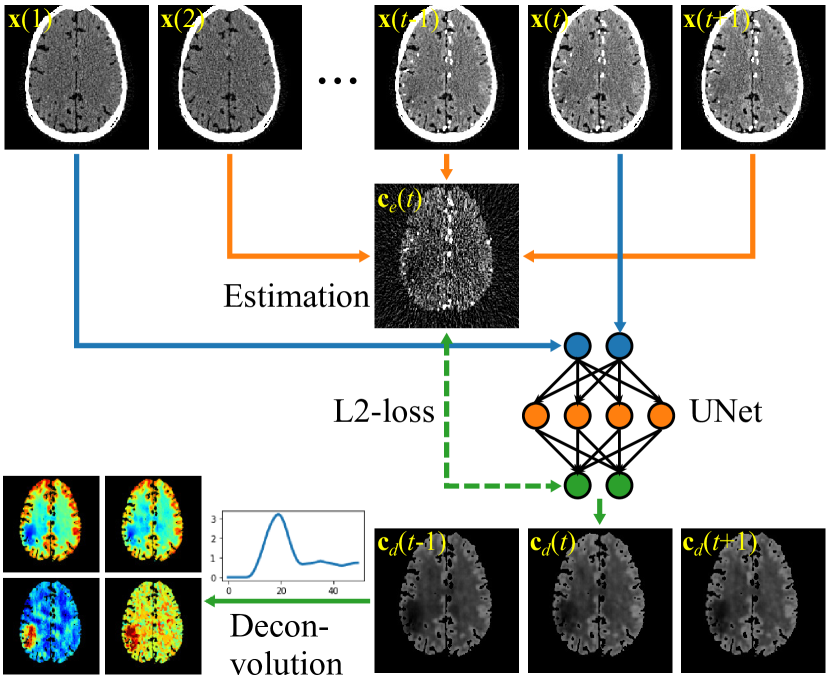
- 该方法采用基于Noise2Noise的自监督学习框架,其中每个低剂量CTP帧均从其时间相邻帧中进行预测。
- 网络通过仅利用相邻帧的时间上下文,将噪声输入帧映射为去噪估计结果,假设帧间噪声相互独立。
- 训练目标是最小化网络输出与目标帧之间的均方误差,目标帧被假设为同一潜在结构的噪声版本。
- 该方法依赖于源帧与目标帧中噪声相互独立且均值为零的假设,从而在无真实标签的情况下实现有效去噪。
- 采用U-Net架构的深度神经网络,以实现有效的特征学习与时空去噪。
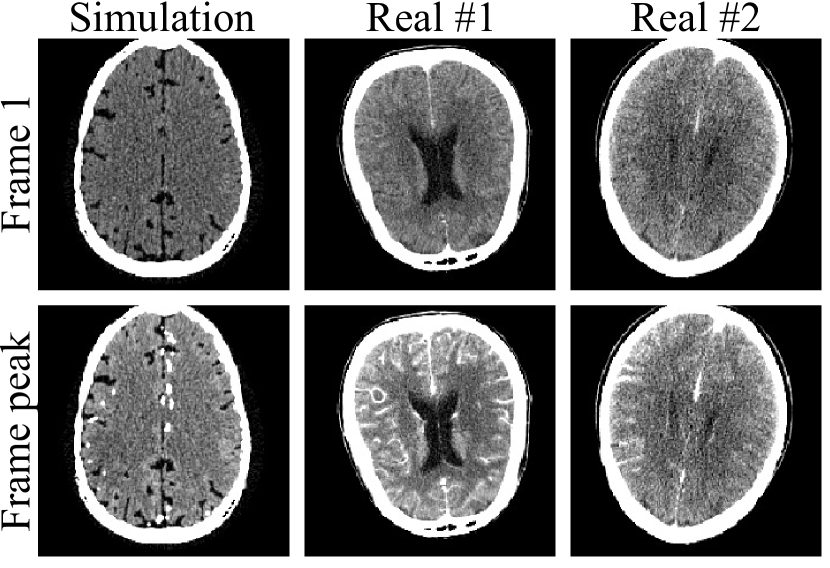
- 该方法在模拟低剂量CTP数据和公开的真实CTP数据集上均进行了验证,与监督学习和传统去噪基线方法进行了性能对比。
实验结果
研究问题
- RQ1自监督深度学习能否在无需高剂量参考扫描的情况下,有效去噪动态CT灌注图像?
- RQ2当在模拟数据上进行训练并在真实数据上测试时,自监督去噪方法的性能与监督学习方法相比如何?
- RQ3相邻CTP帧之间的时间相关性在多大程度上能提升图像去噪质量,并保留对比噪声比和空间分辨率等诊断特征?
- RQ4噪声独立性和零均值假设对Noise2Noise训练目标在CTP去噪中的收敛性和有效性有何影响?
- RQ5该方法能否在不同扫描协议下实现泛化,而无需在高剂量数据上重新训练?
主要发现
- 所提出的自监督方法在模拟和真实CTP数据上均实现了优于传统去噪方法的图像质量。
- 在真实CTP数据上,该方法在空间分辨率和对比噪声比方面优于在模拟数据上训练的监督学习模型。
- 该方法通过利用相邻帧之间的时间相关性,实现了有效的噪声去除,即使在无高剂量参考图像的情况下亦可实现。
- 理论分析证实,在噪声相互独立且均值为零的假设下,Noise2Noise目标函数可收敛至真实潜在图像,验证了该方法学习原理的有效性。
- 由于无需高剂量数据,该方法对不同扫描协议表现出鲁棒性,有利于临床应用。
- 该方法在保留血流动力学参数图准确性方面表现优异,这对缺血性卒中诊断至关重要。
更好的研究,从现在开始
从阅读论文到最终审阅,大幅缩短您的研究时间。
无需绑定信用卡
本解读由 AI 生成,并经人工编辑审核。