
[论文解读] Self-Supervised Guided Segmentation Framework for Unsupervised Anomaly Detection
本文提出了一种自监督引导分割框架(SGSF),用于无监督异常检测。该框架通过显著性增强模块(SAM)生成逼真的伪造异常样本,并利用自监督引导特征提升定位精度。通过结合显著性驱动的异常合成与无噪声、语义丰富的引导特征,该方法在基准数据集上实现了最先进性能。
Unsupervised anomaly detection is a challenging task in industrial applications since it is impracticable to collect sufficient anomalous samples. In this paper, a novel Self-Supervised Guided Segmentation Framework (SGSF) is proposed by jointly exploring effective generation method of forged anomalous samples and the normal sample features as the guidance information of segmentation for anomaly detection. Specifically, to ensure that the generated forged anomaly samples are conducive to model training, the Saliency Augmentation Module (SAM) is proposed. SAM introduces a saliency map to generate saliency Perlin noise map, and develops an adaptive segmentation strategy to generate irregular masks in the saliency region. Then, the masks are utilized to generate forged anomalous samples as negative samples for training. Unfortunately, the distribution gap between forged and real anomaly samples makes it difficult for models trained based on forged samples to effectively locate real anomalies. Towards this end, the Self-supervised Guidance Network (SGN) is proposed. It leverages the self-supervised module to extract features that are noise-free and contain normal semantic information as the prior knowledge of the segmentation module. The segmentation module with the knowledge of normal patterns segments out the abnormal regions that are different from the guidance features. To evaluate the effectiveness of SGSF for anomaly detection, extensive experiments are conducted on three anomaly detection datasets. The experimental results show that SGSF achieves state-of-the-art anomaly detection results.
研究动机与目标
- 解决缺乏真实异常样本时的无监督异常检测挑战。
- 通过生成更具显著性的异常区域,缩小伪造异常与真实异常之间的分布差距。
- 通过利用自监督的无噪声特征作为先验知识,提升异常定位性能。
- 开发一个对微小且不规则异常具有强泛化能力的鲁棒框架。
提出的方法
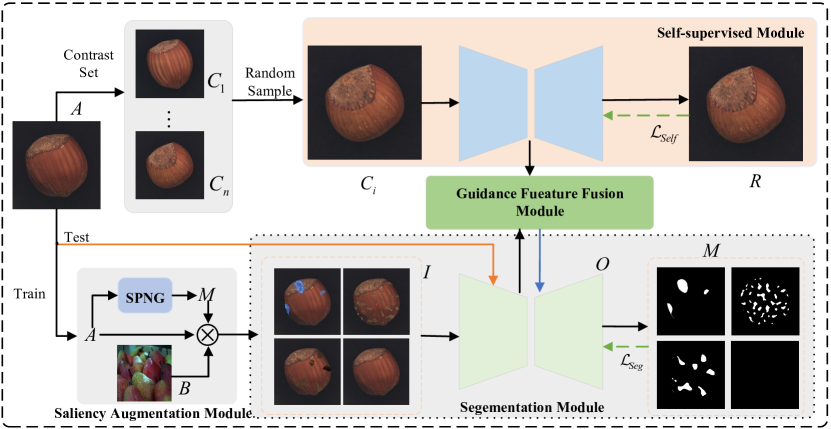
- 显著性增强模块(SAM)利用显著性图生成聚焦于显著区域的Perlin噪声图,从而创建不规则且逼真的异常掩码。
- 自适应分割策略将这些掩码应用于正常图像,生成更具真实感的伪造异常样本,使其更贴近真实异常。
- 自监督引导网络(SGN)从一组增强视图的对比集中提取干净且富含语义的特征,作为分割任务的先验知识。
- 引导特征融合模块将自监督特征与伪造异常图像中的特征在分割解码器中进行融合。
- 模型通过自监督重建损失与分割损失的组合进行训练,以同时优化特征质量与异常定位性能。
- 推理阶段,丢弃SAM模块,直接将输入图像送入分割网络进行异常检测。
![Figure 1: Comparison of different unsupervised anomaly detection methods. (1) Denoising-based method [ 11 , 13 ] . (2) DRAEM method [ 5 ] . (3) The proposed framework (SGSF). The denoising network in methods (1) and (2) cannot accurately remove anomalies, resulting in inaccurate anomaly localization](https://ar5iv.labs.arxiv.org/html/2209.12440/assets/x1.png)
实验结果
研究问题
- RQ1显著性驱动的伪造异常是否能提升无监督异常检测中训练数据的真实感与有效性?
- RQ2自监督特征学习如何增强异常分割的鲁棒性与准确性?
- RQ3在对比集中包含原始图像对引导特征质量与模型性能有何影响?
- RQ4掩码生成中的自适应阈值策略如何影响微小或不规则异常的定位精度?
- RQ5自监督损失与分割损失之间的最优平衡比例如何,以实现模型收敛与性能的最佳平衡?
主要发现
- SGSF在三个基准数据集上,对异常分类与定位任务均实现了最先进性能。
- 消融实验证实,若从对比集中排除原始图像,性能反而提升,因其可防止对低级特征的过拟合。
- 当对比集大小设置为n=4且不包含原始图像时,定位效果最佳,兼顾了特征多样性与引导质量。
- 自适应阈值分割策略(a=0.4, b=0.2)优于固定阈值,尤其在检测微小且分散的异常时表现更优。
- 损失函数中最优超参数λ=1能有效平衡自监督与分割目标,当λ值过低或过高时性能均会下降。
更好的研究,从现在开始
从阅读论文到最终审阅,大幅缩短您的研究时间。
无需绑定信用卡
本解读由 AI 生成,并经人工编辑审核。