
[论文解读] SENSEI: First Direct-Detection Results on sub-GeV Dark Matter from SENSEI at SNOLAB
SENSEI 在 SNOLAB 使用六块 Skipper-CCD 的直接探测结果首次覆盖子 GeV 暗物质,给出在 DM-电子散射、Migdal 基底的 DM-原子核散射以及暗光子 DM 吸收方面的世界领先约束,观测时间为 534.9 g-days,包含详细的背景抑制分析。
We present the first results from a dark matter search using six Skipper-CCDs in the SENSEI detector operating at SNOLAB. We employ a bias-mitigation technique of hiding approximately 46% of our total data and aggressively mask images to remove backgrounds. Given a total exposure after masking of 100.72 gram-days from well-performing sensors, we observe 55 two-electron events, 4 three-electron events, and no events containing 4 to 10 electrons. The two-electron events are consistent with pileup from one-electron events. Among the 4 three-electron events, 2 appear in pixels that are likely impacted by detector defects, although not strongly enough to trigger our "hot-pixel" mask. We use these data to set world-leading constraints on sub-GeV dark matter interacting with electrons and nuclei.
研究动机与目标
- 在地下实验环境中,动机是使用亚电子阈值探测器搜索子 GeV 暗物质。
- 呈现来自 SNOLAB 的 SENSEI 六块 Skipper-CCD 与 534.9 g-days 暴露量的首批结果。
- 开发并应用一套背景抑制掩模以 isolat 潜在的 DM 信号。
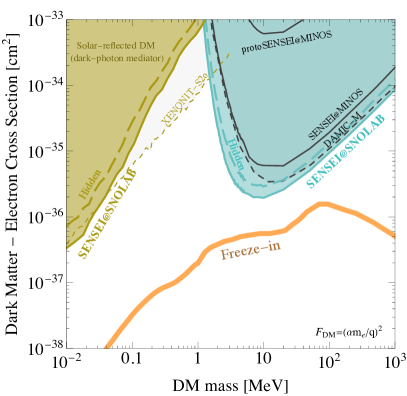
- 利用似然框架量化 DM-电子散射、Migdal 介导的 DM-原子核散射以及暗光子 DM 吸收的极限。
提出的方法
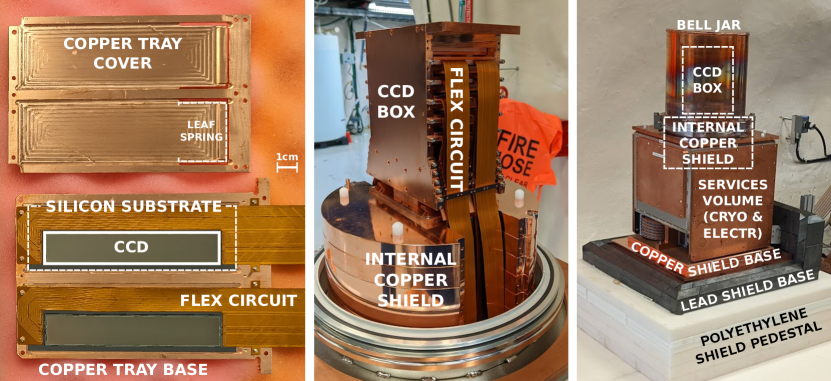
- 使用六块 Skipper-CCD 传感器实现单电子分辨率,以探测低能量电子-空穴对。
- 将像素阈值电荷定义为阈值分级,并将簇定义为非零像素的连通组。
- 应用多阶段背景掩蔽策略(热像、读出噪声、坏像素/列、满槽事件、低能量簇半径、簇形状、水平簇)以构建干净数据集。
- 对扩散和误识别效率建模,以在掩蔽后计算有效暴露量。
- 从 1 e- 事件估计叠加背景,并将暴露量和背景的不确定性传递到极限设定程序。
- 执行似然比检验,结合已知叠加背景,推导对各种 DM 相互作用假设的 90% 置信水平极限。
实验结果
研究问题
- RQ1在 SNOLAB 的 Skipper-CCD 技术下,硅中的子 GeV 暗物质与电子的相互作用有何约束?
- RQ2是否可以用 SENSEI SNOLAB 数据探测到基于 Migdal 效应的 DM-原子核散射和暗光子 DM 吸收?
- RQ3背景抑制策略如何影响对低质量 DM 信号在 Skipper-CCD 中的灵敏度?
- RQ4对于分析暴露量,DM-电子散射(轻/重介质)、Migdal 效应的 DM-核散射以及暗光子吸收的 90% C.L. 上限是多少?
- RQ5观测到的低能的 2e 及 3e 事件是否与预期背景一致,还是显示探测器特有效应的线索?
主要发现
- 在掩蔽后观察到 2 e- 的 55 个事件与 3 e- 的 4 个事件,与 2 e- 的堆叠背景一致,与 3 e- 的背景效应一致。
- 未观测到 4–10 e- 的事件;观测到 26-e- 事件但与康普顿背景一致(只有一个显著的高能事件)。
- 在暗物质-电子散射的光子/介质下,针对轻介质和重介质的星系晕 DM 散射、通过 Migdal 效应的 DM-核散射,以及对暗光子 DM 吸收,设置了世界领先的 90% C.L. 上限,在若干质量/介质区间优于先前的 SENSEI 界限。
- 综合数据产生的极限比以前的结果更紧凑,例如最大似然法的 2e- 率:8.57×10^-2 g^-1-day^-1(隐藏数据)且 90% C.L. 上限为 3.25×10^-1 g^-1-day^-1;对于 3e-:最大似然法为 6.85×10^-2 g^-1-day^-1,90% C.L. 上限为 1.49×10^-1 g^-1-day^-1。
- 分析强调背景建模、基于象限的热像掩蔽以及低能量簇掩蔽以控制系统误差并分离潜在的 DM 信号。
- 未来在更大数据集和改进掩蔽的情况下,预计将进一步提高对低质量 DM 的敏感性。
更好的研究,从现在开始
从论文设计到论文写作,大幅缩短您的研究时间。
无需绑定信用卡
本解读由 AI 生成,并经人工编辑审核。