
[论文解读] Sensor Deployment with Limited Communication Range in Homogeneous and Heterogeneous Wireless Sensor Networks
本文提出了一种针对通信范围受限的无线传感器网络(WSNs)的新型传感器部署框架,引入了受限Lloyd(RL)和模拟退火(DA)算法,联合优化感知失真与网络连通性。通过将部署建模为一种新型失真度量下的源编码问题(该度量考虑了连通性),所提方法在现实通信约束下,于同质与异质WSNs中均优于传统Lloyd算法。
We study the heterogeneous wireless sensor networks (WSNs) and propose the necessary condition of the optimal sensor deployment. Similar to that in homogeneous WSNs, the necessary condition implies that every sensor node location should coincide with the centroid of its own optimal sensing region. Moreover, we discuss the dynamic sensor deployment in both homogeneous and heterogeneous WSNs with limited communication range for the sensor nodes. The purpose of sensor deployment is to improve sensing performance, reflected by distortion and coverage. We model the sensor deployment problem as a source coding problem with distortion reflecting sensing accuracy. Traditionally, coverage is the area covered by the sensor nodes. However, when the communication range is limited, a WSN may be divided into several disconnected sub-graphs. Under such a scenario, neither the conventional distortion nor the coverage represents the sensing performance as the collected data in disconnected sub-graphs cannot be communicated with the access point. By defining an appropriate distortion measure, we propose a Restrained Lloyd (RL) algorithm and a Deterministic Annealing (DA) algorithm to optimize sensor deployment in both homogeneous and heterogeneous WSNs. Our simulation results show that both DA and RL algorithms outperform the existing Lloyd algorithm when communication range is limited.
研究动机与目标
- 解决现有传感器部署算法假设通信范围无限、在连通性约束下失效的局限性。
- 通过将失真(感知精度)与连通性整合进统一的优化框架,重新定义WSNs中的感知性能。
- 开发确保全网连通性的同时,最小化同质与异质WSNs中失真的算法。
- 通过引入传感器特定的感知精度与通信范围,将Lloyd算法推广至异质WSNs。
- 通过仿真验证所提算法,结果表明其性能显著优于基于传统Lloyd的方法。
提出的方法
- 将传感器部署建模为一种新型失真度量下的源编码问题,该度量对子网断连进行惩罚,从而确保连通性作为设计约束。
- 提出受限Lloyd(RL)算法,即对Lloyd算法的改进版本,通过限制传感器移动以维持网络连通性。
- 提出确定性模拟退火(DA)算法,以跳出局部极小值,实现在复杂部署场景下的更好收敛性与全局最优解。
- 使用加权Voronoi图根据传感器特定权重(如感知精度或通信范围)对感知区域进行划分,从而在异质WSNs中实现最优区域分配。
- 通过结合感知失真与连通性约束的代价函数来构建优化问题,并推导基于梯度的更新规则。
- 应用几何分析与星形集理论,推导目标函数的偏导数,从而实现传感器位置的迭代更新。
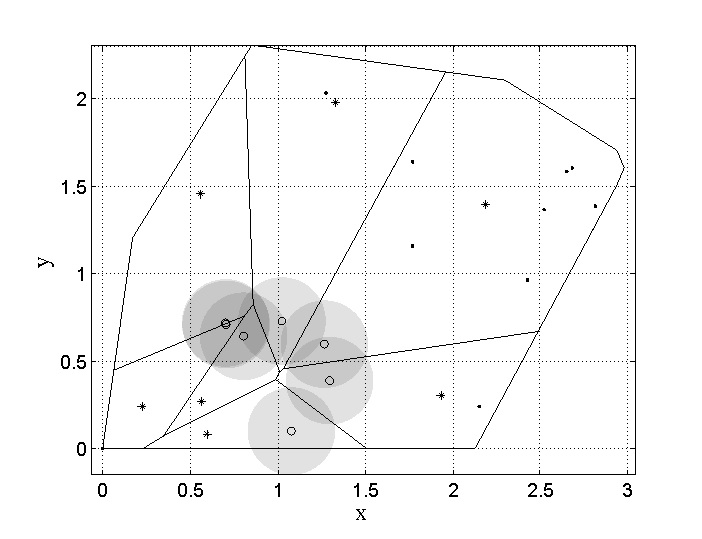
实验结果
研究问题
- RQ1当通信范围受限、无法实现全网连通时,如何优化传感器部署?
- RQ2在感知与通信能力各异的异质WSNs中,最优传感器部署的必要条件是什么?
- RQ3在通信范围受限的WSNs中,如何联合最小化失真与连通性?
- RQ4Lloyd算法能否被调整以在有限通信范围的WSNs中维持连通性?若不能,需要何种替代方案?
- RQ5所提出的RL与DA算法在失真与连通性性能方面,与标准Lloyd算法相比表现如何?
主要发现
- 所提出的受限Lloyd(RL)算法在通信范围受限条件下,显著优于传统Lloyd算法,尤其在子网断连场景中失真最小化效果更优。
- 确定性模拟退火(DA)算法通过跳出局部极小值,实现更优收敛性与更低失真,性能优于RL与标准Lloyd算法。
- 新型失真度量有效捕捉了感知精度与网络连通性,相较于仅考虑覆盖的传统指标,在断连WSNs中更具适用性。
- 在异质WSNs中,基于传感器特定权重的加权Voronoi图部署方案,相比均匀模型,性能更优。
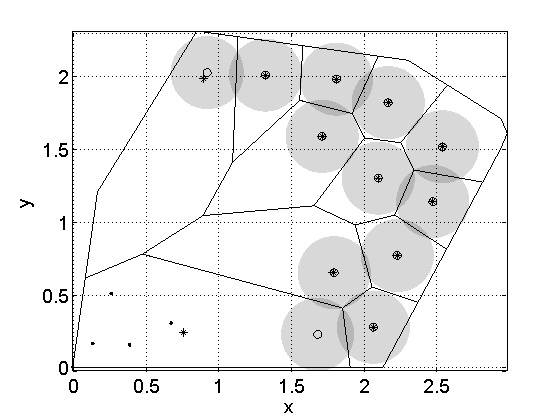
- 仿真结果证实,RL与DA算法即使在传感器密度低于临界传感器密度(CSD)时,仍能保持全网连通性并最小化失真。
- 理论分析证明,最优传感器位置与最优感知区域的质心重合,将Lloyd原理推广至受限且连通的WSNs。
更好的研究,从现在开始
从阅读论文到最终审阅,大幅缩短您的研究时间。
无需绑定信用卡
本解读由 AI 生成,并经人工编辑审核。