
[论文解读] Sequential Logistic Principal Component Analysis (SLPCA): Dimensional Reduction in Streaming Multivariate Binary-State System
本文提出顺序逻辑主成分分析(SLPCA),一种用于流式多变量二值数据的在线降维方法,基于序列凸优化。该方法将批处理逻辑主成分分析(LPCA)扩展至非高斯、二值状态系统的高效处理,展示了其收敛至批处理LPCA结果的能力,并在建筑能耗用能分类建模中表现出低遗憾与稳定性能。
Sequential or online dimensional reduction is of interests due to the explosion of streaming data based applications and the requirement of adaptive statistical modeling, in many emerging fields, such as the modeling of energy end-use profile. Principal Component Analysis (PCA), is the classical way of dimensional reduction. However, traditional Singular Value Decomposition (SVD) based PCA fails to model data which largely deviates from Gaussian distribution. The Bregman Divergence was recently introduced to achieve a generalized PCA framework. If the random variable under dimensional reduction follows Bernoulli distribution, which occurs in many emerging fields, the generalized PCA is called Logistic PCA (LPCA). In this paper, we extend the batch LPCA to a sequential version (i.e. SLPCA), based on the sequential convex optimization theory. The convergence property of this algorithm is discussed compared to the batch version of LPCA (i.e. BLPCA), as well as its performance in reducing the dimension for multivariate binary-state systems. Its application in building energy end-use profile modeling is also investigated.
研究动机与目标
- 解决传统PCA在非高斯、流式多变量二值状态系统中的局限性。
- 为实时数据处理开发一种在线、计算高效的批处理逻辑主成分分析(LPCA)替代方法。
- 在适当的步长规则下,确保序列算法收敛至批处理LPCA解。
- 在使用二值传感器数据建模建筑能耗用能轮廓方面,展示其实际应用价值。
- 为序列框架提供关于遗憾与目标函数收敛性的理论保证。
提出的方法
- 基于在线凸优化理论,将批处理逻辑主成分分析(LPCA)扩展为序列在线框架。
- 采用Bregman散度作为距离度量,以处理非高斯、伯努利分布的数据,替代标准PCA中的Frobenius范数。
- 通过在指数族模型下对数据对数似然函数进行梯度下降,实现投影矩阵的序列更新规则。
- 采用递减与恒定步长(如 $\eta_t = Ct^{-1/2}$)以确保平均目标函数与遗憾的收敛性。
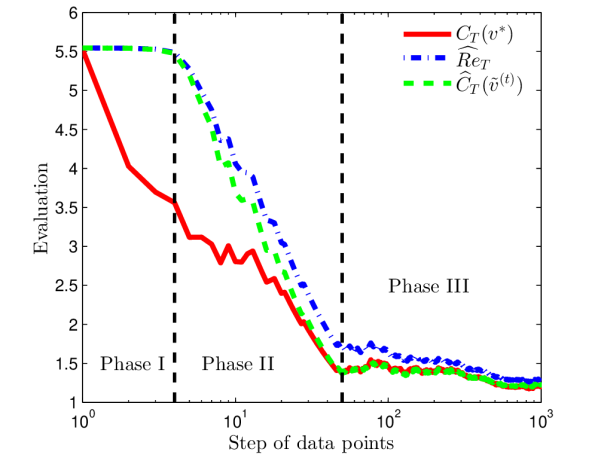
- 引入两种评估指标:平均序列目标函数 $\widehat{C}_N(\widetilde{\mathbf{V}}^N)$ 与遗憾函数 $\widehat{Re}_N$。
- 推导出序列与批处理LPCA目标之间差异的理论界,表明其收敛于一个常数范围内。
实验结果
研究问题
- RQ1能否开发一种LPCA的在线变体,在保持精度的同时实现实时处理流式二值数据?
- RQ2序列算法在目标函数与遗憾方面的性能与批处理LPCA基线相比如何?
- RQ3何种步长规则可确保序列算法收敛至批处理解?
- RQ4SLPCA能否有效建模多变量二值状态系统,如建筑能耗用能轮廓?
- RQ5可为序列优化过程的收敛性提供何种理论保证?
主要发现
- 序列算法使平均目标函数 $\widehat{C}_N(\widetilde{\mathbf{V}}^N)$ 与遗憾 $\widehat{Re}_N$ 收敛至批处理LPCA解的常数范围内。
- 当采用递减步长 $\eta_t = Ct^{-1/2}$ 时,遗憾差异 $|\widehat{Re}_N - \widehat{C}_N(\widetilde{\mathbf{V}}^N)|$ 的界由随 $\mathcal{O}(\frac{\log N}{\sqrt{N}})$ 与 $\mathcal{O}(\frac{1}{\sqrt{N}})$ 衰减的项构成,其极限上界为 $\frac{\gamma\Omega^2}{2}$。
- 当采用恒定步长 $\eta_t = C$ 时,遗憾差异的界为 $\gamma\Omega^2 + \Omega^2C$,表明收敛至一个恒定误差范围。
- 理论分析证实,在适当选择步长下,平均目标函数与遗憾均实现收敛,确保了在线方法的稳定性和可靠性。
- 在建筑能耗用能建模中的实证结果表明,SLPCA在真实世界二值状态系统中具备有效降维的能力。
- 该方法在非高斯环境下优于标准PCA,并保持了适用于流式应用的计算效率。

更好的研究,从现在开始
从阅读论文到最终审阅,大幅缩短您的研究时间。
无需绑定信用卡
本解读由 AI 生成,并经人工编辑审核。