
[论文解读] Shallower radius valley around low-mass hosts: Evidence for icy planets, collisions or high-energy radiation scatter
本研究利用高时间分辨率的开普勒光变曲线,分析了围绕低质量恒星的72颗小型系外行星,以优化行星参数并评估半径空隙的深度。研究发现,与光致蒸发模型预测相比,低质量恒星周围的半径空隙更浅,暗示可能存在其他机制,如冰质行星形成或碰撞演化,而质量测量对于区分这些机制至关重要。
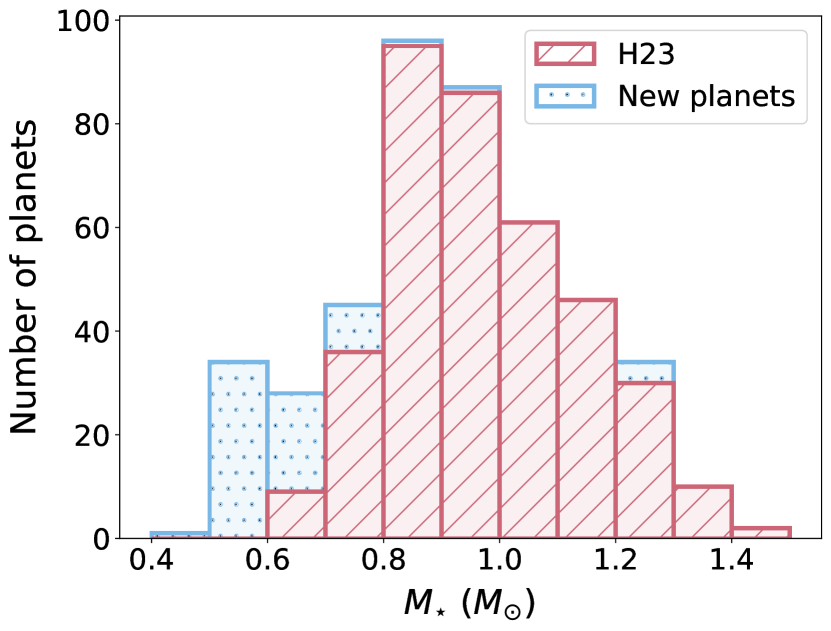
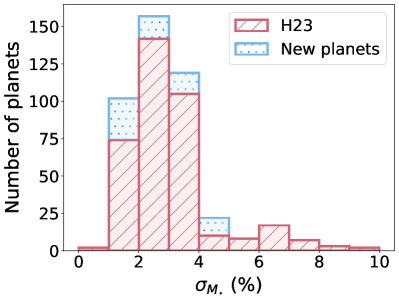
The radius valley, i.e., a dearth of planets with radii between 1.5 and 2 Earth radii, provides insights into planetary formation and evolution. Using homogenously revised planetary parameters from Kepler 1-minute short cadence light curves, we remodel transits of 72 small planets mostly orbiting low-mass stars, improving the precision and accuracy of planet parameters. By combining this sample with a similar sample of planets around higher-mass stars, we determine the depth of the radius valley as a function of stellar mass. We find that the radius valley is shallower for low-mass stars compared to their higher mass counterparts. Upon comparison, we find that theoretical models of photoevaporation under-predict the number of planets observed inside the radius valley for low-mass stars: with decreasing stellar mass, the predicted fraction of planets inside the valley remains approximately constant whereas the observed fraction increases. We argue that this provides evidence for the presence of icy planets around low-mass stars. Alternatively, planets orbiting low-mass stars undergo more frequent collisions and scatter in the stars' high-energy output may also cause planets to fill the valley. We predict that more precise mass measurements for planets orbiting low mass stars would be able to distinguish between these scenarios.
研究动机与目标
- 利用高时间分辨率的开普勒光变曲线,提高围绕低质量恒星运行的小型行星参数的测量精度。
- 研究半径空隙——即1.5至2倍地球半径之间行星稀少的现象——的深度如何随恒星质量变化。
- 检验标准光致蒸发模型是否能够解释低质量恒星系统中观测到的半径空隙。
- 评估其他机制(如冰质行星形成、行星碰撞或XUV辐射散射)作为半径空隙变浅的解释。
- 识别观测约束条件与未来研究方向,特别是精确质量与年龄测量在区分竞争性形成情景中的必要性。
提出的方法
- 利用开普勒1分钟短时基光变曲线,重新分析了72颗围绕低质量恒星的凌星系外行星,以提高掩食拟合的准确性。
- 应用分层贝叶斯建模(哈密顿蒙特卡洛法),推导出行星半径和轨道参数的后验分布。
- 将优化后的样本与Ho与Van Eylen(2023)的类似数据集相结合,比较不同恒星质量区间内半径空隙的深度。
- 量化观测到的空隙内行星的比例,并与包含观测偏差和初始条件离散性的光致蒸发模型预测进行比较。
- 在假设岩石核心的基础上估算预期的大气包层分数,以评估观测群体是否支持冰质行星或碰撞历史。
- 利用美国国家系外行星档案馆补充样本,并评估系外行星组成与结构的群体趋势。
实验结果
研究问题
- RQ1半径空隙的深度是否系统性地随宿主恒星质量变化,特别是对于低质量的M型恒星?
- RQ2理论光致蒸发模型在多大程度上能再现低质量恒星周围半径空隙内行星的观测比例?
- RQ3在低质量恒星周围观测到的半径空隙变浅是否与冰质行星或行星碰撞的存在一致?
- RQ4恒星年龄和行星质量的不确定性在多大程度上影响对行星组成和演化路径的解释?
- RQ5未来的任务如TESS和PLATO能否帮助解决冰质行星形成与碰撞情景之间的模糊性?
主要发现
- 与更高质量的FGK型恒星相比,低质量恒星周围的半径空隙显著更浅,且随着恒星质量降低,观测到的空隙深度持续减小。
- 光致蒸发模型对低质量恒星周围空隙内行星数量的预测偏低:观测到的空隙内行星比例随恒星质量降低而增加,而模型预测的比例则基本保持不变。
- 观测与光致蒸发模型之间的差异无法通过观测偏差或初始条件的离散性来解释,表明需要引入额外的物理机制。
- 数据与低质量恒星周围存在冰质行星或碰撞频率增加的可能性一致,但当前群体统计尚无法唯一支持任一情景。
- 由于大多数行星缺乏精确的质量和年龄测量,目前尚无法明确区分冰质行星形成与碰撞演化作为空隙变浅主因的可能性。
- 未来高精度的质量测量和更精确的年龄估计——由TESS和PLATO任务实现——将对解析其根本形成机制至关重要。
更好的研究,从现在开始
从阅读论文到最终审阅,大幅缩短您的研究时间。
无需绑定信用卡
本解读由 AI 生成,并经人工编辑审核。