
[论文解读] Simultaneously probing the sound speed and equation of state of the early Universe with pulsar timing arrays
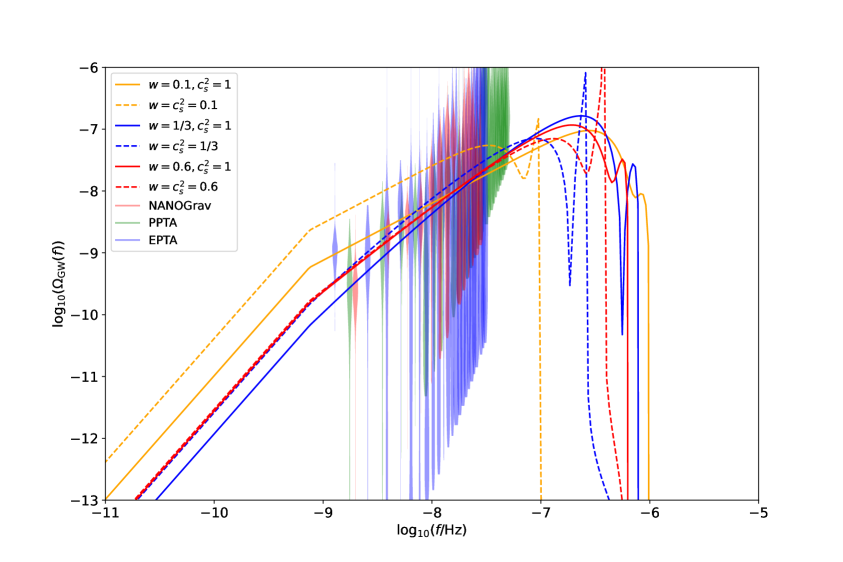
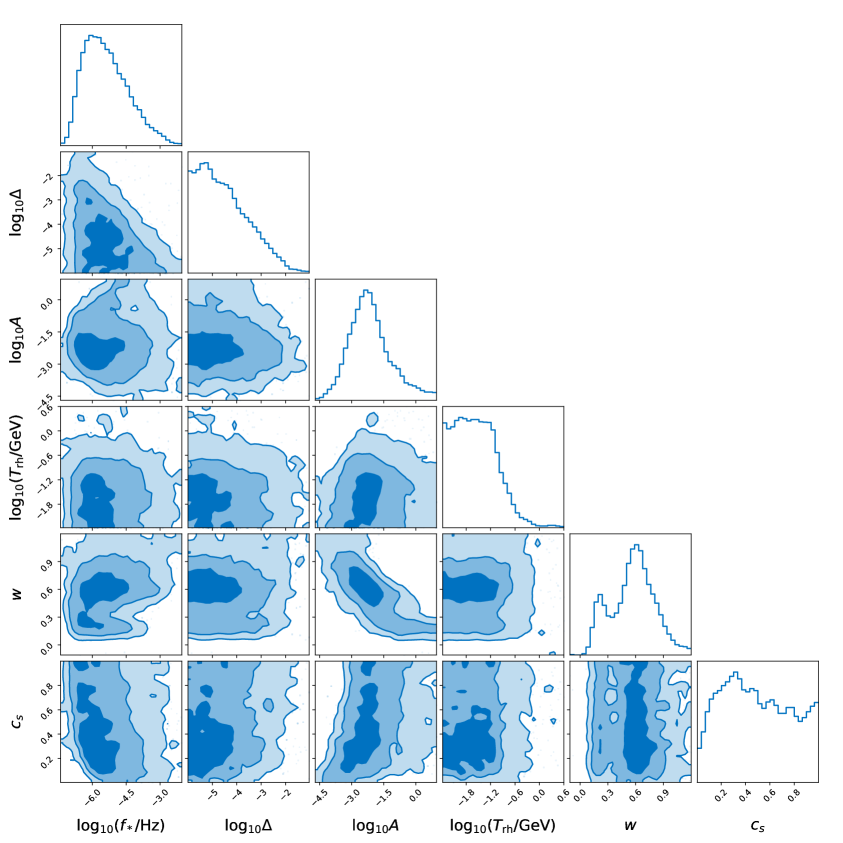
该论文利用来自 NANOGrav、PPTA 和 EPTA 的脉冲星计时阵列(PTA)数据,假设探测到的纳赫兹引力波背景源自标量诱导引力波,同时约束早期宇宙的物态方程(w)和声速(cₛ)。结果表明 w = 0.60⁺⁰.³²₋₀.³⁹,cₛ ≳ 0.09,且 T_rh ≲ 0.2 GeV,支持非辐射主导的早期宇宙,并排除了无压流体模型。
Recently, several major pulsar timing array (PTA) collaborations have assembled strong evidence for the existence of a gravitational-wave background at frequencies around the nanohertz regime. Assuming that the PTA signal is attributed to scalar-induced gravitational waves, we jointly employ the PTA data from the NANOGrav 15-year data set, PPTA DR3, and EPTA DR2 to probe the conditions of the early Universe. Specifically, we explore the equation of state parameter ($w$), the reheating temperature ($T_\mathrm{rh}$), and the sound speed ($c_s$), finding $w = 0.59^{+0.36}_{-0.40}$ (median + $90\%$ credible interval), and $T_\mathrm{rh}\lesssim 0.2\,\mathrm{GeV}$ at the $95\%$ credible interval for a lognormal power spectrum of the curvature perturbation. Furthermore, we compute Bayes factors to compare different models against the power-law spectrum model, effectively excluding the pressure-less fluid domination model. Our study underscores the significance of scalar-induced gravitational waves as a powerful tool to explore the nature of the early Universe.
研究动机与目标
- 利用引力波数据同时约束早期宇宙的物态方程(w)和声速(cₛ)。
- 检验观测到的脉冲星计时阵列(PTA)信号是否源自标量诱导引力波(SIGWs)而非天体物理源(如超大质量双黑洞)。
- 通过贝叶斯模型比较,评估不同宇宙学模型与标准辐射主导情景(w = 1/3,cₛ² = 1/3)的相对优劣。
- 探讨 SIGWs 对原初黑洞(PBH)形成及再加热温度(T_rh)的影响。
- 利用多仪器 PTA 数据集,评估具有任意 w 和 cₛ 的非标准早期宇宙模型的可行性。
提出的方法
- 采用对数正态功率谱建模原始密度涨落的曲率扰动。
- 使用二阶微扰理论计算在一般 w 和 cₛ 宇宙中,标量诱导引力波(SIGWs)的能量密度。
- 应用贝叶斯推断,使用嵌套采样工具 dynesty 分析来自 NANOGrav 15 年、PPTA DR3 和 EPTA DR2 的 PTA 数据。
- 计算贝叶斯因子,将具有不同 w 和 cₛ 的模型与辐射主导参考模型(w = 1/3,cₛ² = 1/3)进行比较。
- 结合大曲率扰动导致原初黑洞(PBH)产生的约束,进一步精炼参数空间。
- 使用 BILBY 贝叶斯推断库对联合 PTA 数据集执行完整的后验抽样与模型比较。
实验结果
研究问题
- RQ1PTA 观测对早期宇宙的物态方程(w)和声速(cₛ)的联合约束是什么?
- RQ2观测到的 PTA 信号是否更倾向于标量诱导引力波(SIGW)起源而非超大质量双星等天体物理源?
- RQ3推断出的 w 和 cₛ 值与标准辐射主导模型(w = 1/3,cₛ² = 1/3)相比如何?
- RQ4数据能否排除无压流体模型(w = 0)或 cₛ² = 1 的模型?
- RQ5在最佳拟合的 SIGW 情景下,对再加热温度(T_rh)和原初黑洞(PBH)形成的含义是什么?
主要发现
- 分析结果表明,w = 0.60⁺⁰.³²₋₀.³⁹(68%可信区间),表明与辐射主导条件存在偏离。
- 声速被约束为 cₛ ≳ 0.09,表明早期宇宙中流体行为非理想。
- 再加热温度估计为 T_rh ≲ 0.2 GeV,与低尺度再加热情景一致。
- 基于贝叶斯因子,w = 1/3 且 cₛ² = 1/3(辐射主导)的模型被排除,支持其他早期宇宙动力学。
- 无压流体模型(w = 0)被数据有效排除,因其证据值显著偏低。
- 结果支持标量诱导引力波情景作为 PTA 信号的可行解释,具有强有力的贝叶斯证据支持其优于其他竞争模型。
更好的研究,从现在开始
从阅读论文到最终审阅,大幅缩短您的研究时间。
无需绑定信用卡
本解读由 AI 生成,并经人工编辑审核。